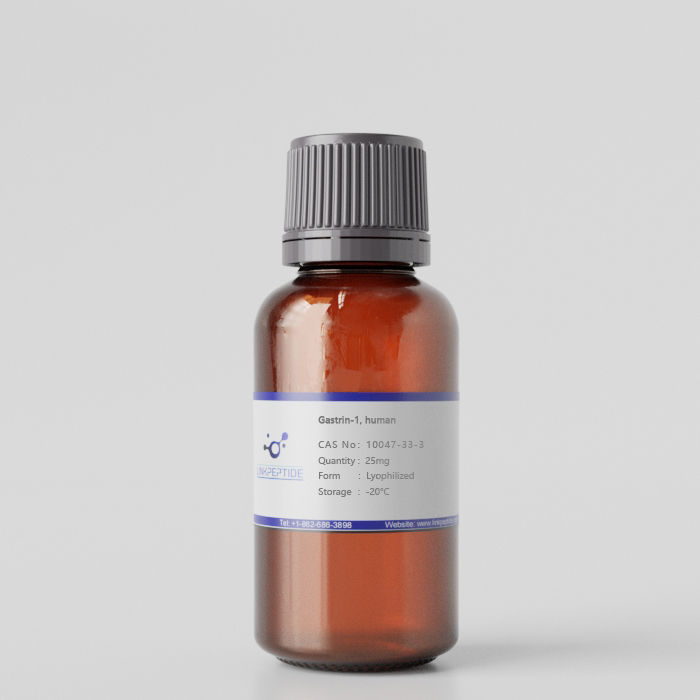
Product Name: Gastrin-1, human
Sequence One Letter Code: Pyr-GPWLEEEEEAYGWMDF-NH2
Sequence Three Letter Code: Pyr-Gly-Pro-Trp-Leu-Glu-Glu-Glu-Glu-Glu-Ala-Tyr-Gly-Trp-Met-Asp-Phe-NH2
Cas No: 10047-33-3
Chemical Formula:C97H124N20O31S
Molecular Weight: 2098.3
Purity: 95%
Form: Lyophilized
Storage Conditions: - 20 °C
Research Area: Endocrinology Disease Research
SMILES: C[C@@H](C(=O)N[C@@H](CC1=CC=C(C=C1)O)C(=O)NCC(=O)N[C@@H](CC2=CNC3=CC=CC=C32)C(=O)N[C@@H](CCSC)C(=O)N[C@@H](CC(=O)O)C(=O)N[C@@H](CC4=CC=CC=C4)C(=O)N)NC(=O)[C@H](CCC(=O)O)NC(=O)[C@H](CCC(=O)O)NC(=O)[C@H](CCC(=O)O)NC(=O)[C@H](CCC(=O)O)NC(=O)[C@H](CCC(=O)O)NC(=O)[C@H](CC(C)C)NC(=O)[C@H](CC5=CNC6=CC=CC=C65)NC(=O)[C@@H]7CCCN7C(=O)CNC(=O)[C@@H]8CCC(=O)N8
IUPAC: (4S)-5-[[(2S)-1-[[(2S)-1-[[2-[[(2S)-1-[[(2S)-1-[[(2S)-1-[[(2S)-1-amino-1-oxo-3-phenylpropan-2-yl]amino]-3-carboxy-1-oxopropan-2-yl]amino]-4-methylsulfanyl-1-oxobutan-2-yl]amino]-3-(1H-indol-3-yl)-1-oxopropan-2-yl]amino]-2-oxoethyl]amino]-3-(4-hydroxyphenyl)-1-oxopropan-2-yl]amino]-1-oxopropan-2-yl]amino]-4-[[(2S)-4-carboxy-2-[[(2S)-4-carboxy-2-[[(2S)-4-carboxy-2-[[(2S)-4-carboxy-2-[[(2S)-2-[[(2S)-3-(1H-indol-3-yl)-2-[[(2S)-1-[2-[[(2S)-5-oxopyrrolidine-2-carbonyl]amino]acetyl]pyrrolidine-2-carbonyl]amino]propanoyl]amino]-4-methylpentanoyl]amino]butanoyl]amino]butanoyl]amino]butanoyl]amino]butanoyl]amino]-5-oxopentanoic acid
INCHIKEY: GKDWRERMBNGKCZ-RNXBIMIWSA-N
INCHI:
InChI=1S/C97H124N20O31S/c1-49(2)39-68(114-95(146)71(43-54-46-100-59-18-11-9-16-57(54)59)116-97(148)73-19-12-37-117(73)76(121)48-102-85(136)60-24-30-74(119)104-60)93(144)110-65(29-35-81(130)131)91(142)109-64(28-34-80(128)129)90(141)108-63(27-33-79(126)127)89(140)107-62(26-32-78(124)125)88(139)106-61(25-31-77(122)123)87(138)103-50(3)84(135)113-69(41-52-20-22-55(118)23-21-52)86(137)101-47-75(120)105-70(42-53-45-99-58-17-10-8-15-56(53)58)94(145)111-66(36-38-149-4)92(143)115-72(44-82(132)133)96(147)112-67(83(98)134)40-51-13-6-5-7-14-51/h5-11,13-18,20-23,45-46,49-50,60-73,99-100,118H,12,19,24-44,47-48H2,1-4H3,(H2,98,134)(H,101,137)(H,102,136)(H,103,138)(H,104,119)(H,105,120)(H,106,139)(H,107,140)(H,108,141)(H,109,142)(H,110,144)(H,111,145)(H,112,147)(H,113,135)(H,114,146)(H,115,143)(H,116,148)(H,122,123)(H,124,125)(H,126,127)(H,128,129)(H,130,131)(H,132,133)/t50-,60-,61-,62-,63-,64-,65-,66-,67-,68-,69-,70-,71-,72-,73-/m0/s1
Source / Species: human
Conjugation: Unconjugated
Code Nacres: NA.26
Application: Gastrin-1 (Gastrin-17), human, also termed “Little Gastrin,” is a C-terminally amidated peptide hormone secreted by gastric G cells in response to nutrient stimulation. It binds to the CCK2/gastrin receptor on parietal and enterochromaffin-like cells, stimulating gastric acid secretion and promoting histamine release. Gastrin-17 also influences pepsinogen secretion and activates intracellular signaling pathways involving PKC and RhoA. As one of the predominant circulating gastrin forms, it plays a central role in regulating gastric physiology and mucosal growth. This peptide is widely used in gastrointestinal and endocrine research to examine receptor activation, acid secretion mechanisms, and hormone-mediated gene regulation. It supports mechanistic studies of gastric function and pathological hypergastrinemia models.
Current Research: Gastrin-1 (Gastrin-17), human—commonly referred to as “Little Gastrin”—is a C-terminally amidated 17–amino acid peptide hormone secreted by gastric G cells in response to nutrient ingestion, particularly peptides and amino acids. As one of the predominant biologically active gastrin forms in circulation, Gastrin-17 plays a central role in the regulation of gastric acid secretion, mucosal growth, and digestive enzyme activity. Its defined structure and physiological relevance make it a widely used reagent in gastrointestinal and endocrine research. Receptor Interaction and Signal Transduction Gastrin-17 exerts its biological effects through binding to the cholecystokinin B receptor (CCK2 receptor), also known as the gastrin receptor. This G protein–coupled receptor (GPCR) is expressed primarily on gastric parietal cells and enterochromaffin-like (ECL) cells. Upon receptor activation, Gastrin-17 initiates G_q/11-mediated signaling pathways, leading to phospholipase C activation, inositol trisphosphate (IP₃) production, intracellular calcium mobilization, and protein kinase C (PKC) activation. In ECL cells, gastrin stimulation promotes histamine release, which in turn acts on parietal cells to enhance gastric acid secretion via H₂ receptor activation. Gastrin can also directly stimulate parietal cells, contributing to maximal acid output. Additionally, RhoA-dependent signaling pathways have been implicated in cytoskeletal rearrangement and gene transcription downstream of CCK2 receptor activation. Regulation of Gastric Acid and Enzyme Secretion Gastrin-17 is a key regulator of gastric acid production. Following food intake, elevated circulating gastrin stimulates acid secretion to facilitate digestion and nutrient absorption. Beyond acid production, Gastrin-17 enhances pepsinogen secretion from chief cells and contributes to coordinated digestive responses within the gastric mucosa. Because acid secretion is tightly regulated by neural, hormonal, and paracrine inputs—including acetylcholine, histamine, and somatostatin—Gastrin-17 is frequently used in experimental models to isolate gastrin-dependent signaling mechanisms. Trophic Effects and Mucosal Growth In addition to its secretory functions, Gastrin-17 exerts trophic effects on the gastric mucosa. It promotes proliferation of gastric epithelial cells and ECL cells, influencing mucosal architecture and adaptive growth responses. Chronic hypergastrinemia has been associated with mucosal hypertrophy and enterochromaffin-like cell hyperplasia, making gastrin signaling relevant in pathological conditions such as Zollinger–Ellison syndrome and long-term proton pump inhibitor therapy. Experimental applications often include evaluation of gastrin-induced gene expression changes, growth factor regulation, and signaling cross-talk in gastric epithelial cell lines. Applications in Research Gastrin-17 is widely applied in: Gastric acid secretion assays CCK2 receptor activation studies Intracellular calcium and PKC signaling analysis Histamine release measurements Gene regulation and proliferation assays in gastric cells Hypergastrinemia and gastric pathology models In endocrine research, it is used to examine hormonal feedback loops involving somatostatin and other regulatory peptides that modulate gastrin secretion. Pathophysiological Relevance Elevated gastrin levels occur in conditions characterized by impaired acid feedback inhibition or gastrin-secreting tumors. Gastrin signaling has also been investigated in the context of gastric carcinogenesis, where aberrant CCK2 receptor activation may contribute to proliferative signaling. Consequently, Gastrin-17 serves as a useful experimental ligand for evaluating receptor antagonists and signaling modulators targeting the gastrin/CCK2 pathway. Experimental Advantages Native C-terminal amidation essential for receptor activation High affinity for CCK2/gastrin receptor Reproducible stimulation of acid secretion pathways Suitable for in vitro and ex vivo gastric models Supports mechanistic studies of gastric physiology Research Significance Gastrin-1 (Gastrin-17), human is a central regulator of gastric physiology and an established experimental tool for studying hormone-mediated control of acid secretion and mucosal growth. By enabling controlled activation of the CCK2 receptor and downstream signaling pathways, it supports detailed investigation of digestive regulation, endocrine feedback mechanisms, and pathological hypergastrinemia in gastrointestinal research models.
Get a Quote
 LinkPeptide