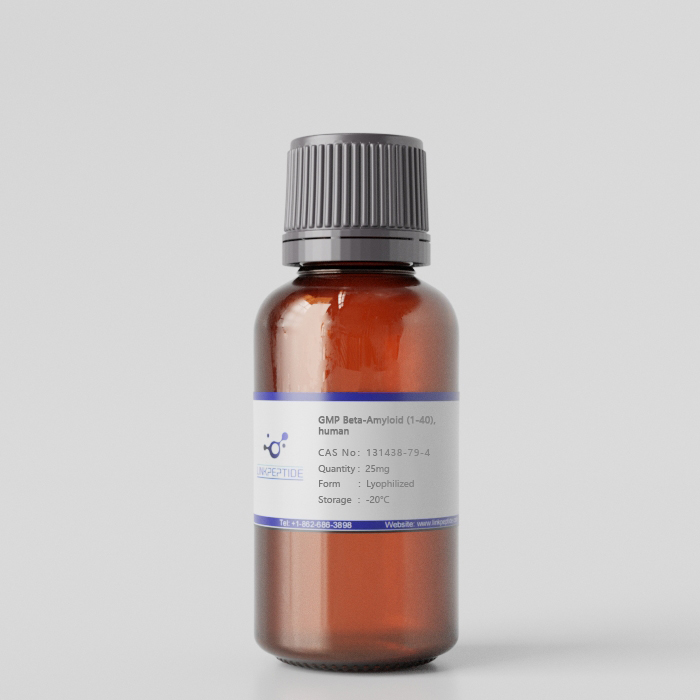
Product Name: GMP Beta-Amyloid (1-40), human
Sequence One Letter Code: DAEFRHDSGYEVHHQKLVFFAEDVGSNKGAIIGLMVGGVV
Sequence Three Letter Code: NH2-Asp-Ala-Glu-Phe-Arg-His-Asp-Ser-Gly-Tyr-Glu-Val-His-His-Gln-Lys-Leu-Val-Phe-Phe-Ala-Glu-Asp-Val-Gly-Ser-Asn-Lys-Gly-Ala-Ile-Ile-Gly-Leu-Met-Val-Gly-Gly-Val-Val-COOH
Cas No: 131438-79-4
Chemical Formula:C194H295N53O58S
Molecular Weight: 4329.7
Purity: 95%
Form: Lyophilized
Storage Conditions: - 20°C ± 5°C
Research Area: Neurological Disease Research
SMILES: CC[C@H](C)[C@@H](C(=O)N[C@@H]([C@@H](C)CC)C(=O)NCC(=O)N[C@@H](CC(C)C)C(=O)N[C@@H](CCSC)C(=O)N[C@@H](C(C)C)C(=O)NCC(=O)NCC(=O)N[C@@H](C(C)C)C(=O)N[C@@H](C(C)C)C(=O)O)NC(=O)[C@H](C)NC(=O)CNC(=O)[C@H](CCCCN)NC(=O)[C@H](CC(=O)N)NC(=O)[C@H](CO)NC(=O)CNC(=O)[C@H](C(C)C)NC(=O)[C@H](CC(=O)O)NC(=O)[C@H](CCC(=O)O)NC(=O)[C@H](C)NC(=O)[C@H](CC1=CC=CC=C1)NC(=O)[C@H](CC2=CC=CC=C2)NC(=O)[C@H](C(C)C)NC(=O)[C@H](CC(C)C)NC(=O)[C@H](CCCCN)NC(=O)[C@H](CCC(=O)N)NC(=O)[C@H](CC3=CNC=N3)NC(=O)[C@H](CC4=CNC=N4)NC(=O)[C@H](C(C)C)NC(=O)[C@H](CCC(=O)O)NC(=O)[C@H](CC5=CC=C(C=C5)O)NC(=O)CNC(=O)[C@H](CO)NC(=O)[C@H](CC(=O)O)NC(=O)[C@H](CC6=CNC=N6)NC(=O)[C@H](CCCNC(=N)N)NC(=O)[C@H](CC7=CC=CC=C7)NC(=O)[C@H](CCC(=O)O)NC(=O)[C@H](C)NC(=O)[C@H](CC(=O)O)N
IUPAC: (4S)-5-[[(2S)-1-[[(2S)-1-[[(2S)-1-[[(2S)-1-[[(2S)-1-[[2-[[(2S)-1-[[(2S)-1-[[(2S)-1-[[(2S)-1-[[(2S)-1-[[(2S)-5-amino-1-[[(2S)-6-amino-1-[[(2S)-1-[[(2S)-1-[[(2S)-1-[[(2S)-1-[[(2S)-1-[[(2S)-1-[[(2S)-1-[[(2S)-1-[[2-[[(2S)-1-[[(2S)-4-amino-1-[[(2S)-6-amino-1-[[2-[[(2S)-1-[[(2S,3S)-1-[[(2S,3S)-1-[[2-[[(2S)-1-[[(2S)-1-[[(2S)-1-[[2-[[2-[[(2S)-1-[[(1S)-1-carboxy-2-methylpropyl]amino]-3-methyl-1-oxobutan-2-yl]amino]-2-oxoethyl]amino]-2-oxoethyl]amino]-3-methyl-1-oxobutan-2-yl]amino]-4-methylsulfanyl-1-oxobutan-2-yl]amino]-4-methyl-1-oxopentan-2-yl]amino]-2-oxoethyl]amino]-3-methyl-1-oxopentan-2-yl]amino]-3-methyl-1-oxopentan-2-yl]amino]-1-oxopropan-2-yl]amino]-2-oxoethyl]amino]-1-oxohexan-2-yl]amino]-1,4-dioxobutan-2-yl]amino]-3-hydroxy-1-oxopropan-2-yl]amino]-2-oxoethyl]amino]-3-methyl-1-oxobutan-2-yl]amino]-3-carboxy-1-oxopropan-2-yl]amino]-4-carboxy-1-oxobutan-2-yl]amino]-1-oxopropan-2-yl]amino]-1-oxo-3-phenylpropan-2-yl]amino]-1-oxo-3-phenylpropan-2-yl]amino]-3-methyl-1-oxobutan-2-yl]amino]-4-methyl-1-oxopentan-2-yl]amino]-1-oxohexan-2-yl]amino]-1,5-dioxopentan-2-yl]amino]-3-(1H-imidazol-4-yl)-1-oxopropan-2-yl]amino]-3-(1H-imidazol-4-yl)-1-oxopropan-2-yl]amino]-3-methyl-1-oxobutan-2-yl]amino]-4-carboxy-1-oxobutan-2-yl]amino]-3-(4-hydroxyphenyl)-1-oxopropan-2-yl]amino]-2-oxoethyl]amino]-3-hydroxy-1-oxopropan-2-yl]amino]-3-carboxy-1-oxopropan-2-yl]amino]-3-(1H-imidazol-4-yl)-1-oxopropan-2-yl]amino]-5-carbamimidamido-1-oxopentan-2-yl]amino]-1-oxo-3-phenylpropan-2-yl]amino]-4-[[(2S)-2-[[(2S)-2-amino-3-carboxypropanoyl]amino]propanoyl]amino]-5-oxopentanoic acid
INCHIKEY: FEWOUVRMGWFWIH-ILZZQXMPSA-N
INCHI:
InChI=1S/C194H295N53O58S/c1-25-102(19)158(188(299)211-87-143(256)218-124(67-94(3)4)174(285)228-123(62-66-306-24)172(283)241-152(96(7)8)186(297)209-83-140(253)206-84-145(258)240-154(98(11)12)191(302)245-157(101(17)18)193(304)305)247-192(303)159(103(20)26-2)246-162(273)104(21)215-141(254)85-207-164(275)116(47-36-38-63-195)223-181(292)133(77-139(199)252)234-185(296)137(90-249)220-144(257)88-210-187(298)153(97(9)10)242-184(295)135(79-151(269)270)235-170(281)121(56-60-147(261)262)222-161(272)106(23)217-173(284)127(69-107-41-30-27-31-42-107)231-177(288)129(71-109-45-34-29-35-46-109)237-189(300)156(100(15)16)244-183(294)125(68-95(5)6)229-166(277)117(48-37-39-64-196)224-168(279)119(54-58-138(198)251)226-178(289)130(73-111-80-202-91-212-111)233-180(291)132(75-113-82-204-93-214-113)238-190(301)155(99(13)14)243-171(282)122(57-61-148(263)264)227-175(286)126(72-110-50-52-114(250)53-51-110)219-142(255)86-208-165(276)136(89-248)239-182(293)134(78-150(267)268)236-179(290)131(74-112-81-203-92-213-112)232-167(278)118(49-40-65-205-194(200)201)225-176(287)128(70-108-43-32-28-33-44-108)230-169(280)120(55-59-146(259)260)221-160(271)105(22)216-163(274)115(197)76-149(265)266/h27-35,41-46,50-53,80-82,91-106,115-137,152-159,248-250H,25-26,36-40,47-49,54-79,83-90,195-197H2,1-24H3,(H2,198,251)(H2,199,252)(H,202,212)(H,203,213)(H,204,214)(H,206,253)(H,207,275)(H,208,276)(H,209,297)(H,210,298)(H,211,299)(H,215,254)(H,216,274)(H,217,284)(H,218,256)(H,219,255)(H,220,257)(H,221,271)(H,222,272)(H,223,292)(H,224,279)(H,225,287)(H,226,289)(H,227,286)(H,228,285)(H,229,277)(H,230,280)(H,231,288)(H,232,278)(H,233,291)(H,234,296)(H,235,281)(H,236,290)(H,237,300)(H,238,301)(H,239,293)(H,240,258)(H,241,283)(H,242,295)(H,243,282)(H,244,294)(H,245,302)(H,246,273)(H,247,303)(H,259,260)(H,261,262)(H,263,264)(H,265,266)(H,267,268)(H,269,270)(H,304,305)(H4,200,201,205)/t102-,103-,104-,105-,106-,115-,116-,117-,118-,119-,120-,121-,122-,123-,124-,125-,126-,127-,128-,129-,130-,131-,132-,133-,134-,135-,136-,137-,152-,153-,154-,155-,156-,157-,158-,159-/m0/s1
Source / Species: human
Conjugation: Unconjugated
Code Nacres: NA.26
Application: GMP Beta-Amyloid (1–40) is a synthetic human amyloid-β peptide corresponding to residues 1–40 of amyloid precursor protein processing. It is a major component of cerebrovascular amyloid deposits and is commonly used as a reference standard in analytical and biochemical assays. Compared to longer variants, Aβ (1–40) provides controlled aggregation behavior, making it suitable for reproducibility studies. This peptide is widely applied in amyloid aggregation research, fibril formation studies, and assay validation. It serves as a well-characterized model for investigating amyloid structure, peptide self-assembly, and consistency in experimental systems related to neurodegenerative disease research.
Current Research: GMP β-Amyloid (1–40) is a synthetic human amyloid-β peptide corresponding to residues 1–40 generated from amyloid precursor protein (APP) processing. Produced under Good Manufacturing Practice (GMP) standards, this peptide offers high consistency, purity, and traceability, making it particularly suitable for analytical applications, assay validation, and reproducible experimental workflows. As one of the most abundant amyloid-β isoforms, Aβ (1–40) is a key component of cerebrovascular amyloid deposits and a widely used model in neurodegeneration research. GMP Quality and Experimental Reliability The GMP designation indicates that the peptide is manufactured under stringent quality control conditions, ensuring: High batch-to-batch consistency Defined purity and identity Traceable production and documentation Suitability for regulated or standardized studies These attributes make GMP Aβ (1–40) especially valuable for assay calibration, method validation, and comparative studies, where reproducibility is critical. Structural and Aggregation Characteristics Like other amyloid-β peptides, Aβ (1–40) can adopt β-sheet–rich conformations and undergo self-assembly into: Soluble oligomers Protofibrils Mature fibrils Compared to Aβ (1–42), the 1–40 isoform exhibits: Lower hydrophobicity Slower and more controlled aggregation kinetics Improved experimental reproducibility These properties make it particularly suitable for systematic studies of amyloid formation and aggregation pathways. Role in Amyloid and Neurodegenerative Research Aβ (1–40) is a major contributor to cerebrovascular amyloid deposition, especially in cerebral amyloid angiopathy (CAA). While less prone to forming highly toxic oligomers than Aβ (1–42), it remains highly relevant for studying: Amyloid structure and fibril architecture Peptide self-assembly mechanisms Interactions with vascular and cellular components Its abundance and stability make it a foundational model for investigating amyloid biology in neurodegenerative disease contexts. Applications in Analytical and Biochemical Assays GMP β-Amyloid (1–40) is widely used as a reference standard in a variety of analytical platforms. Typical applications include: Calibration of aggregation and fibrillization assays Validation of detection methods (e.g., ELISA, mass spectrometry) Quality control in assay development Standardization of experimental conditions across studies Its defined properties enable accurate comparison between experiments and laboratories. Use in Aggregation and Fibril Formation Studies Due to its controlled aggregation behavior, Aβ (1–40) is frequently employed in: Kinetic studies of amyloid formation Investigation of nucleation and elongation processes Evaluation of aggregation modulators or inhibitors Biophysical characterization of fibrils and intermediates These studies are essential for understanding the molecular mechanisms of protein misfolding and aggregation. Importance for Reproducibility and Standardization One of the key challenges in amyloid research is experimental variability, particularly in aggregation assays. GMP-grade Aβ (1–40) addresses this issue by providing: Consistent starting material across experiments Reduced variability in aggregation outcomes Reliable benchmarking for method development This makes it indispensable for multi-lab studies, validation pipelines, and high-throughput screening workflows. A Standard Model for Amyloid Research GMP β-Amyloid (1–40) combines biological relevance with manufacturing consistency, making it a preferred choice for both fundamental and applied research. Its well-characterized aggregation properties and role in cerebrovascular amyloid pathology position it as a core reference peptide in studies of neurodegeneration. By supporting reproducible investigation of amyloid structure, aggregation dynamics, and assay performance, GMP Aβ (1–40) continues to facilitate advances in understanding Alzheimer’s disease mechanisms and the development of diagnostic and therapeutic strategies.
Get a Quote
 LinkPeptide