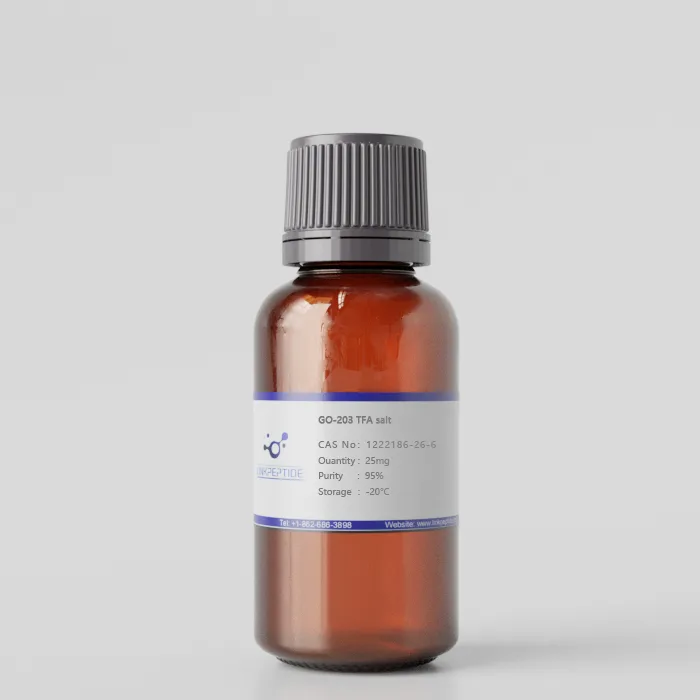
Product Name:GO-203 TFA salt
CAS No:1222186-26-6
Purity:95%
Molar Mass:2426.77
Chemical Formula:C89H171F3N52O21S2
Storage:Store at -20 degrees Celsius
Sequence:d-{Arg-Arg-Arg-Arg-Arg-Arg-Arg-Arg-Arg-Cys-Gln-Cys-Arg-Arg-Lys-Asn}
Target:PI3K
Application:GO-203 TFA salt is a small-molecule inhibitor designed to target the oncogenic MUC1-C protein, which is overexpressed in several types of cancers. By disrupting MUC1-C homodimerization, GO-203 interferes with the protein's role in promoting tumorigenesis, including cancer cell survival, proliferation, and resistance to therapy. The compound has shown promise in preclinical models for inhibiting cancer growth, making it an important tool in cancer research. GO-203 TFA salt is used in studies aiming to develop targeted therapies for cancers with MUC1-C overexpression, providing insights into new strategies for combating resistant and aggressive tumors.
Current Research:
GO-203 TFA is a novel cell-penetrating peptide designed to inhibit the oncogenic activity of MUC1-C, a transmembrane protein overexpressed in various cancers, including colorectal, breast, prostate, and lung malignancies. Composed entirely of D-amino acids, GO-203 TFA disrupts MUC1-C homodimerization, which is critical for its role in driving tumorigenesis. This targeted inhibition affects downstream signaling pathways, making it a potent candidate for cancer treatment. The primary mechanism of action involves blocking MUC1-C dimerization, thereby disrupting the PI3K-AKT-S6K1 signaling cascade. This interference reduces the synthesis of the TP53-induced glycolysis and apoptosis regulator (TIGAR) protein. As a result, cancer cells experience increased levels of reactive oxygen species (ROS) and a loss of mitochondrial membrane potential, ultimately leading to apoptosis. GO-203 TFA's selectivity for MUC1-positive cancer cells ensures minimal impact on normal tissues, highlighting its therapeutic precision. Preclinical studies demonstrate the efficacy of GO-203 TFA in vitro and in vivo. In colorectal cancer cell lines, such as SKCO-1 and Colo-205, GO-203 TFA effectively inhibits growth by modulating the AKT-S6K1-eIF4A signaling pathway and downregulating TIGAR expression. In mouse xenograft models, the compound has shown significant tumor growth suppression. Beyond colorectal cancer, its activity has been observed in breast, prostate, and lung cancers, as well as hematologic malignancies, underscoring its broad antitumor potential. The unique design and mechanism of GO-203 TFA open avenues for targeting MUC1-driven oncogenesis, a pathway often associated with therapy resistance and poor prognosis. While these findings position GO-203 TFA as a promising candidate for cancer treatment, further clinical studies are required to confirm its safety and efficacy in humans. In conclusion, GO-203 TFA represents an innovative approach in cancer therapy, targeting a critical pathway in tumor development with precision and efficacy.
Reference:
Get a Quote
 LinkPeptide