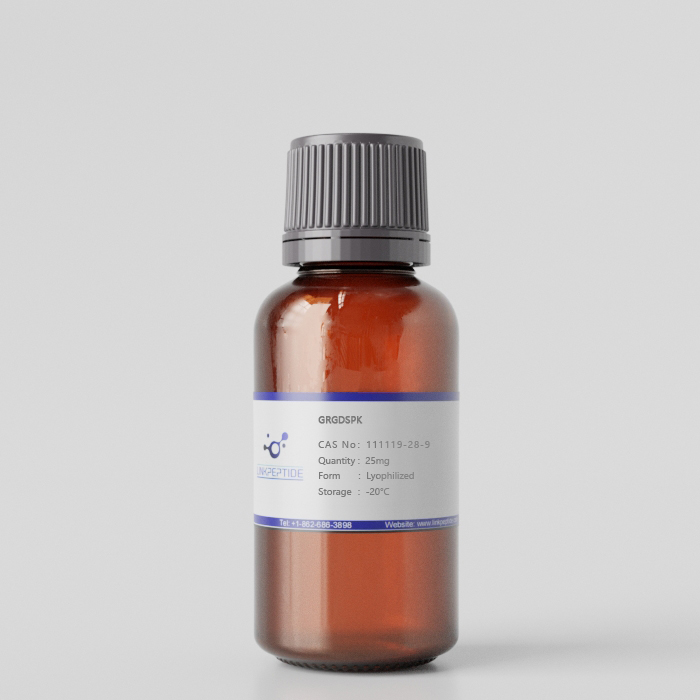
Product Name: GRGDSPK
Sequence One Letter Code: GRGDSPK
Sequence Three Letter Code: H-Gly-Arg-Gly-Asp-Ser-Pro-Lys-OH
Cas No: 111119-28-9
Chemical Formula:C28H49N11O11
Molecular Weight: 715.8
Purity: 95%
Form: Lyophilized
Storage Conditions: - 20 °C
Research Area: Cancer Disease Research
SMILES: C1C[C@H](N(C1)C(=O)[C@H](CO)NC(=O)[C@H](CC(=O)O)NC(=O)CNC(=O)[C@H](CCCN=C(N)N)NC(=O)CN)C(=O)N[C@@H](CCCCN)C(=O)O
IUPAC: (2S)-6-amino-2-[[(2S)-1-[(2S)-2-[[(2S)-2-[[2-[[(2S)-2-[(2-aminoacetyl)amino]-5-(diaminomethylideneamino)pentanoyl]amino]acetyl]amino]-3-carboxypropanoyl]amino]-3-hydroxypropanoyl]pyrrolidine-2-carbonyl]amino]hexanoic acid
INCHIKEY: ZRVZOBGMZWVJOS-VMXHOPILSA-N
INCHI:
InChI=1S/C28H49N11O11/c29-8-2-1-5-16(27(49)50)37-25(47)19-7-4-10-39(19)26(48)18(14-40)38-24(46)17(11-22(43)44)36-21(42)13-34-23(45)15(35-20(41)12-30)6-3-9-33-28(31)32/h15-19,40H,1-14,29-30H2,(H,34,45)(H,35,41)(H,36,42)(H,37,47)(H,38,46)(H,43,44)(H,49,50)(H4,31,32,33)/t15-,16-,17-,18-,19-/m0/s1
Source / Species: synthetic
Conjugation: Unconjugated
Code Nacres: NA.26
Application: GRGDSPK is a linear peptide containing the Arg-Gly-Asp (RGD) motif, a canonical recognition sequence for integrin receptors. By binding RGD-dependent integrins, it competitively inhibits integrin–ligand interactions and modulates cell adhesion dynamics. GRGDSPK effectively blocks endothelial cell attachment to extracellular matrix components such as fibronectin and interferes with integrin-mediated signaling pathways. It is extensively used in cell biology and vascular research to study integrin-dependent adhesion, migration, and angiogenic processes, as well as to evaluate integrin function in endothelial and other adherent cell systems.
Current Research: GRGDSPK is a linear synthetic peptide containing the canonical Arg-Gly-Asp (RGD) motif, the minimal recognition sequence required for binding to multiple RGD-dependent integrin receptors. The RGD tripeptide is present in several extracellular matrix (ECM) proteins, including fibronectin, vitronectin, fibrinogen, and osteopontin. By mimicking this adhesion motif, GRGDSPK acts as a competitive inhibitor of integrin–ligand interactions, thereby modulating cell adhesion, spreading, migration, and downstream signaling pathways. Because of its well-defined mechanism and predictable biological effects, GRGDSPK is widely used as a functional tool in cell biology, vascular biology, biomaterials research, and integrin signaling studies. Mechanism of Action Integrins are heterodimeric transmembrane receptors (α/β subunits) that mediate cell attachment to the ECM and transmit bidirectional signals between the extracellular environment and the cytoskeleton. Several integrins—including α5β1 and αvβ3—recognize RGD-containing ligands. GRGDSPK binds to the extracellular ligand-binding domain of RGD-dependent integrins, thereby: Competing with native ECM proteins such as fibronectin Preventing focal adhesion formation Disrupting integrin clustering and outside-in signaling Modulating cytoskeletal organization and actin dynamics Through these effects, the peptide reduces cell attachment and alters integrin-mediated signaling cascades, including pathways involving focal adhesion kinase (FAK), Src family kinases, PI3K/Akt, and MAPK. Applications in Cell Adhesion and Migration Research 1. Endothelial Cell Adhesion Assays GRGDSPK is commonly used to inhibit endothelial cell attachment to fibronectin- or vitronectin-coated surfaces. In adhesion assays, pre-incubation with the peptide significantly reduces integrin-mediated substrate binding, allowing investigators to confirm RGD-dependent adhesion mechanisms. 2. Migration and Wound Healing Models Integrins play a central role in cell migration and angiogenic sprouting. GRGDSPK is used in transwell migration assays, scratch wound assays, and 3D matrix models to determine the contribution of RGD-recognizing integrins to directed cell movement. 3. Angiogenesis Studies In vascular biology, RGD-dependent integrins such as αvβ3 are critical regulators of angiogenesis. GRGDSPK serves as a pharmacological tool to assess how integrin blockade influences endothelial proliferation, tube formation, and neovascularization processes in vitro. 4. Signal Transduction Analysis By disrupting integrin engagement, GRGDSPK enables mechanistic interrogation of integrin-linked signaling networks. Researchers often combine peptide treatment with phosphorylation analysis of FAK, paxillin, or ERK to evaluate downstream pathway modulation. Utility in Biomaterials and Tissue Engineering Beyond basic cell biology, GRGDSPK is frequently used in biomaterials research to: Validate integrin-dependent cell–surface interactions Compare effects of RGD-presenting scaffolds Control adhesion strength in engineered substrates It also serves as a soluble competitive inhibitor in experiments designed to distinguish specific integrin-mediated adhesion from nonspecific cell attachment. Experimental Considerations The inhibitory effect of GRGDSPK is concentration-dependent and may vary depending on integrin expression levels and substrate coating density. Proper experimental controls are essential, including use of a scrambled or non-RGD-containing peptide (e.g., GRGESP) to confirm specificity. Short pre-incubation times are typically sufficient for competitive blockade in adhesion assays.
Get a Quote
 LinkPeptide