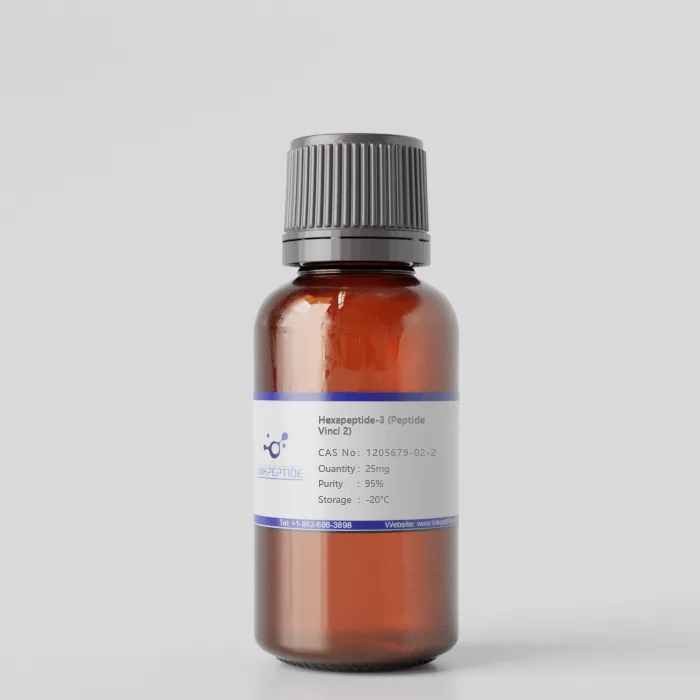
Product Name: Hexapeptide-3 (Peptide Vinci 2)
Cas No: 1205679-02-2
Purity: 95%
Storage: Keep in dark and cool dry place -5~8 degree Celsius
Sequence: Ala-Asp-Leu-Lys-Pro-Thr
Molar Mass: 847
Chemical Formula: C32H58N14O11S
IUPAC Name: (4S)-4-amino-5-[[(2S)-1-[[(2S)-1-[[(2S)-5-amino-1-[[(2S)-1-[[(2S)-1-amino-5-(diaminomethylideneamino)-1-oxopentan-2-yl]amino]-5-(diaminomethylideneamino)-1-oxopentan-2-yl]amino]-1,5-dioxopentan-2-yl]amino]-4-methylsulfanyl-1-oxobutan-2-yl]amino]-4-carboxy-1-oxobutan-2-yl]amino]-5-oxopentanoic acid
SMILES: CSCC[C@@H](C(=O)N[C@@H](CCC(=O)N)C(=O)N[C@@H](CCCN=C(N)N)C(=O)N[C@@H](CCCN=C(N)N)C(=O)N)NC(=O)[C@H](CCC(=O)O)NC(=O)[C@H](CCC(=O)O)N
InChIKey: RYBWAQANBURYGX-PXQJOHHUSA-N
InChI: InChI=1S/C32H58N14O11S/c1-58-15-12-21(46-29(56)20(8-11-24(50)51)43-26(53)16(33)6-10-23(48)49)30(57)45-19(7-9-22(34)47)28(55)44-18(5-3-14-41-32(38)39)27(54)42-17(25(35)52)4-2-13-40-31(36)37/h16-21H,2-15,33H2,1H3,(H2,34,47)(H2,35,52)(H,42,54)(H,43,53)(H,44,55)(H,45,57)(H,46,56)(H,48,49)(H,50,51)(H4,36,37,40)(H4,38,39,41)/t16-,17-,18-,19-,20-,21-/m0/s1
Application:
Hexapeptide-3 (Peptide Vinci 2) is a biomimetic six?Camino acid peptide designed to support visible skin rejuvenation, firmness, and smoothness. Known for enhancing cellular communication within the extracellular matrix, it helps promote collagen synthesis, improve elasticity, and refine overall texture. In cosmetic research, Hexapeptide-3 is valued for reducing the appearance of fine lines, revitalizing dull skin, and strengthening structural integrity. Its strong formulation stability and solubility make it suitable for serums, creams, and advanced anti-aging treatments aimed at restoring a youthful, resilient, and radiant complexion.
Current Research:
Hexapeptide-3 (Peptide Vinci 2): Current Research Overview
Hexapeptide-3, marketed as Peptide Vinci 02? / Peptide Vinci 2, is a synthetic fibronectin-mimetic hexapeptide used as an anti-aging, restructuring, and lip-plumping active in cosmetics. It is a short chain of six amino acids with the sequence Ala–Asp–Leu–Lys–Pro–Thr (ADLKPT).
This sequence was designed to mimic functional domains of fibronectin, a key extracellular matrix (ECM) glycoprotein involved in cell adhesion, migration, and tissue repair. By echoing fibronectin’s behavior in a compact, stable peptide, Hexapeptide-3 is positioned to enhance dermal repair, regeneration, and localized volume (especially lips).
Mechanism of Action: Fibronectin-Mimetic, Integrins, and Dermal Repair
Fibronectin is central to the ECM–cell interface: it binds integrins, organizes collagen, and guides cell migration and differentiation during repair. The ADLKPT sequence represents a class of biomimetic fibronectin peptides created to reproduce these functions at a smaller scale.
In vitro and technical sources describe Hexapeptide-3 as:
A fibronectin-like ligand that helps reinforce cell–matrix interactions,
An enhancer of cell adhesion, differentiation, and migration in the dermal environment,
A signal that supports dermal restructuring and repair in aged or stressed skin.
Peptide guides report that Hexapeptide-3 up-regulates the expression of genes responsible for integrin synthesis, increasing the “signal” for repair.
Integrins act as transmembrane anchors connecting cells to fibronectin and the collagen network. Increased integrin expression and engagement can:
Improve fibroblast attachment and survival,
Support organized ECM deposition,
Help restore dermal architecture, leading to smoother, firmer skin.
One of the most distinctive claims of Peptide Vinci 02 is its clinically demonstrated lip-plumping effect. Ashland positions the ingredient as enhancing dermal repair and regeneration and notes that it is clinically proven to plump lips.
In lip skin, the combination of:
Improved ECM integrity (fibronectin-like signaling),
Better cell–matrix cohesion, and
Localized tissue regeneration
supports increased softness, volume, and contour definition. Technical summaries also mention its use in body-contour applications (breasts, buttocks, cheeks) as a restructuring / plumping active.
Some ingredient datasheets describe Hexapeptide-3 (Peptide Vinci 2) as suitable for anti-photoaging and DNA protection, grouping it with actives that help counter UV-induced dermal damage and structural breakdown.
The rationale is that a healthier, fibronectin-supported ECM and better-integrated dermal cells are more resistant to cumulative photo-stress and better able to repair micro-damage that would otherwise accelerate wrinkles and laxity.
Place in Modern Cosmetic Peptide Science
Within the usual cosmetic peptide taxonomy, Hexapeptide-3 (Peptide Vinci 2) falls into:
Matrix / ECM-mimetic peptides – inspired by fibronectin rather than collagen fragments,
Restructuring and repair peptides – focused on dermal architecture and cell–matrix communication,
Plumping / contour actives – especially for lips and selected facial/body areas.
This differentiates it from:
Classic collagen signal peptides (which mainly boost collagen synthesis), and
Neuromodulating “Botox-like” hexapeptides (which target neurotransmitter release).
Hexapeptide-3’s story is more about rebuilding the scaffold and improving cellular anchorage than paralyzing expression lines.
In Vitro and Application-Level Data
Most data available today come from supplier studies, distributors, and peptide-guide summaries, but they consistently highlight:
Up-regulation of integrin-related genes and support for fibronectin-like interactions in cell models, indicating enhanced repair signaling.
Enhanced skin smoothness and hydration when incorporated into skincare, reflecting better ECM integrity and water retention in the upper layers.
Clinical evidence of lip plumping, with Peptide Vinci 02 described as “clinically proven to plump lips” and used in high-end lip-care formulations.
These are cosmetic-scale tests (small–medium sample sizes, limited duration), so claims should remain clearly aesthetic: improved appearance of volume, smoothness, and firmness, not medical treatment.
Get a Quote
 LinkPeptide