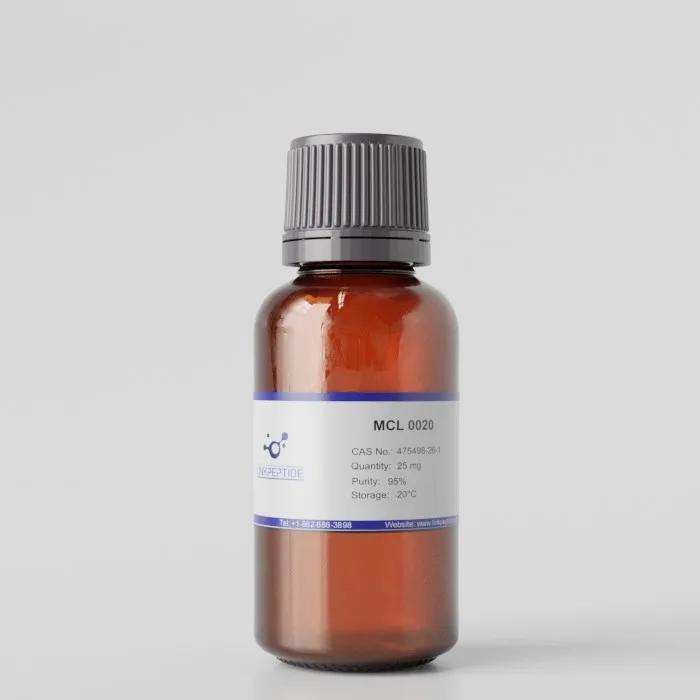
Product Name: HIF-1a (556-574)
Sequence One Letter Code: DLDLEMLAPYIPMDDDFQL
Sequence Three Letter Code: H-Asp-Leu-Asp-Leu-Glu-Met-Leu-Ala-Pro-Tyr-Ile-Pro-Met-Asp-Asp-Asp-Phe-Gln-Leu-OH
Chemical Formula:C101H152N20O34S2
Molecular Weight: 2254.7
Purity: 95%
Form: Lyophilized
Storage Conditions: - 20 °C
Research Area: Cancer Disease Research
Source / Species: human
Conjugation: Unconjugated
Code Nacres: NA.26
Application: This peptide corresponds to residues 556–574 of hypoxia-inducible factor-1α (HIF-1α), a transcription factor that regulates cellular adaptation to low oxygen conditions. The sequence contains a key proline residue that undergoes oxygen-dependent hydroxylation and enables recognition by the von Hippel–Lindau (VHL) E3 ubiquitin ligase complex. Under normoxic conditions, this interaction targets HIF-1α for ubiquitination and proteasomal degradation, while hypoxia disrupts this pathway and stabilizes the transcription factor. This peptide is widely used to investigate the molecular mechanisms governing HIF-1α stability and oxygen-dependent signaling. It is suitable for protein–protein interaction studies, enzymatic assays involving prolyl hydroxylases, and research into hypoxia signaling pathways associated with cancer, angiogenesis, and metabolic adaptation.
Current Research: Cellular adaptation to oxygen availability is controlled by a sophisticated regulatory network centered on hypoxia-inducible factor-1 (HIF-1). This transcription factor coordinates gene expression programs that allow cells to survive and function under low-oxygen conditions. The HIF-1α (556–574) peptide, corresponding to residues 556–574 of the HIF-1α protein, represents a critical regulatory region involved in oxygen-dependent degradation of the transcription factor. Because this sequence contains the key proline residue targeted for hydroxylation, it has become a widely used tool for studying hypoxia signaling, protein–protein interactions, and oxygen-sensing mechanisms. HIF-1α and Cellular Oxygen Sensing HIF-1 is a heterodimeric transcription factor composed of two subunits: HIF-1α, which is oxygen-sensitive, and HIF-1β, which is constitutively expressed. The stability of the HIF-1α subunit determines whether the transcription factor becomes active. Under conditions of low oxygen, or hypoxia, HIF-1α accumulates in the cell, dimerizes with HIF-1β, and activates transcription of genes involved in adaptive responses such as angiogenesis, metabolic reprogramming, erythropoiesis, and cell survival. In contrast, when oxygen levels are normal (normoxia), HIF-1α is rapidly degraded. This degradation process depends on oxygen-dependent enzymatic modifications that mark the protein for destruction through the ubiquitin–proteasome pathway. The Oxygen-Dependent Degradation Domain A key regulatory region of HIF-1α is its oxygen-dependent degradation domain (ODD). Within this domain lies a critical proline residue that undergoes hydroxylation by prolyl hydroxylase domain (PHD) enzymes. This hydroxylation event is the central molecular switch that determines whether HIF-1α is stabilized or degraded. The HIF-1α (556–574) peptide contains one of these regulatory sequences from the ODD region. When the target proline residue within this sequence becomes hydroxylated, it creates a recognition motif for the von Hippel–Lindau (VHL) protein, which functions as the substrate recognition component of an E3 ubiquitin ligase complex. Interaction with the VHL Ubiquitin Ligase Complex Following hydroxylation, the modified HIF-1α sequence is recognized by the VHL protein, which recruits additional components of an E3 ubiquitin ligase complex. This complex attaches ubiquitin molecules to HIF-1α, marking the protein for degradation by the 26S proteasome. Through this mechanism, cells maintain extremely low levels of HIF-1α when oxygen is abundant. However, under hypoxic conditions, the activity of prolyl hydroxylases decreases because these enzymes require oxygen as a co-substrate. Without hydroxylation, the VHL complex cannot recognize HIF-1α, preventing ubiquitination and allowing the transcription factor to accumulate. The stabilization of HIF-1α then triggers transcriptional activation of genes that help cells adapt to oxygen deprivation. A Tool for Studying Prolyl Hydroxylase Activity Because the HIF-1α (556–574) peptide contains the critical hydroxylation motif, it is widely used as a substrate in enzymatic assays involving prolyl hydroxylases. These enzymes belong to the family of 2-oxoglutarate–dependent dioxygenases, which require oxygen, iron, and 2-oxoglutarate to catalyze hydroxylation reactions. Using a defined peptide substrate allows researchers to measure hydroxylase activity, enzyme kinetics, and substrate recognition mechanisms in controlled biochemical experiments. Such assays are valuable for exploring how oxygen availability regulates enzyme activity and for identifying compounds that influence hypoxia signaling pathways. Applications in Protein–Protein Interaction Studies The peptide is also useful for investigating protein–protein interactions between HIF-1α and VHL. When hydroxylated, the sequence forms a binding motif that is specifically recognized by the VHL complex. This property makes the peptide a convenient model for studying the molecular basis of VHL-mediated recognition and ubiquitination. Binding assays using this peptide can help determine interaction specificity, structural determinants of binding, and the effects of modifications such as proline hydroxylation. These experiments have contributed to a deeper understanding of how cells detect oxygen levels and regulate the stability of hypoxia-responsive proteins. Relevance to Cancer and Metabolic Research Hypoxia signaling plays a significant role in many physiological and pathological processes. In tumors, for example, rapidly growing cells often experience oxygen deprivation, leading to HIF-1 activation and increased expression of genes involved in angiogenesis and metabolic adaptation. This response promotes the formation of new blood vessels and allows cancer cells to survive in poorly oxygenated environments. The pathway is also linked to disorders involving abnormal oxygen sensing, including conditions associated with mutations in the VHL gene, which disrupt normal regulation of HIF-1α stability. By enabling detailed analysis of the hydroxylation and recognition mechanisms controlling HIF-1α degradation, the HIF-1α (556–574) peptide supports research into the molecular basis of hypoxia-related diseases and adaptive metabolic responses. Supporting Research on Hypoxia Signaling Defined peptide models such as the HIF-1α (556–574) sequence provide researchers with practical tools for examining the core biochemical events that regulate cellular oxygen sensing. By reproducing the critical regulatory motif that controls HIF-1α stability, the peptide facilitates studies of prolyl hydroxylase activity, VHL recognition, and ubiquitin-mediated protein degradation. These investigations continue to advance understanding of hypoxia signaling pathways and their roles in cancer biology, angiogenesis, and metabolic adaptation, helping researchers uncover new insights into how cells respond to changing oxygen environments.
Get a Quote
 LinkPeptide