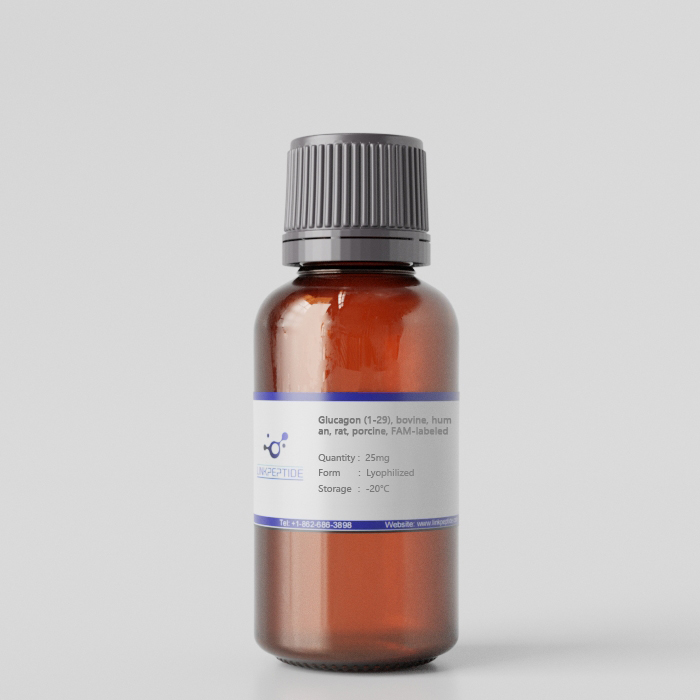
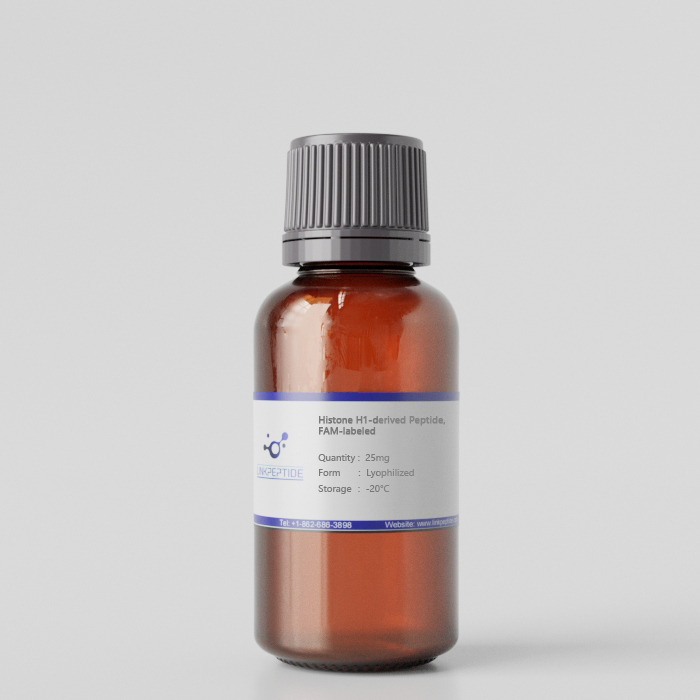
Product Name: Histone H1-derived Peptide, FAM-labeled
Sequence One Letter Code: 5-FAM-GGGPATPKKAKKL
Sequence Three Letter Code: 5-FAM-Gly-Gly-Gly-Pro-Ala-Thr-Pro-lys-lys-Ala-Lys-Lys-Leu-OH
Chemical Formula:C77H111N17O21
Molecular Weight: 1610.9
Purity: 95%
Form: Lyophilized
Storage Conditions: - 20 °C Protected from light
Research Area: peptide substrate
Source / Species: human
Conjugation: Conjugated
Conjugation Type: Fluorescent dyes
Code Nacres: NA.26
Application: This peptide is derived from the histone H1 sequence and is labeled with fluorescein amidite (FAM), enabling sensitive fluorescence detection in kinase assays. The fluorophore provides excitation and emission maxima at approximately 494 and 521 nm, making the peptide compatible with common fluorescence-based assay platforms. The sequence functions as a substrate for several kinases, including protein kinase A (PKA) as well as cyclin-dependent kinases CDK2 and CDK5. Because these enzymes regulate key cellular processes such as cell cycle progression and neuronal signaling, the peptide is widely used in enzymatic and inhibitor screening assays. It supports studies of kinase activity, enzyme kinetics, and signal transduction pathways involved in cell proliferation and neuronal function.
Current Research: Introduction to Fluorescent Peptide Substrates in Kinase Assays Protein kinases are essential regulators of cellular signaling, controlling biological processes through phosphorylation of specific protein substrates. These enzymes influence cell proliferation, metabolism, gene expression, and neuronal communication. Because abnormal kinase activity is associated with diseases such as cancer and neurodegenerative disorders, researchers require reliable tools to measure kinase activity and screen potential inhibitors. Fluorescent peptide substrates have become widely used in kinase assays due to their high sensitivity, reproducibility, and compatibility with high-throughput screening platforms. Among these tools, the FAM-labeled histone H1 peptide has emerged as a valuable reagent for studying kinase activity, enzyme kinetics, and signal transduction pathways. Histone H1–Derived Peptide as a Kinase Substrate Histone H1 is a linker histone protein that binds DNA between nucleosomes and helps maintain chromatin structure. It plays an important role in regulating chromatin compaction and gene accessibility. Phosphorylation of histone H1 is known to influence chromatin dynamics, particularly during cell cycle progression and transcriptional regulation. Peptides derived from histone H1 retain key phosphorylation motifs recognized by multiple kinases. Because of this property, histone H1–based peptide sequences are commonly used as model kinase substrates in biochemical assays. These peptides provide a simplified and efficient system for studying phosphorylation reactions without the structural complexity of full-length proteins. FAM Labeling Enables Sensitive Fluorescence Detection To facilitate detection in enzymatic assays, the histone H1 peptide is labeled with fluorescein amidite (FAM), one of the most widely used fluorophores in biochemical research. FAM provides strong fluorescence intensity and stable photophysical properties, making it ideal for fluorescence-based assay platforms. The fluorophore exhibits excitation and emission maxima at approximately 494 nm and 521 nm, respectively. These spectral characteristics align with the optical filters of most fluorescence detection instruments, including microplate readers and fluorescence polarization systems. As a result, FAM-labeled peptides can be easily integrated into existing laboratory workflows. Fluorescent labeling allows researchers to monitor phosphorylation reactions with high sensitivity. Changes in fluorescence signals provide a direct readout of kinase activity, enabling quantitative analysis of enzymatic reactions in real time. Compatibility with Multiple Kinases The FAM-labeled histone H1 peptide serves as a substrate for several important kinases involved in cellular regulation. These include protein kinase A (PKA) as well as cyclin-dependent kinases CDK2 and CDK5. PKA is a central component of cyclic AMP signaling pathways and regulates processes such as metabolism, transcription, and cellular stress responses. CDK2 is a key regulator of the cell cycle and plays an essential role in controlling transitions between different stages of cell division. CDK5, although structurally related to other CDKs, is primarily active in neuronal tissues and contributes to neuronal development and synaptic signaling. Because these kinases regulate critical cellular pathways, they are widely studied targets in biomedical research. A peptide substrate capable of interacting with multiple kinases provides researchers with a versatile reagent for evaluating enzyme activity across different signaling systems. Applications in Kinase Activity and Inhibitor Screening One of the major advantages of the FAM-labeled histone H1 peptide is its suitability for fluorescence-based kinase assays. Researchers can measure phosphorylation levels by monitoring fluorescence changes, allowing accurate quantification of kinase activity. This peptide substrate is frequently used in studies that investigate enzyme kinetics, including determination of catalytic efficiency and substrate affinity. By measuring reaction rates under different experimental conditions, scientists can better understand how kinases function within signaling pathways. In addition to enzymatic studies, the peptide is also highly useful in kinase inhibitor screening. Drug discovery programs often rely on fluorescence assays to identify small molecules that modulate kinase activity. In these experiments, candidate compounds are incubated with the kinase and the fluorescent peptide substrate. Compounds that inhibit phosphorylation reduce the fluorescence signal, allowing rapid identification of potential inhibitors. Because fluorescence assays are compatible with automated workflows and multi-well plates, the FAM-labeled histone H1 peptide is well suited for high-throughput screening applications. Research Applications in Cell Cycle and Neuroscience Studies Beyond drug discovery, this fluorescent peptide substrate supports research into signaling pathways that regulate cell growth and neuronal function. Kinases such as CDK2 play a central role in controlling cell cycle progression and cell proliferation. Meanwhile, CDK5 activity is closely linked to neuronal development, synaptic plasticity, and cytoskeletal organization. Using fluorescent peptide substrates allows researchers to monitor kinase activity in controlled biochemical systems, helping clarify how phosphorylation events influence these biological processes. Such studies contribute to a deeper understanding of cell cycle regulation, neuronal signaling, and disease-related signaling pathways. Conclusion The FAM-labeled histone H1–derived peptide is a versatile fluorescent substrate widely used in kinase research. By combining a biologically relevant phosphorylation sequence with a strong fluorescent reporter, this peptide enables sensitive detection of enzymatic activity in fluorescence-based assays. Its compatibility with kinases such as PKA, CDK2, and CDK5 makes it particularly valuable for studies of cell cycle regulation, neuronal signaling, and inhibitor discovery. With its strong fluorescence signal, compatibility with common assay platforms, and suitability for high-throughput screening, the FAM-labeled histone H1 peptide remains an important reagent for researchers investigating kinase activity and signal transduction mechanisms.
Get a Quote
 LinkPeptide

![Tyrosine Kinase Peptide 1 [KVEKIGEGTYGVVYK], 5-...](https://www.linkpeptide.com/wp-content/uploads/2026/06/Tyrosine-Kinase-Peptide-1-KVEKIGEGTYGVVYK-5-TMR-labeled.jpg "Tyrosine Kinase Peptide 1 [KVEKIGEGTYGVVYK], 5-...")