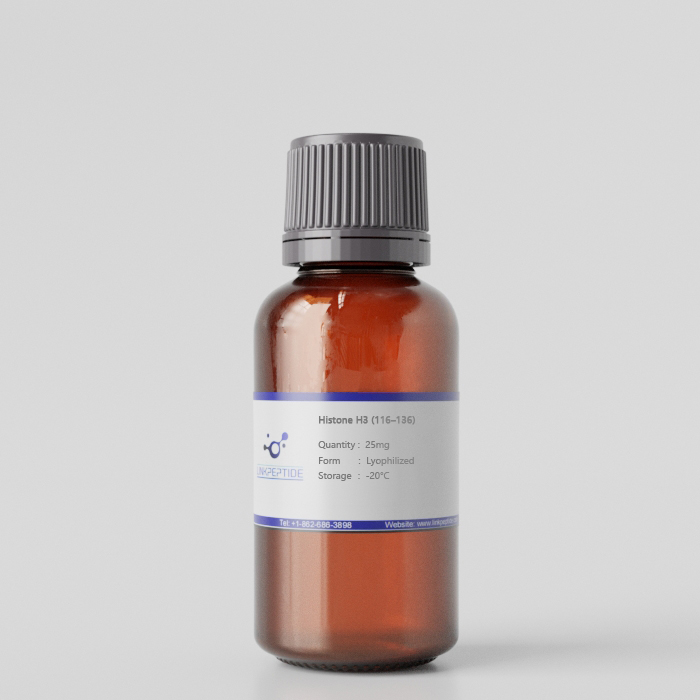
Product Name: Histone H3 (116–136)
Sequence One Letter Code: KRVTIMPKDIQLARRIRGERA
Sequence Three Letter Code: H-Lys-Arg-Val-Thr-Ile-Met-Pro-Lys-Asp-Ile-Gln-Leu-Ala-Arg-Arg-Ile-Arg-Gly-Glu-Arg-Ala-OH
Chemical Formula:C107H195N39O28S1
Molecular Weight: 2508.2
Purity: 95%
Form: Lyophilized
Storage Conditions: - 20 °C
Research Area: Cancer Disease Research
Source / Species: human
Conjugation: Unconjugated
Code Nacres: NA.26
Application: Histone H3 (116–136) is a synthetic peptide corresponding to the C-terminal region of histone H3, encompassing residues 116 to 136. This segment contributes to nucleosome stability and higher-order chromatin organization through histone–histone and histone–DNA interactions within the nucleosome core particle. The C-terminal domain plays an important structural role in maintaining chromatin architecture and regulating accessibility of genomic DNA. This peptide is suitable for studies examining chromatin assembly, nucleosome dynamics, and protein–protein interactions involving histone H3. It supports biochemical, structural, and immunological assays designed to investigate epigenetic regulation, chromatin remodeling complexes, and mechanisms controlling gene expression.
Current Research: Histone H3 (116–136) is a synthetic peptide corresponding to residues 116–136 within the C-terminal region of histone H3, one of the four core histone proteins (H2A, H2B, H3, and H4) that form the nucleosome core particle. In canonical nucleosomes, two H3 molecules assemble with two H4 molecules to form the central (H3–H4)₂ tetramer, around which ~147 base pairs of DNA are wrapped. While much attention in epigenetics focuses on the N-terminal histone tails, the C-terminal region of H3 plays a critical structural role in nucleosome stability and higher-order chromatin organization. Residues 116–136 lie within the histone fold domain, contributing to histone–histone interactions and stabilization of the nucleosome core. This region participates in contacts with histone H4 and supports the formation of the H3–H4 tetramer interface. It also contributes indirectly to histone–DNA interactions by maintaining the structural integrity of the nucleosomal scaffold. Alterations within this domain can influence nucleosome positioning, stability, and susceptibility to remodeling. Because of its structural importance, the H3 (116–136) peptide is useful in biochemical assays examining nucleosome assembly and histone complex formation. In vitro reconstitution systems frequently use defined histone fragments to dissect interaction interfaces within histone octamers. This peptide can be applied in binding studies to evaluate protein–protein interactions involving histone H3, including associations with histone chaperones, chromatin remodeling factors, and structural maintenance proteins. Although most well-characterized post-translational modifications (PTMs) of histone H3 occur in the N-terminal tail, emerging evidence suggests that regions within the histone fold domain may also influence chromatin behavior through structural modulation or interaction with regulatory proteins. The 116–136 segment provides a defined fragment for mapping binding sites of chromatin-associated factors that recognize non-tail regions of H3. In structural biology, Histone H3 (116–136) can be employed in peptide–protein interaction assays, surface plasmon resonance studies, and NMR-based binding analyses to characterize interactions between H3 and regulatory complexes. These approaches help define how chromatin remodeling complexes, histone chaperones (such as ASF1 or CAF-1), and architectural proteins engage histone cores during nucleosome assembly or disassembly. The peptide is also applicable in immunological assays, including antibody epitope mapping and validation. Antibodies raised against specific regions of histone H3 can be tested for sequence specificity using defined peptide fragments. This is particularly relevant in studies investigating histone variants (e.g., H3.1, H3.3) or mutation-associated oncohistones, where subtle sequence differences within the histone fold domain may alter chromatin structure and gene regulation. In chromatin remodeling research, defined H3 fragments support mechanistic investigations into how ATP-dependent remodeling complexes reposition nucleosomes or alter histone–DNA contacts. The integrity of the H3–H4 tetramer is central to these processes, and peptides derived from the C-terminal region can be used to probe interaction surfaces critical for chromatin dynamics. Overall, Histone H3 (116–136) represents a structurally significant segment of the histone fold domain that contributes to nucleosome stability and chromatin architecture. As a defined synthetic fragment, it supports biochemical, structural, and interaction-based studies aimed at understanding nucleosome assembly, chromatin remodeling, and the molecular mechanisms underlying epigenetic regulation and gene expression control.
Get a Quote
 LinkPeptide