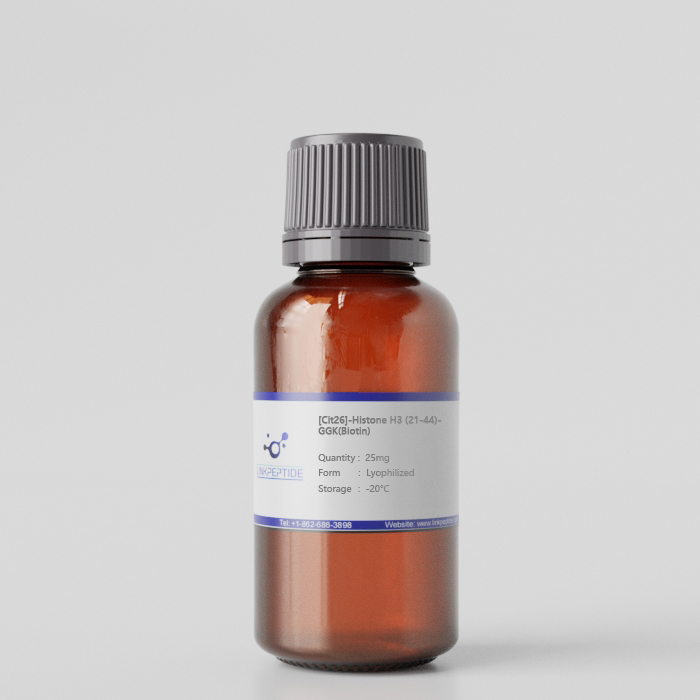
Product Name: Histone H3 (21-44)-GK(Biotin)-NH2
Sequence One Letter Code: ATKAARKSAPSTGGVKKPHRYRPG-GK(Biotin)-NH2
Sequence Three Letter Code: H-Ala-Thr-Lys-Ala-Ala-Arg-Lys-Ser-Ala-Pro-Ser-Thr-Gly-Gly-Val-Lys-Lys-Pro-His-Arg-Tyr-Arg-Pro-Gly-Gly-Lys(Biotin)-NH2
Chemical Formula:C127H215N45O33S1
Molecular Weight: 2932.6
Purity: 95%
Form: Lyophilized
Storage Conditions: - 20 °C
Research Area: epigenetics
Source / Species: human
Conjugation: Conjugated
Conjugation Type: Biotins
Code Nacres: NA.26
Application: Histone H3 (21–44), Biotinylated is a synthetic peptide spanning residues 21–44 of histone H3, with a C-terminal glycine followed by a biotinylated lysine. This region contains multiple sites of post-translational modification that regulate chromatin structure and transcriptional activity. The biotin tag enables affinity-based applications such as pull-down assays and protein interaction studies, facilitating the identification of chromatin-associated proteins. This peptide is widely used to investigate histone-binding partners, chromatin remodeling complexes, and regulatory mechanisms governing gene expression. It supports studies in epigenetics, transcriptional control, and protein–chromatin interactions, providing a versatile tool for analyzing the functional roles of histone modifications.
Current Research: Histone proteins play a central role in organizing DNA into chromatin and regulating gene expression through a wide range of post-translational modifications (PTMs). The Histone H3 (21–44), Biotinylated peptide is a synthetic construct representing a key regulatory region of histone H3, encompassing amino acid residues 21 to 44. This segment contains multiple modification sites that are critical for controlling chromatin structure and transcriptional activity. By incorporating a C-terminal glycine linker followed by a biotinylated lysine, this peptide is optimized for affinity-based assays and protein interaction studies. Due to its structural relevance and experimental flexibility, this peptide is widely used in epigenetics, chromatin biology, and transcriptional regulation research. Functional Importance of the H3 (21–44) Region The histone H3 sequence spanning residues 21–44 lies within the N-terminal tail and proximal region, which is rich in regulatory modification sites. This region includes lysine residues such as K27 and K36, which are subject to methylation and acetylation events that influence gene expression. These post-translational modifications serve as molecular signals that: Regulate chromatin accessibility Recruit chromatin-binding proteins and remodeling complexes Coordinate transcriptional activation or repression Influence higher-order chromatin structure Because this region integrates multiple regulatory signals, it is particularly valuable for studying how combinations of histone modifications contribute to chromatin dynamics. Design and Features of the Biotinylated Peptide The Histone H3 (21–44), Biotinylated peptide is engineered to preserve the native amino acid sequence of this regulatory region while adding functionality for experimental applications. Key design features include: Residues 21–44 of histone H3, maintaining biologically relevant sequence context A C-terminal glycine (G) linker, providing flexibility and reducing steric hindrance A biotinylated lysine residue, enabling strong and specific binding to streptavidin or avidin The inclusion of biotin allows the peptide to be immobilized on solid supports such as beads, plates, or sensor surfaces, facilitating a wide range of biochemical and proteomic assays. Applications in Protein–Chromatin Interaction Studies One of the primary uses of this peptide is in affinity-based pull-down assays designed to identify proteins that interact with histone H3 regions. By immobilizing the biotinylated peptide on streptavidin-coated matrices, researchers can capture histone-binding proteins from cell extracts. These proteins may include: Chromatin remodeling complexes Histone-modifying enzymes (e.g., methyltransferases, acetyltransferases) Epigenetic reader proteins that recognize specific histone marks Transcriptional regulators and coactivators/repressors Following capture, interacting proteins can be analyzed using techniques such as mass spectrometry or immunoblotting, providing insights into chromatin-associated protein networks. Studying Chromatin Remodeling and Epigenetic Signaling The H3 (21–44) region is particularly important for understanding how chromatin structure is dynamically regulated. By using this peptide, researchers can investigate how specific proteins or complexes interact with histone sequences and influence chromatin organization. Applications include: Characterization of chromatin remodeling complexes Analysis of histone modification recognition mechanisms Investigation of transcriptional activation and repression pathways Mapping protein-binding domains involved in chromatin regulation Because this peptide can be modified further (e.g., methylation or acetylation at specific residues), it also serves as a flexible platform for studying combinatorial histone modification effects. Utility in Epigenetics and Transcriptional Control Research Histone modifications within the H3 (21–44) region play critical roles in regulating gene expression programs during development, differentiation, and cellular response to stimuli. Dysregulation of these processes is associated with various diseases, including cancer and developmental disorders. The biotinylated peptide enables controlled investigation of these mechanisms by allowing researchers to isolate and study specific protein–histone interactions in vitro. This contributes to a better understanding of how epigenetic signals are interpreted and translated into functional outcomes. A Versatile Platform for Chromatin Biology The Histone H3 (21–44), Biotinylated peptide provides a robust and adaptable tool for studying chromatin structure and function. Its combination of a biologically relevant histone sequence with a convenient biotin tag makes it suitable for a wide range of experimental approaches. By supporting affinity capture, protein interaction analysis, and epigenetic studies, this peptide plays an important role in advancing research on chromatin dynamics, transcriptional regulation, and the molecular mechanisms that govern gene expression.
Get a Quote
 LinkPeptide

![[Lys(Ac)79]-Histone H3 (69-89)-K(Biotin)](https://www.linkpeptide.com/wp-content/uploads/2026/06/LysAc79-Histone-H3-69-89-KBiotin.jpg "[Lys(Ac)79]-Histone H3 (69-89)-K(Biotin)")
![Ser(OGlcNAc)]400-KWK-Tau (388-411)-KK(Biotin)-NH2](https://www.linkpeptide.com/wp-content/uploads/2026/06/SerOGlcNAc400-KWK-Tau-388-411-KKBiotin-NH2.jpg "Ser(OGlcNAc)]400-KWK-Tau (388-411)-KK(Biotin)-NH2")