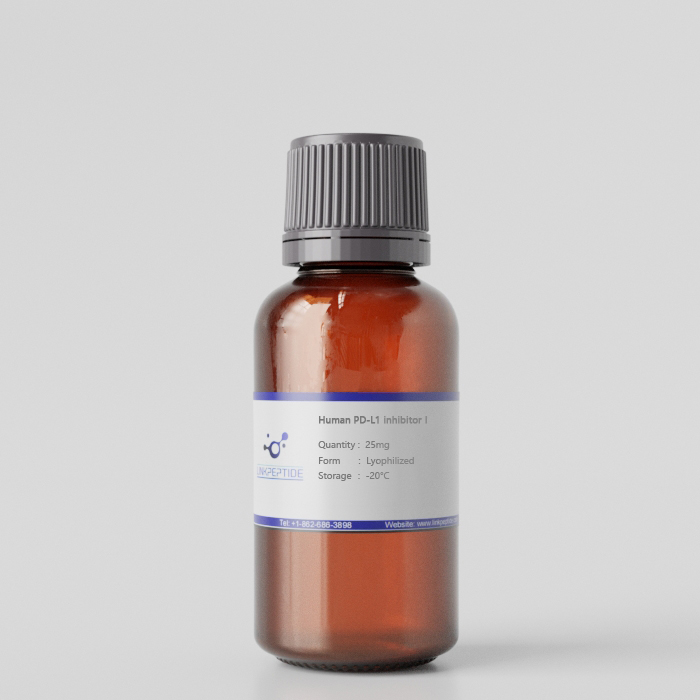
Product Name: Human PD-L1 inhibitor I
Sequence One Letter Code: FNWDYSWKSERLKEAYDL
Sequence Three Letter Code: H-Phe-Asn-Trp-Asp-Tyr-Ser-Trp-Lys-Ser-Glu-Arg-Leu-Lys-Glu-Ala-Tyr-Asp-Leu-OH
Chemical Formula:C110H152N26O32
Molecular Weight: 2350.7
Purity: 95%
Form: Lyophilized
Storage Conditions: - 20 °C
Research Area: Cancer Disease Research
Source / Species: human
Conjugation: Unconjugated
Code Nacres: NA.26
Application: Human PD-L1 Inhibitor I is a synthetic peptide that targets the PD-1 immune checkpoint pathway by binding human PD-1 and disrupting its interaction with PD-L1. The PD-1/PD-L1 axis suppresses T cell activation and is frequently exploited by tumor cells to evade immune surveillance. This peptide contains critical anchor residues, including a WDY motif essential for blocking PD-1/PD-L1 engagement. It is widely used in immuno-oncology research to evaluate checkpoint signaling, restore T cell activation in experimental systems, and study peptide-based immune modulation strategies. The inhibitor supports mechanistic investigations of antitumor immune responses and checkpoint blockade approaches.
Current Research: Human PD-L1 Inhibitor I is a synthetic peptide designed to disrupt the programmed cell death protein 1 (PD-1)/programmed death ligand 1 (PD-L1) immune checkpoint pathway. By binding to human PD-1 and preventing its interaction with PD-L1, this peptide interferes with a key inhibitory signaling axis that suppresses T cell activation. The PD-1/PD-L1 pathway is a central mechanism of peripheral immune tolerance and is frequently co-opted by tumor cells to evade immune surveillance. PD-1 is an inhibitory receptor expressed on activated T cells, B cells, and certain myeloid populations. Upon engagement with PD-L1 or PD-L2, PD-1 recruits SHP2 phosphatase to its intracellular ITIM and ITSM motifs, resulting in dephosphorylation of proximal T cell receptor (TCR) signaling components. This leads to reduced cytokine production, diminished proliferation, and functional exhaustion of T cells. In the tumor microenvironment, upregulation of PD-L1 on malignant cells and antigen-presenting cells contributes to impaired antitumor immunity. Human PD-L1 Inhibitor I contains key anchor residues, including a WDY motif that plays a critical role in blocking PD-1/PD-L1 binding. Structural studies of the PD-1/PD-L1 interface reveal defined contact regions responsible for high-affinity interaction. Peptide inhibitors are engineered to mimic or competitively occupy these binding interfaces, thereby preventing ligand engagement. The inclusion of essential aromatic and hydrophobic residues enhances binding affinity and functional antagonism. In immuno-oncology research, this peptide is used as a tool compound to evaluate checkpoint signaling in vitro. Co-culture systems involving PD-1–expressing T cells and PD-L1–positive tumor cells allow assessment of T cell activation markers such as CD69 expression, IL-2 secretion, and interferon-γ production. Addition of the inhibitor restores TCR-mediated signaling, enabling mechanistic dissection of checkpoint-dependent suppression. Reporter assays measuring NFAT or NF-κB activity are also employed to quantify pathway reactivation. Compared to monoclonal antibodies targeting PD-1 or PD-L1, peptide-based inhibitors offer advantages in experimental flexibility, rapid diffusion, and potential for structural modification. Although antibodies dominate clinical checkpoint blockade therapy, peptide inhibitors are valuable in preclinical systems for probing structure–function relationships and identifying minimal binding motifs required for disruption of receptor–ligand interaction. The inhibitor is also used to investigate T cell exhaustion and immune modulation. Chronic antigen exposure in cancer or viral infection leads to sustained PD-1 expression and progressive T cell dysfunction. By blocking PD-1 engagement, researchers can assess reversibility of exhausted phenotypes and study downstream transcriptional changes associated with functional restoration. In addition to tumor biology, PD-1/PD-L1 signaling is relevant in autoimmune and inflammatory conditions. Experimental use of peptide inhibitors helps clarify the balance between immune activation and tolerance, particularly in models where transient checkpoint disruption is desired for mechanistic evaluation rather than long-term blockade. Structural and biophysical assays such as surface plasmon resonance (SPR), fluorescence polarization, and competitive ELISA are frequently used to quantify binding affinity and inhibitory potency of the peptide. These studies support optimization of sequence variants for improved stability or enhanced receptor interaction. Overall, Human PD-L1 Inhibitor I is a selective peptide antagonist of the PD-1/PD-L1 checkpoint pathway that enables controlled modulation of T cell inhibitory signaling. By restoring T cell activation in experimental systems, it serves as a valuable tool for studying antitumor immunity, checkpoint signaling mechanisms, and peptide-based immune modulation strategies in immuno-oncology research.
Get a Quote
 LinkPeptide