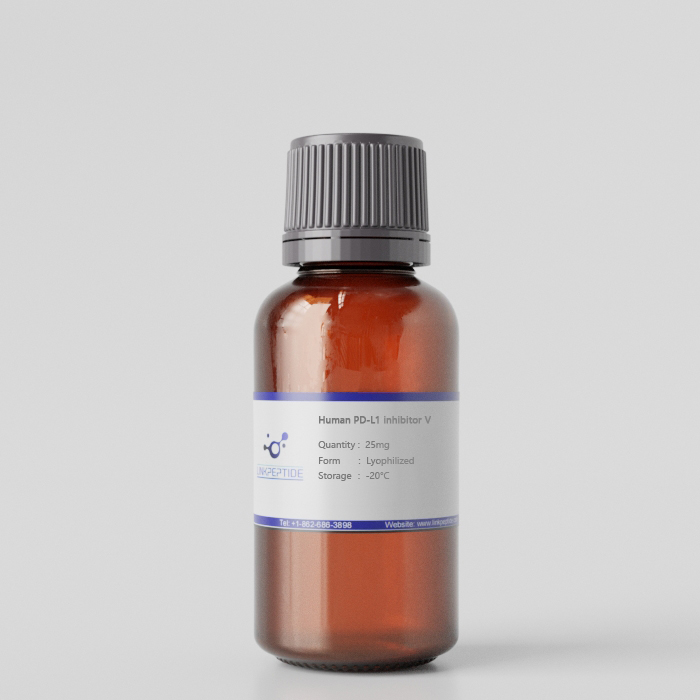
Product Name: Human PD-L1 inhibitor V
Sequence One Letter Code: LDYVNRRKMYQ
Sequence Three Letter Code: H-Leu-Asp-Tyr-Val-Asn-Arg-Arg-Lys-Met-Tyr-Gln-OH
Chemical Formula:C65H104N20O18S1
Molecular Weight: 1485.8
Purity: 95%
Form: Lyophilized
Storage Conditions: - 20 °C
Research Area: Inflammation and Immunology Research
Source / Species: human
Conjugation: Unconjugated
Code Nacres: NA.26
Application: Human PD-L1 Inhibitor V is a synthetic immune checkpoint–targeting peptide designed to disrupt the PD-1/PD-L1 interaction, a central regulatory pathway in tumor immune evasion. By binding directly to human PD-1, this peptide inhibits PD-1/PD-L1 signaling and restores T cell activation in experimental systems. The sequence contains critical anchor residues (LDYVNRRKMYQ) responsible for high-affinity PD-1 recognition. This peptide is widely applied in cancer immunotherapy research, immune checkpoint blockade studies, and T cell signaling analysis. It provides a useful tool for investigating peptide-based immunotherapeutic strategies, screening immune modulators, and characterizing mechanisms of immune suppression in oncology research.
Current Research: The PD-1/PD-L1 immune checkpoint axis remains a central focus of cancer immunotherapy research due to its critical role in suppressing T cell activation and enabling tumor immune evasion. While monoclonal antibodies targeting PD-1 or PD-L1 have transformed oncology, increasing attention is being directed toward peptide-based modulators that offer alternative pharmacological profiles, improved tissue penetration, and flexible engineering potential. Human PD-L1 Inhibitor V is designed to bind directly to human PD-1, disrupting its interaction with PD-L1 and thereby restoring downstream T cell signaling in experimental systems. Current research explores the structural determinants governing PD-1/PD-L1 engagement, including the contribution of defined anchor residues such as LDYVNRRKMYQ within peptide inhibitors. Structural modeling and competitive binding assays use synthetic PD-1–targeting peptides to map interaction interfaces and evaluate binding affinity relative to native ligand engagement. These approaches support rational design of next-generation checkpoint inhibitors with optimized specificity and stability. In vitro studies commonly employ peptide inhibitors to assess reversal of PD-1–mediated suppression of T cell receptor (TCR) signaling. Functional assays measure restoration of cytokine production (e.g., IFN-γ, IL-2), proliferation, and cytotoxic activity in activated T cells exposed to PD-L1–expressing tumor cells. Peptide-based inhibitors provide a controllable system for dissecting proximal signaling events downstream of PD-1, including SHP2 recruitment, dephosphorylation of CD28 and TCR-associated kinases, and modulation of AKT and MAPK pathways. Beyond direct immune activation, current investigations evaluate combination strategies integrating PD-1 pathway blockade with chemotherapy, targeted kinase inhibitors, or adoptive T cell therapies. Peptide inhibitors serve as screening tools to characterize synergistic effects and to analyze immune microenvironment modulation under defined experimental conditions. Their smaller size compared with antibodies also facilitates mechanistic studies of tissue penetration and receptor occupancy in preclinical models. In addition, peptide-based checkpoint modulators are increasingly studied in the context of delivery platforms, including nanoparticle conjugation and fusion constructs designed to enhance stability or tumor targeting. Defined PD-1–binding sequences enable systematic optimization of pharmacodynamic properties and receptor selectivity. Collectively, ongoing research underscores the importance of dissecting PD-1/PD-L1 signaling at molecular resolution and developing diverse modalities for immune checkpoint modulation. Human PD-L1 Inhibitor V provides a structurally defined tool for studying PD-1 engagement, T cell reactivation, inhibitor screening, and mechanistic evaluation of immune suppression pathways in oncology research.
Get a Quote
 LinkPeptide