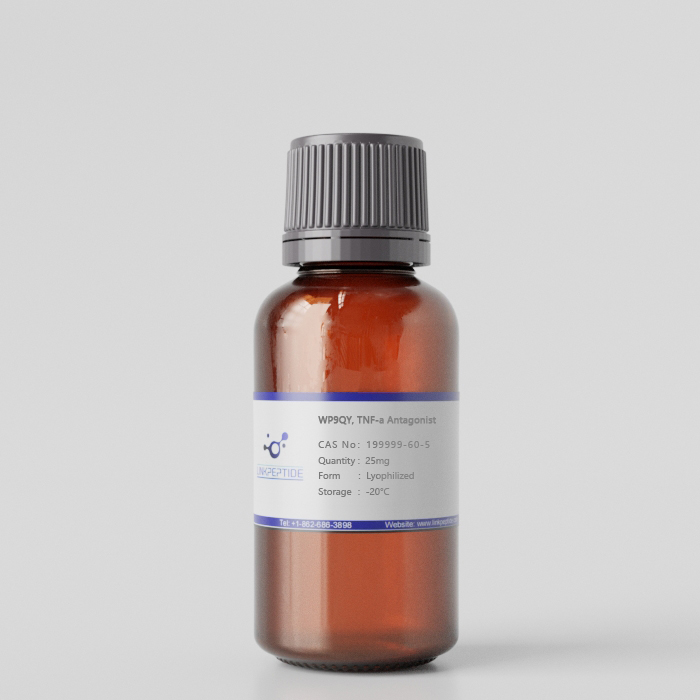
Product Name: WP9QY, TNF-a Antagonist
Sequence One Letter Code: YCWSQYLCY (Disulfide bridge: 2-8)
Sequence Three Letter Code: H-Tyr-Cys-Trp-Ser-Gln-Tyr-Leu-Cys-Tyr-OH (Disulfide bridge: 2-8)
Cas No: 199999-60-5
Chemical Formula:C58H73N11O15S2
Molecular Weight: 1226.4
Purity: 95%
Form: Lyophilized
Storage Conditions: - 20 °C
Research Area: Cancer Disease Research
SMILES: CC(C)C[C@H]1C(=O)N[C@@H](CSSC[C@@H](C(=O)N[C@H](C(=O)N[C@H](C(=O)N[C@H](C(=O)N[C@H](C(=O)N1)CC2=CC=C(C=C2)O)CCC(=O)N)CO)CC3=CNC4=CC=CC=C43)NC(=O)[C@H](CC5=CC=C(C=C5)O)N)C(=O)N[C@@H](CC6=CC=C(C=C6)O)C(=O)O
IUPAC: (2S)-2-[[(4R,7S,10S,13S,16S,19S,22R)-22-[[(2S)-2-amino-3-(4-hydroxyphenyl)propanoyl]amino]-13-(3-amino-3-oxopropyl)-16-(hydroxymethyl)-10-[(4-hydroxyphenyl)methyl]-19-(1H-indol-3-ylmethyl)-7-(2-methylpropyl)-6,9,12,15,18,21-hexaoxo-1,2-dithia-5,8,11,14,17,20-hexazacyclotricosane-4-carbonyl]amino]-3-(4-hydroxyphenyl)propanoic acid
INCHIKEY: OXRZFLLXMORPHO-XCLFSWKQSA-N
INCHI:
InChI=1S/C58H71N11O15S2/c1-30(2)21-42-52(77)69-48(57(82)66-45(58(83)84)24-33-11-17-37(73)18-12-33)29-86-85-28-47(68-50(75)39(59)22-31-7-13-35(71)14-8-31)56(81)65-44(25-34-26-61-40-6-4-3-5-38(34)40)54(79)67-46(27-70)55(80)62-41(19-20-49(60)74)51(76)64-43(53(78)63-42)23-32-9-15-36(72)16-10-32/h3-18,26,30,39,41-48,61,70-73H,19-25,27-29,59H2,1-2H3,(H2,60,74)(H,62,80)(H,63,78)(H,64,76)(H,65,81)(H,66,82)(H,67,79)(H,68,75)(H,69,77)(H,83,84)/t39-,41-,42-,43-,44-,45-,46-,47-,48-/m0/s1
Source / Species: Synthetic construct
Conjugation: Unconjugated
Code Nacres: NA.26
Application: WP9QY is a cyclic peptide engineered to mimic a recognition loop of tumor necrosis factor receptor I (TNFR1). By binding TNF-α, it competitively inhibits receptor engagement and downstream inflammatory signaling cascades. Preclinical studies have demonstrated its capacity to suppress inflammatory bone destruction and systemic bone loss, particularly in models of rheumatoid arthritis. As a structurally defined TNF antagonist, WP9QY serves as a template for the development of small-molecule or peptide-based TNF inhibitors. It is widely utilized in research focused on cytokine signaling, osteoimmunology, and therapeutic modulation of TNF-mediated inflammatory diseases.
Current Research: Tumor necrosis factor-α (TNF-α) is a central cytokine in the regulation of inflammation and immune responses. While essential for host defense, excessive or dysregulated TNF signaling contributes to a range of inflammatory diseases, including rheumatoid arthritis, inflammatory bowel disease, psoriasis, and osteoporosis associated with chronic inflammation. Because TNF-α exerts many of its biological effects through interaction with tumor necrosis factor receptor I (TNFR1), strategies that disrupt this interaction have become a major focus of therapeutic research. The cyclic peptide WP9QY was engineered to mimic a recognition loop of TNFR1 and functions as a competitive inhibitor of TNF-α binding, making it a valuable experimental tool for studying cytokine signaling and inflammatory pathology. Current research on WP9QY has primarily focused on its role as a selective antagonist of TNF-mediated signaling pathways. By binding directly to TNF-α, the peptide prevents the cytokine from interacting with TNFR1, thereby blocking downstream signaling events that would normally activate inflammatory transcription factors such as NF-κB and MAPK pathways. These pathways regulate the expression of numerous proinflammatory mediators, including cytokines, chemokines, and matrix-degrading enzymes. Inhibition of TNF signaling using peptides such as WP9QY allows researchers to investigate the molecular mechanisms through which TNF contributes to inflammatory tissue damage. A major application of WP9QY is in osteoclast biology and osteoimmunology, an interdisciplinary field examining how immune signaling influences bone remodeling. TNF-α is known to stimulate osteoclast differentiation and activation, leading to increased bone resorption during chronic inflammation. Preclinical studies using WP9QY have demonstrated that blocking TNF activity can suppress inflammatory bone destruction in experimental models. In particular, studies in rheumatoid arthritis models have shown that treatment with the peptide reduces osteoclast formation and prevents erosion of bone at inflamed joints. These findings highlight the potential of TNF-targeting peptides as modulators of immune-driven skeletal pathology. Another important research area involves the prevention of systemic bone loss associated with inflammatory diseases. Chronic inflammatory conditions often accelerate bone turnover and contribute to osteoporosis. Experimental studies have shown that WP9QY can inhibit TNF-induced bone resorption in animal models, suggesting that the peptide interferes with signaling pathways that promote osteoclastogenesis. Investigations using this peptide have therefore helped clarify how inflammatory cytokines disrupt the balance between bone formation and bone degradation. WP9QY has also attracted interest as a template for developing peptide-based TNF inhibitors. Currently approved TNF-targeting therapies, such as monoclonal antibodies and receptor fusion proteins, have demonstrated substantial clinical benefits but can be associated with high production costs and potential immunogenicity. Smaller peptide-based inhibitors offer the possibility of more flexible molecular design and potentially improved tissue penetration. By mimicking structural elements of TNFR1 involved in ligand recognition, WP9QY provides a structural framework for designing next-generation TNF antagonists. Beyond therapeutic development, the peptide is widely used in cellular and molecular studies of cytokine signaling. In vitro experiments often employ WP9QY to selectively block TNF activity when examining inflammatory signaling networks. This approach allows investigators to dissect the specific contribution of TNF to cellular responses such as cytokine production, apoptosis, or immune cell activation. Such studies are particularly relevant in diseases where multiple inflammatory mediators interact within complex signaling environments. Recent work has further integrated WP9QY into research exploring immune–bone interactions and inflammatory microenvironments. By modulating TNF activity in experimental systems, researchers can evaluate how cytokine signaling influences interactions among immune cells, osteoclast precursors, and stromal cells within bone tissue. These investigations contribute to a deeper understanding of the molecular pathways driving inflammatory bone diseases. In summary, WP9QY is an important research peptide that functions as a competitive inhibitor of TNF-α signaling. Its ability to disrupt TNF–TNFR1 interactions makes it a useful tool for studying inflammatory pathways, osteoclast-mediated bone resorption, and immune regulation in inflammatory diseases. Through applications in cytokine signaling studies, osteoimmunology research, and peptide-based drug design, WP9QY continues to support efforts aimed at developing improved strategies for controlling TNF-driven inflammatory disorders.
Get a Quote
 LinkPeptide