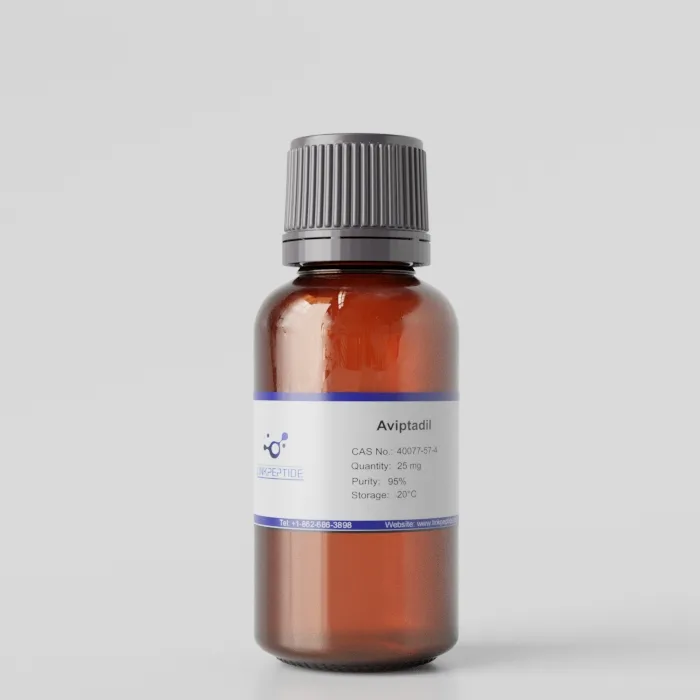
Product Name: Humanin, HN
Sequence One Letter Code: MAPRGFSCLLLLTSEIDLPVKRRA
Sequence Three Letter Code: H-Met-Ala-Pro-Arg-Gly-Phe-Ser-Cys-Leu-Leu-Leu-Leu-Thr-Ser-Glu-Ile-Asp-Leu-Pro-Val-Lys-Arg-Arg-Ala-OH
Cas No: 330936-69-1
Chemical Formula:C137H212N42O39S
Molecular Weight: 2687.4
Purity: 95%
Form: Lyophilized
Storage Conditions: - 20 °C
Research Area: Alzheimer's Disease
SMILES: CC[C@H](C)[C@@H](C(=O)N[C@@H](CC(=O)O)C(=O)N[C@@H](CC(C)C)C(=O)N1CCC[C@H]1C(=O)N[C@@H](C(C)C)C(=O)N[C@@H](CCCCN)C(=O)N[C@@H](CCCNC(=N)N)C(=O)N[C@@H](CCCNC(=N)N)C(=O)N[C@@H](C)C(=O)O)NC(=O)[C@H](CCC(=O)O)NC(=O)[C@H](CO)NC(=O)[C@H]([C@@H](C)O)NC(=O)[C@H](CC(C)C)NC(=O)[C@H](CC(C)C)NC(=O)[C@H](CC(C)C)NC(=O)[C@H](CC(C)C)NC(=O)[C@H](CS)NC(=O)[C@H](CO)NC(=O)[C@H](CC2=CC=CC=C2)NC(=O)CNC(=O)[C@H](CCCNC(=N)N)NC(=O)[C@@H]3CCCN3C(=O)[C@H](C)NC(=O)[C@H](CCSC)N
IUPAC: (4S)-5-[[(2S,3S)-1-[[(2S)-1-[[(2S)-1-[(2S)-2-[[(2S)-1-[[(2S)-6-amino-1-[[(2S)-5-carbamimidamido-1-[[(2S)-5-carbamimidamido-1-[[(1S)-1-carboxyethyl]amino]-1-oxopentan-2-yl]amino]-1-oxopentan-2-yl]amino]-1-oxohexan-2-yl]amino]-3-methyl-1-oxobutan-2-yl]carbamoyl]pyrrolidin-1-yl]-4-methyl-1-oxopentan-2-yl]amino]-3-carboxy-1-oxopropan-2-yl]amino]-3-methyl-1-oxopentan-2-yl]amino]-4-[[(2S)-2-[[(2S,3R)-2-[[(2S)-2-[[(2S)-2-[[(2S)-2-[[(2S)-2-[[(2R)-2-[[(2S)-2-[[(2S)-2-[[2-[[(2S)-2-[[(2S)-1-[(2S)-2-[[(2S)-2-amino-4-methylsulfanylbutanoyl]amino]propanoyl]pyrrolidine-2-carbonyl]amino]-5-carbamimidamidopentanoyl]amino]acetyl]amino]-3-phenylpropanoyl]amino]-3-hydroxypropanoyl]amino]-3-sulfanylpropanoyl]amino]-4-methylpentanoyl]amino]-4-methylpentanoyl]amino]-4-methylpentanoyl]amino]-4-methylpentanoyl]amino]-3-hydroxybutanoyl]amino]-3-hydroxypropanoyl]amino]-5-oxopentanoic acid
INCHIKEY: DPEUWKZJZIPZKE-OFANTOPUSA-N
INCHI:
InChI=1S/C119H204N34O32S2/c1-19-65(14)92(112(180)144-81(54-90(160)161)104(172)145-82(52-63(10)11)115(183)153-46-29-37-87(153)110(178)149-91(64(12)13)111(179)139-72(32-23-24-41-120)97(165)136-74(35-27-44-130-119(126)127)98(166)135-73(34-26-43-129-118(124)125)96(164)133-67(16)116(184)185)150-99(167)75(38-39-89(158)159)137-106(174)84(57-155)147-113(181)93(68(17)156)151-105(173)79(51-62(8)9)142-101(169)77(49-60(4)5)140-100(168)76(48-59(2)3)141-102(170)78(50-61(6)7)143-108(176)85(58-186)148-107(175)83(56-154)146-103(171)80(53-69-30-21-20-22-31-69)134-88(157)55-131-95(163)71(33-25-42-128-117(122)123)138-109(177)86-36-28-45-152(86)114(182)66(15)132-94(162)70(121)40-47-187-18/h20-22,30-31,59-68,70-87,91-93,154-156,186H,19,23-29,32-58,120-121H2,1-18H3,(H,131,163)(H,132,162)(H,133,164)(H,134,157)(H,135,166)(H,136,165)(H,137,174)(H,138,177)(H,139,179)(H,140,168)(H,141,170)(H,142,169)(H,143,176)(H,144,180)(H,145,172)(H,146,171)(H,147,181)(H,148,175)(H,149,178)(H,150,167)(H,151,173)(H,158,159)(H,160,161)(H,184,185)(H4,122,123,128)(H4,124,125,129)(H4,126,127,130)/t65-,66-,67-,68+,70-,71-,72-,73-,74-,75-,76-,77-,78-,79-,80-,81-,82-,83-,84-,85-,86-,87-,91-,92-,93-/m0/s1
Source / Species: human
Conjugation: Unconjugated
Code Nacres: NA.26
Application: Humanin (HN) is a mitochondrial-derived peptide with documented cytoprotective and neuroprotective activity. It suppresses neuronal apoptosis induced by mutant amyloid precursor protein, presenilin variants, and β-amyloid toxicity. Humanin acts through receptor-mediated signaling and intracellular pathways that enhance cell survival and inhibit pro-apoptotic cascades. The peptide is widely used in neuroscience research to study mitochondrial communication, stress response signaling, and mechanisms of neuroprotection. It provides a defined experimental tool for investigating therapeutic strategies aimed at mitigating amyloid-associated neuronal degeneration.
Current Research: Humanin (HN) Humanin (HN) is a mitochondrial-derived peptide (MDP) originally identified for its ability to protect neurons from amyloid-associated toxicity. Encoded within the mitochondrial genome, humanin represents a class of small peptides that mediate retrograde signaling between mitochondria and the nucleus, contributing to cellular stress adaptation and survival regulation. HN has demonstrated robust cytoprotective and neuroprotective effects in multiple experimental systems and is widely used in research focused on neurodegeneration and mitochondrial biology. Mitochondrial-Origin Signaling Humanin is translated from a short open reading frame within mitochondrial DNA and can be detected intracellularly and in extracellular compartments. As an MDP, it functions as a signaling molecule that modulates cellular responses to oxidative stress, metabolic imbalance, and proteotoxic injury. This mitochondrial–nuclear communication axis is increasingly recognized as a key regulator of cellular homeostasis and aging-related processes. Mechanisms of Neuroprotection Humanin suppresses neuronal apoptosis induced by mutant amyloid precursor protein (APP), presenilin variants, and β-amyloid exposure. Its protective activity is mediated through both intracellular and receptor-dependent mechanisms. Intracellularly, HN interacts with pro-apoptotic Bcl-2 family proteins such as Bax and tBid, preventing mitochondrial outer membrane permeabilization and subsequent cytochrome c release. This inhibition blocks caspase activation and downstream apoptotic cascades. At the cell surface, HN can engage a heterotrimeric receptor complex composed of CNTFRα, WSX-1, and gp130. Activation of this receptor stimulates JAK/STAT and PI3K/Akt signaling pathways, enhancing transcription of pro-survival genes and promoting resistance to stress-induced cell death. Role in Amyloid-Associated Toxicity Amyloid β–induced mitochondrial dysfunction and oxidative stress are central features of Alzheimer’s disease pathology. Humanin counteracts these processes by preserving mitochondrial membrane potential, reducing reactive oxygen species (ROS) accumulation, and maintaining cellular metabolic activity. Its ability to suppress amyloid-triggered apoptosis has positioned HN as a key molecular tool in Alzheimer’s disease research. Experimental models demonstrate that HN can attenuate neuronal cell loss under conditions of amyloid exposure and proteotoxic stress, supporting investigation into therapeutic strategies aimed at mitigating amyloid-associated degeneration. Applications in Neuroscience Research Humanin is widely applied in: Amyloid toxicity and apoptosis assays Mitochondrial stress response studies Caspase activation analysis Oxidative stress and ROS measurement Neuroinflammation and survival pathway investigations It is also used in aging research, where mitochondrial signaling peptides are implicated in lifespan regulation and metabolic resilience. Broader Cytoprotective Functions Beyond neuroprotection, humanin has demonstrated protective roles in cardiovascular, metabolic, and inflammatory models. It can modulate insulin sensitivity, reduce ischemia-induced injury, and influence stress adaptation pathways. These findings highlight its broader function as a cytoprotective signaling peptide. Experimental Advantages Defined mitochondrial-derived peptide sequence Dual intracellular and receptor-mediated protective mechanisms Effective suppression of apoptosis Suitable for neuronal and non-neuronal cell models Applicable in studies of mitochondrial communication and stress signaling Research Significance Humanin (HN) serves as a foundational tool for investigating mitochondrial-derived peptide signaling and apoptosis regulation. By inhibiting amyloid-induced neuronal death and activating pro-survival pathways, it provides mechanistic insight into mitochondrial resilience and neuroprotection. Its use supports translational research aimed at developing strategies to mitigate amyloid-associated neurodegeneration and related age-associated disorders.
Get a Quote
 LinkPeptide

![[Ala17]-MCH](https://www.linkpeptide.com/wp-content/uploads/2024/08/Ala17-MCH-jpg.webp "[Ala17]-MCH")