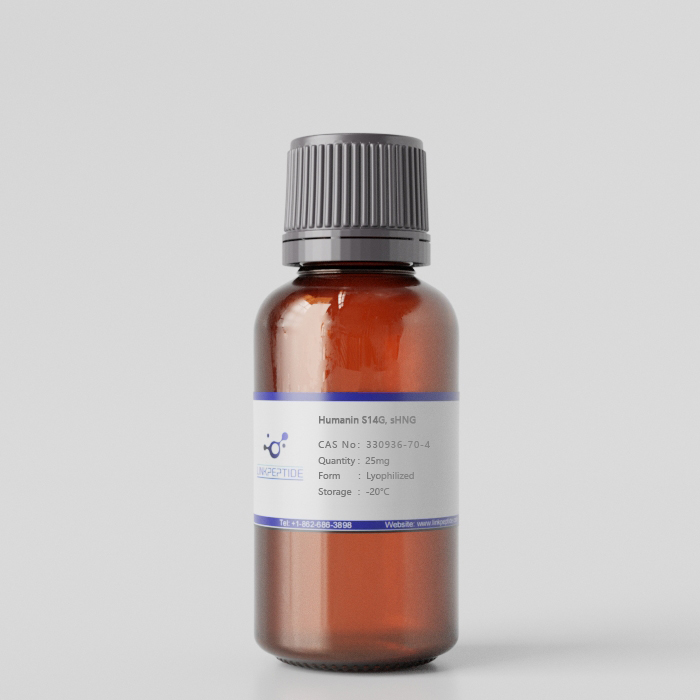
Product Name: Humanin S14G, sHNG
Sequence One Letter Code: MAPRGFSCLLLLTGEIDLPVKRRA
Sequence Three Letter Code: H-Met-Ala-Pro-Arg-Gly-Phe-Ser-Cys-Leu-Leu-Leu-Leu-Thr-Gly-Glu-Ile-Asp-Leu-Pro-Val-Lys-Arg-Arg-Ala-OH
Cas No: 330936-70-4
Chemical Formula:C118H202N34O31S2
Molecular Weight: 2657.3
Purity: 95%
Form: Lyophilized
Storage Conditions: - 20 °C
Research Area: Alzheimer's Disease
SMILES: CC[C@H](C)[C@@H](C(=O)N[C@@H](CC(=O)O)C(=O)N[C@@H](CC(C)C)C(=O)N1CCC[C@H]1C(=O)N[C@@H](C(C)C)C(=O)N[C@@H](CCCCN)C(=O)N[C@@H](CCCNC(=N)N)C(=O)N[C@@H](CCCNC(=N)N)C(=O)N[C@@H](C)C(=O)O)NC(=O)[C@H](CCC(=O)O)NC(=O)CNC(=O)[C@H]([C@@H](C)O)NC(=O)[C@H](CC(C)C)NC(=O)[C@H](CC(C)C)NC(=O)[C@H](CC(C)C)NC(=O)[C@H](CC(C)C)NC(=O)[C@H](CS)NC(=O)[C@H](CO)NC(=O)[C@H](CC2=CC=CC=C2)NC(=O)CNC(=O)[C@H](CCCNC(=N)N)NC(=O)[C@@H]3CCCN3C(=O)[C@H](C)NC(=O)[C@H](CCSC)N
IUPAC: (4S)-5-[[(2S,3S)-1-[[(2S)-1-[[(2S)-1-[(2S)-2-[[(2S)-1-[[(2S)-6-amino-1-[[(2S)-5-carbamimidamido-1-[[(2S)-5-carbamimidamido-1-[[(1S)-1-carboxyethyl]amino]-1-oxopentan-2-yl]amino]-1-oxopentan-2-yl]amino]-1-oxohexan-2-yl]amino]-3-methyl-1-oxobutan-2-yl]carbamoyl]pyrrolidin-1-yl]-4-methyl-1-oxopentan-2-yl]amino]-3-carboxy-1-oxopropan-2-yl]amino]-3-methyl-1-oxopentan-2-yl]amino]-4-[[2-[[(2S,3R)-2-[[(2S)-2-[[(2S)-2-[[(2S)-2-[[(2S)-2-[[(2R)-2-[[(2S)-2-[[(2S)-2-[[2-[[(2S)-2-[[(2S)-1-[(2S)-2-[[(2S)-2-amino-4-methylsulfanylbutanoyl]amino]propanoyl]pyrrolidine-2-carbonyl]amino]-5-carbamimidamidopentanoyl]amino]acetyl]amino]-3-phenylpropanoyl]amino]-3-hydroxypropanoyl]amino]-3-sulfanylpropanoyl]amino]-4-methylpentanoyl]amino]-4-methylpentanoyl]amino]-4-methylpentanoyl]amino]-4-methylpentanoyl]amino]-3-hydroxybutanoyl]amino]acetyl]amino]-5-oxopentanoic acid
INCHIKEY: WUYRHUFIUFJVQU-XJUNAYMOSA-N
INCHI:
InChI=1S/C118H202N34O31S2/c1-19-65(14)92(112(179)144-81(54-90(159)160)104(171)145-82(52-63(10)11)114(181)152-46-29-37-86(152)109(176)148-91(64(12)13)111(178)139-72(32-23-24-41-119)97(164)137-74(35-27-44-129-118(125)126)98(165)136-73(34-26-43-128-117(123)124)96(163)133-67(16)115(182)183)149-99(166)75(38-39-89(157)158)134-87(155)56-131-110(177)93(68(17)154)150-105(172)79(51-62(8)9)142-101(168)77(49-60(4)5)140-100(167)76(48-59(2)3)141-102(169)78(50-61(6)7)143-107(174)84(58-184)147-106(173)83(57-153)146-103(170)80(53-69-30-21-20-22-31-69)135-88(156)55-130-95(162)71(33-25-42-127-116(121)122)138-108(175)85-36-28-45-151(85)113(180)66(15)132-94(161)70(120)40-47-185-18/h20-22,30-31,59-68,70-86,91-93,153-154,184H,19,23-29,32-58,119-120H2,1-18H3,(H,130,162)(H,131,177)(H,132,161)(H,133,163)(H,134,155)(H,135,156)(H,136,165)(H,137,164)(H,138,175)(H,139,178)(H,140,167)(H,141,169)(H,142,168)(H,143,174)(H,144,179)(H,145,171)(H,146,170)(H,147,173)(H,148,176)(H,149,166)(H,150,172)(H,157,158)(H,159,160)(H,182,183)(H4,121,122,127)(H4,123,124,128)(H4,125,126,129)/t65-,66-,67-,68+,70-,71-,72-,73-,74-,75-,76-,77-,78-,79-,80-,81-,82-,83-,84-,85-,86-,91-,92-,93-/m0/s1
Source / Species: human
Conjugation: Unconjugated
Code Nacres: NA.26
Application: Humanin S14G (sHNG) is a potent analog of the mitochondrial-derived peptide humanin containing a serine-to-glycine substitution at position 14. This single amino acid modification markedly enhances cytoprotective and neuroprotective potency compared with native humanin. sHNG inhibits neuronal cell death triggered by amyloid-associated toxicity and other cellular stressors at nanomolar concentrations. The peptide is widely used in neurodegeneration research to investigate mitochondrial signaling, apoptosis suppression, and pro-survival pathways. It provides a robust tool for studying protective mechanisms relevant to Alzheimer’s disease and related neurodegenerative conditions.
Current Research: Humanin S14G (sHNG) is a potent synthetic analog of the mitochondrial-derived peptide humanin, incorporating a serine-to-glycine substitution at position 14. This single amino acid modification significantly enhances the peptide’s biological activity, increasing its cytoprotective and neuroprotective potency compared with native humanin. sHNG exhibits robust anti-apoptotic effects at nanomolar concentrations and is widely used in neurodegeneration research to investigate mitochondrial signaling and cellular survival mechanisms. Mitochondrial-Derived Peptide Biology Humanin belongs to a class of mitochondrial-derived peptides (MDPs) encoded within the mitochondrial genome. These peptides function as retrograde signaling molecules that communicate mitochondrial stress status to the nucleus and cytoplasm. Native humanin has been shown to protect cells against oxidative stress, excitotoxicity, and amyloid-induced toxicity. The S14G substitution enhances receptor affinity and stability, resulting in amplified biological effects. As a result, sHNG has become the preferred experimental analog for mechanistic studies. Mechanisms of Cytoprotection Humanin S14G exerts protective effects through multiple pathways. It interferes with pro-apoptotic signaling by binding to and inhibiting members of the Bcl-2 family, including Bax, thereby preventing mitochondrial outer membrane permeabilization and cytochrome c release. This inhibition suppresses caspase activation and apoptotic progression. In addition to direct mitochondrial protection, sHNG can activate cell-surface receptors, including a heterotrimeric receptor complex involving CNTFRα, WSX-1, and gp130. Engagement of this complex stimulates downstream JAK/STAT and PI3K/Akt signaling pathways, promoting transcription of pro-survival genes and enhancing cellular resilience. Neuroprotective Effects sHNG has demonstrated potent protective activity in neuronal cell models exposed to amyloid-associated toxicity, oxidative stress, and excitatory insults. In experimental systems relevant to Alzheimer’s disease, the peptide reduces amyloid β-induced apoptosis and preserves mitochondrial function. Observed neuroprotective effects include: Reduction of reactive oxygen species (ROS) Stabilization of mitochondrial membrane potential Inhibition of caspase activation Preservation of neuronal viability Because amyloid-related mitochondrial dysfunction is a key contributor to neurodegenerative pathology, sHNG provides a focused tool for dissecting protective signaling pathways. Applications in Neurodegeneration Research Humanin S14G is widely applied in: Amyloid toxicity models Mitochondrial stress assays Apoptosis pathway investigations Neuroinflammation studies Aging-related cellular resilience research Its enhanced potency allows effective signaling modulation at low concentrations, improving reproducibility in in vitro and in vivo systems. Broader Cytoprotective Roles Beyond neuroprotection, sHNG has been studied in contexts of metabolic stress, ischemia-reperfusion injury, and cardiovascular protection. Its ability to activate pro-survival pathways suggests a broader role in cellular stress adaptation and mitochondrial quality control. Emerging evidence links mitochondrial-derived peptides to longevity and metabolic regulation, positioning sHNG as a valuable reagent in aging research. Experimental Advantages Single amino acid modification enhancing potency Strong anti-apoptotic and cytoprotective activity Effective at nanomolar concentrations Suitable for neuronal and non-neuronal cell models Supports mechanistic analysis of mitochondrial signaling Research Significance Humanin S14G (sHNG) provides a powerful tool for investigating mitochondrial-derived peptide biology and apoptosis regulation. By enhancing the protective properties of native humanin, this analog enables detailed exploration of pro-survival signaling pathways relevant to Alzheimer’s disease and other neurodegenerative disorders. Its robust cytoprotective profile supports ongoing research into mitochondrial resilience, aging, and therapeutic modulation of cell survival mechanisms.
Get a Quote
 LinkPeptide