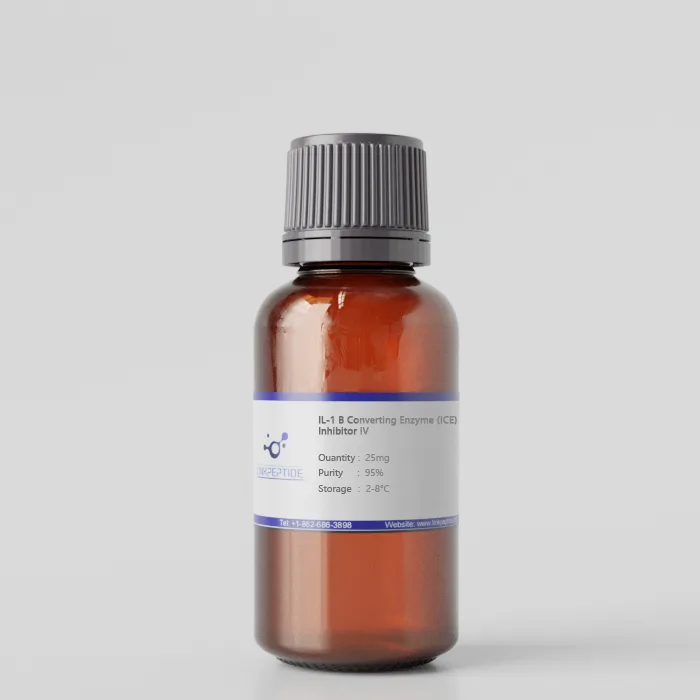
Product Name:IL-1 B Converting Enzyme (ICE) Inhibitor IV
Purity:95%
Storage:2-8 degree Celsius
Molar Mass:549.6
Chemical Formula:C26H39N5O8
Sequence:Ac-Tyr-Val-Lys-Asp-CHO
Application:
IL-1β Converting Enzyme (ICE) Inhibitor IV is a potent, cell-permeable inhibitor of caspase-1 (also known as IL-1β Converting Enzyme or ICE), a key regulator of inflammation and pyroptosis. By blocking caspase-1 activity, this inhibitor prevents the maturation of pro-inflammatory cytokines IL-1β and IL-18, making it valuable for studying inflammasome signaling pathways. It is widely used in research on autoimmune disorders, neuroinflammation, and metabolic diseases. ICE Inhibitor IV is instrumental in screening potential anti-inflammatory therapeutics and understanding caspase-1’s role in diseases such as rheumatoid arthritis, sepsis, and neurodegenerative conditions like Alzheimer’s disease.
Current Research:
Caspase-1, also known as IL-1β Converting Enzyme (ICE), is a crucial protease involved in innate immune responses, primarily through the activation of pro-inflammatory cytokines IL-1β and IL-18. Dysregulated caspase-1 activity contributes to inflammatory and autoimmune diseases, making it a key target for therapeutic intervention. ICE Inhibitor IV is widely used in research as a selective caspase-1 inhibitor to modulate inflammation and study inflammasome-driven pathologies.
- Role in Inflammatory and Autoimmune Diseases
Excessive caspase-1 activation leads to chronic inflammation, which underlies many autoimmune diseases such as rheumatoid arthritis (RA), systemic lupus erythematosus (SLE), and inflammatory bowel disease (IBD). Research utilizing ICE Inhibitor IV has demonstrated its ability to reduce IL-1β levels in experimental models of arthritis, preventing joint inflammation and tissue destruction. Similarly, in Crohn’s disease and ulcerative colitis, caspase-1 inhibition has been shown to alleviate gut inflammation by suppressing cytokine release.
- Applications in Neuroinflammation and Neurodegenerative Disorders
Caspase-1 is increasingly recognized as a contributor to neuroinflammatory processes in Alzheimer’s disease (AD), Parkinson’s disease (PD), and multiple sclerosis (MS). Studies using ICE Inhibitor IV have shown that blocking caspase-1 can prevent excessive IL-1β production, which is associated with β-amyloid plaque accumulation and neurotoxicity in AD. Furthermore, caspase-1 inhibition has been explored as a strategy to reduce neuroinflammation in MS models, where inflammasome activation contributes to demyelination and neuronal damage.
- Role in Metabolic and Cardiovascular Diseases
Chronic inflammation plays a significant role in metabolic disorders like type 2 diabetes (T2D) and atherosclerosis. Caspase-1 has been linked to insulin resistance and β-cell dysfunction, making ICE inhibition a potential therapeutic strategy for T2D. Studies using ICE Inhibitor IV have shown reduced inflammation and improved metabolic profiles in preclinical diabetes models. Similarly, in cardiovascular diseases, caspase-1 inhibition has been associated with decreased plaque formation and reduced risk of myocardial infarction by targeting IL-1β-driven vascular inflammation.
- Therapeutic Potential in Infectious Diseases and Sepsis
Severe infections and sepsis involve excessive immune activation, often leading to a cytokine storm. Caspase-1-mediated pyroptosis contributes to immune dysregulation in sepsis, making ICE inhibitors potential candidates for therapeutic intervention. Preclinical studies have shown that ICE Inhibitor IV can attenuate cytokine-induced organ damage, improving survival rates in sepsis models.
Conclusion
ICE Inhibitor IV is a vital tool in studying caspase-1’s role in inflammation-related diseases, including autoimmune, neurodegenerative, metabolic, and infectious conditions. Its use in preclinical research highlights its therapeutic potential in targeting excessive IL-1β activation, paving the way for novel anti-inflammatory drug development.
 LinkPeptide