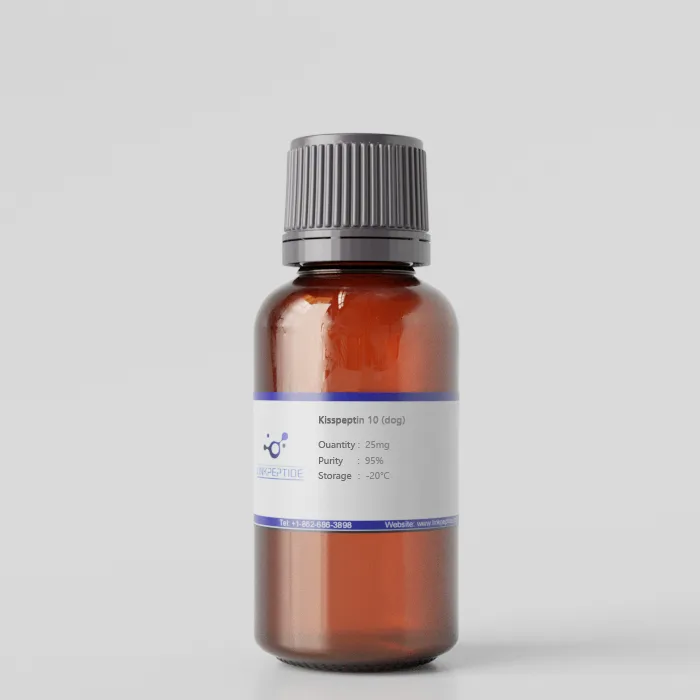
Product Name:Kisspeptin 10 (dog)
Purity:95%
Molar Mass:1330.51
Chemical Formula:C65H87N17O14
Storage:Store at -20 degrees Celsius
Sequence:YNWNVFGLRY
Target:canine KISS1 receptor
Application:Kisspeptin 10 (dog) is a decapeptide that belongs to the kisspeptin family, known for its role in regulating reproductive hormones. This specific peptide is derived from dogs and plays a critical role in the modulation of the hypothalamic-pituitary-gonadal (HPG) axis. It stimulates the release of gonadotropin-releasing hormone (GnRH), leading to the secretion of luteinizing hormone (LH) and follicle-stimulating hormone (FSH), which are essential for reproductive function. Kisspeptin 10 is a key player in the control of puberty onset, fertility, and reproductive behaviors, making it valuable for research in veterinary endocrinology and reproductive biology.
Current Research:
Kisspeptin-10 (KP-10) is a decapeptide derived from the C-terminal region of the kisspeptin protein, serving as a critical endogenous ligand for the kisspeptin receptor (KISS1R or GPR54). In canines, KP-10 plays a pivotal role in regulating reproductive hormone secretion and the hypothalamic-pituitary-gonadal axis, making it an essential molecule for both research and therapeutic applications.
Structure and Conservation
The amino acid sequence of canine KP-10, Tyr-Asn-Trp-Asn-Val-Phe-Gly-Leu-Arg-Tyr-NH?, is highly conserved across species. This conservation reflects the fundamental role of kisspeptins in reproductive physiology. The peptide structure is critical for binding and activating KISS1R, initiating downstream signaling pathways that regulate reproductive hormones.
Mechanism and Function
Kisspeptin-10 stimulates the release of luteinizing hormone (LH), follicle-stimulating hormone (FSH), and estradiol by acting on GnRH neurons in the hypothalamus. This activation promotes the secretion of gonadotropins, essential for reproductive processes such as ovulation and spermatogenesis. In canine models, administration of KP-10 has been shown to effectively trigger these hormonal cascades, underscoring its importance in fertility regulation.
Beyond Reproduction
Emerging research highlights additional roles for KP-10, particularly in oncology. Kisspeptin-10 downregulates CXCR4-mediated signaling, which is involved in tumor metastasis. By inhibiting stromal cell-derived factor 1 (SDF-1)-induced chemotaxis and signaling, KP-10 demonstrates potential as a therapeutic agent for mitigating cancer metastasis.
Research and Applications
Canine Kisspeptin-10 is a valuable tool for studying reproductive biology, with potential therapeutic applications in treating infertility and cancer. Its ability to modulate key hormonal and metastatic pathways continues to make it a focus of both veterinary and medical research.
Reference:
Get a Quote
 LinkPeptide