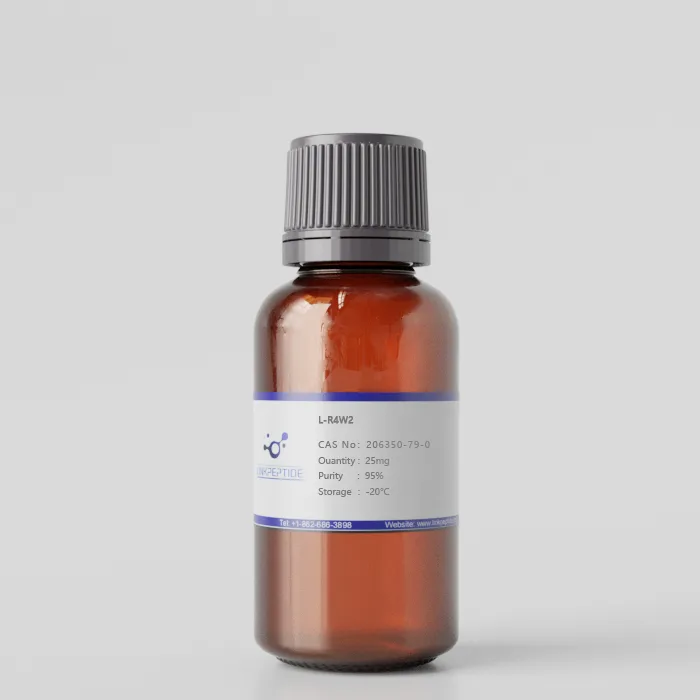
Product Name:L-R4W2
CAS No:206350-79-0
Purity:95%
Molar Mass:1014.2
Chemical Formula:C46H71N21O6
Storage:Store at -20 degrees Celsius
Sequence:RRRRWW
Application:
L-R4W2 is a synthetic peptide designed with a sequence containing leucine (L), four arginine (R) residues, and two tryptophan (W) residues. This specific arrangement enhances its ability to interact with cellular membranes, making it a useful tool in research focused on cell-penetrating peptides (CPPs) and antimicrobial peptides (AMPs). L-R4W2 is often employed in studies exploring mechanisms of cellular uptake, protein-protein interactions, and the development of novel drug delivery systems. Its unique properties also make it valuable in antimicrobial research, where it can help in designing new therapeutic agents with improved efficacy and targeted action.
Current Research:
L-R4W2, also known as RRRRWW-NH₂, is a synthetic hexapeptide composed of four arginine (R) residues followed by two tryptophan (W) residues, terminating with a C-terminal amide group. This peptide functions as a potent antagonist of the transient receptor potential vanilloid 1 (TRPV1) receptor, also referred to as the vanilloid receptor 1 (VR1). It exhibits an inhibitory concentration (IC₅₀) of approximately 0.1 μM, indicating high efficacy in blocking TRPV1 activity.
TRPV1 receptors are integral membrane proteins that play a crucial role in detecting and regulating body temperature and pain perception. They are activated by various stimuli, including capsaicin (the active component in chili peppers), heat, and acidic conditions. By antagonizing these receptors, L-R4W2 can inhibit calcium ion influx in dorsal root ganglion neurons, which are pivotal in transmitting pain signals. This mechanism suggests that L-R4W2 has potential applications in pain management.
Research has demonstrated that L-R4W2 effectively blocks TRPV1-mediated responses. For instance, studies have shown that this peptide can inhibit capsaicin-induced calcium influx in sensory neurons, thereby attenuating pain-related behaviors in animal models. These findings highlight the potential of L-R4W2 as a therapeutic agent for conditions involving TRPV1 activation, such as inflammatory pain and hyperalgesia.
In summary, L-R4W2 is a synthetic peptide that serves as a potent TRPV1 antagonist. Its ability to inhibit TRPV1 activity positions it as a promising candidate for developing new analgesic therapies targeting pain pathways mediated by this receptor.
Reference:
Get a Quote
 LinkPeptide