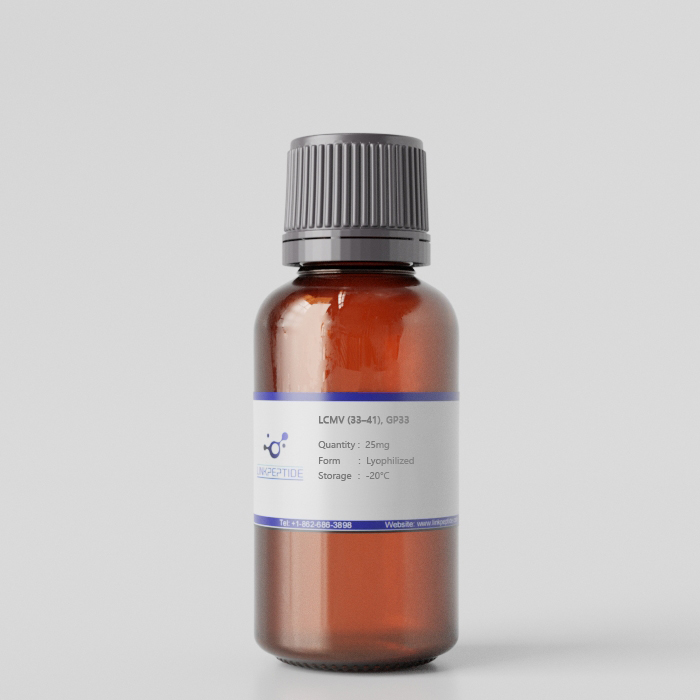
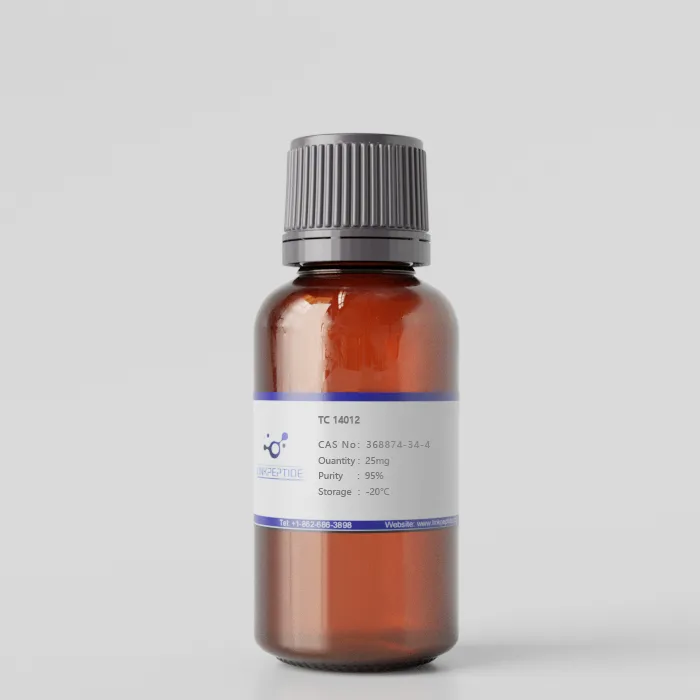
Product Name: LCMV (33–41), GP33
Sequence One Letter Code: KAVYNFATC
Sequence Three Letter Code: H-Lys-Ala-Val-Tyr-Asn-Phe-Ala-Thr-Cys-OH
Chemical Formula:C46H69N11O13S1
Molecular Weight: 1016.2
Purity: 95%
Form: Lyophilized
Storage Conditions: - 20 °C
Research Area: Inflammation and Immunology Research
Source / Species: LCMV
Conjugation: Unconjugated
Code Nacres: NA.26
Application: LCMV GP33 (33–41) is a synthetic nonamer peptide derived from residues 33–41 of the lymphocytic choriomeningitis virus glycoprotein. It is a well-characterized H-2Dᵇ–restricted CD8⁺ T cell epitope that induces strong cytotoxic T lymphocyte (CTL) responses in murine models. As a dominant viral antigen, GP33 is extensively used in cellular immunology to study antigen processing, MHC class I presentation, T cell receptor specificity, clonal expansion, and effector differentiation. It plays a central role in experimental systems analyzing immune memory formation, exhaustion, and viral clearance kinetics. GP33-specific tetramers are commonly used to track antigen-specific CD8⁺ T cells in vivo. The peptide is also valuable in adoptive transfer studies and TCR transgenic models. Owing to its reproducibility and well-defined immunogenic properties, LCMV GP33 remains a gold-standard model antigen for mechanistic studies of antiviral immunity and CD8⁺ T cell biology.
Current Research: LCMV GP33 (33–41) continues to serve as a foundational model epitope in modern T cell immunology. Derived from the glycoprotein of lymphocytic choriomeningitis virus (LCMV), this H-2Dᵇ–restricted nonamer peptide elicits robust and highly reproducible CD8⁺ cytotoxic T lymphocyte (CTL) responses in C57BL/6 mice. Because of its strong immunodominance and well-characterized T cell receptor (TCR) interactions, GP33 has become a benchmark antigen for dissecting the molecular and cellular mechanisms governing antiviral immunity. Recent research has leveraged GP33 to investigate the dynamics of acute versus chronic viral infection. In acute LCMV Armstrong infection, GP33-specific CD8⁺ T cells undergo rapid clonal expansion, acquire effector functions such as IFN-γ and granzyme B production, and subsequently form long-lived memory populations. In contrast, during chronic LCMV Clone 13 infection, persistent antigen exposure drives progressive T cell exhaustion, characterized by upregulation of inhibitory receptors including PD-1, TIM-3, and LAG-3, reduced cytokine production, and altered metabolic programming. GP33-specific T cells are central to defining transcriptional and epigenetic signatures of exhaustion, particularly involving TOX, TCF-1, and chromatin remodeling pathways. The peptide is also widely used in tetramer-based tracking systems to quantify antigen-specific CD8⁺ T cells in vivo. GP33–MHC class I tetramers enable high-resolution phenotyping of effector, memory precursor, central memory, and tissue-resident memory (T_RM) subsets. These tools have supported studies of memory differentiation, homeostatic proliferation, and recall responses following secondary challenge. Single-cell RNA sequencing and TCR repertoire analyses of GP33-specific populations have further refined understanding of clonal selection and lineage commitment. Adoptive transfer models using GP33-specific TCR transgenic mice, such as P14 cells, remain instrumental for mechanistic experiments. These systems allow precise manipulation of precursor frequency, gene editing, metabolic pathways, and signaling components to evaluate their roles in activation, differentiation, and persistence. GP33-based platforms have also been used extensively to study immune checkpoint blockade, providing preclinical insight into PD-1/PD-L1 pathway inhibition and its effects on reinvigorating exhausted T cells. Beyond virology, GP33 has been incorporated into tumor and vaccine models as a defined neoantigen surrogate, enabling controlled evaluation of antigen presentation, cross-priming, and immunotherapeutic strategies. Its consistent immunogenicity and extensive validation across experimental systems ensure continued relevance. Overall, LCMV GP33 (33–41) remains a gold-standard epitope for investigating CD8⁺ T cell activation, differentiation, exhaustion, memory formation, and immunotherapeutic modulation in antiviral and translational immunology research.
Get a Quote
 LinkPeptide