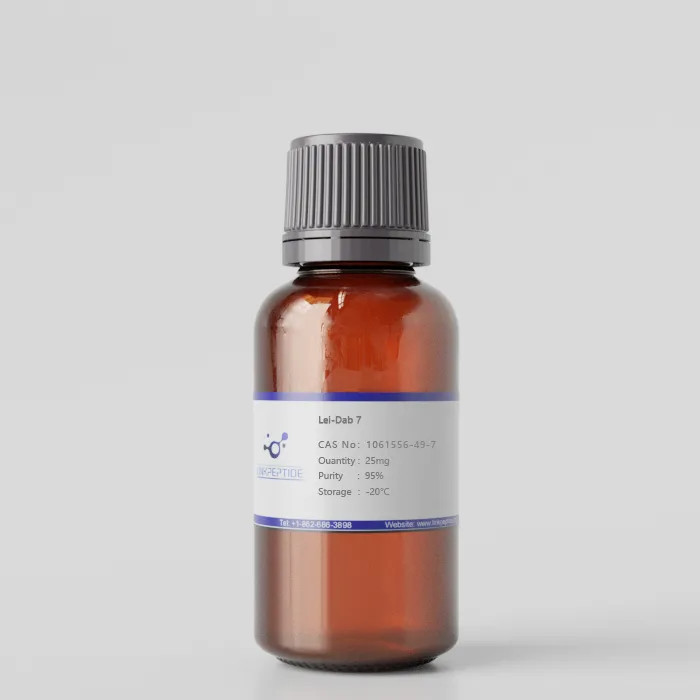
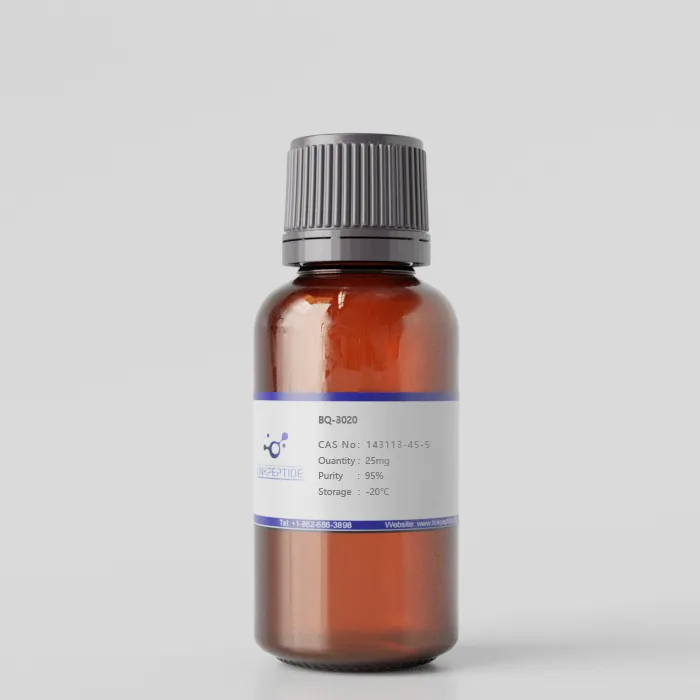
Product Name:Lei-Dab 7
CAS No:1061556-49-7
Purity:95%
Molar Mass:3392.06
Chemical Formula:C141H236N46O39S6
Storage:Store at -20 degrees Celsius
Sequence:AFCNLR-{Dab}-CQLSCRSLGLLGKCIGDKCECVKH-NH2
Target:K2 (KCa2.2) channels blocker
Application:Lei-Dab 7 is a synthetic peptide derived from toxins found in the venom of the scorpion Leiurus quinquestriatus. It targets potassium channels, particularly Kv1.1, Kv1.2, and Kv1.3, and acts as a potent blocker of these voltage-gated channels. By inhibiting potassium channel activity, Lei-Dab 7 has been studied for its potential applications in immunology, especially regarding T cell function, and in research related to autoimmune diseases where Kv1.3 channels play a role. This peptide is also valuable in exploring neurological conditions where potassium channel regulation is critical for maintaining neuronal excitability and signaling.
Current Research:
Lei-Dab 7 is a synthetic peptide derived from leiurotoxin I, a component of the venom from the scorpion Leiurus quinquestriatus hebraeus. This engineered peptide functions as a potent and selective inhibitor of small conductance calcium-activated potassium channels, specifically the SK2 subtype (KCa2.2).
Structural Modification and Selectivity
The key modification in Lei-Dab 7 involves substituting the seventh amino acid, methionine, in leiurotoxin I with diaminobutyric acid (Dab). This alteration significantly enhances the peptide's selectivity for SK2 channels, achieving over 200-fold selectivity compared to other related channels such as SK1 (KCa2.1), SK3 (KCa2.3), intermediate conductance potassium channels (IK or KCa3.1), voltage-gated potassium channels (Kv), and inwardly rectifying potassium channels (Kir2.1). The dissociation constant (K_d) for SK2 channels is approximately 3.8 nM, indicating high affinity.
Mechanism of Action
Lei-Dab 7 binds to the external vestibule of SK2 channels, effectively blocking potassium ion conduction. This inhibition modulates neuronal excitability by affecting the afterhyperpolarization phase of action potentials, which is crucial for regulating neuronal firing rates and synaptic plasticity.
Research Applications
Due to its high specificity and potency, Lei-Dab 7 is a valuable tool in neurophysiological research. It has been utilized to investigate the role of SK2 channels in synaptic plasticity and memory formation. For instance, studies have shown that blocking SK2 channels with Lei-Dab 7 can enhance long-term potentiation (LTP) in rat hippocampal slices, suggesting a significant role for these channels in learning and memory processes.
In Vivo Effects
Intracerebroventricular administration of Lei-Dab 7 in animal models has been reported to decrease locomotor activity, food intake, and body weight in food-deprived rats, indicating its potential influence on central nervous system functions. Notably, these effects were observed without gross central nervous system toxicity at concentrations that specifically blocked SK2 homotetramers.
Conclusion
Lei-Dab 7 serves as a potent and selective inhibitor of SK2 channels, offering significant utility in exploring the physiological and pathological roles of these channels in the central nervous system. Its application in research continues to provide insights into neuronal excitability, synaptic plasticity, and associated behavioral outcomes.
Reference:
Get a Quote
 LinkPeptide