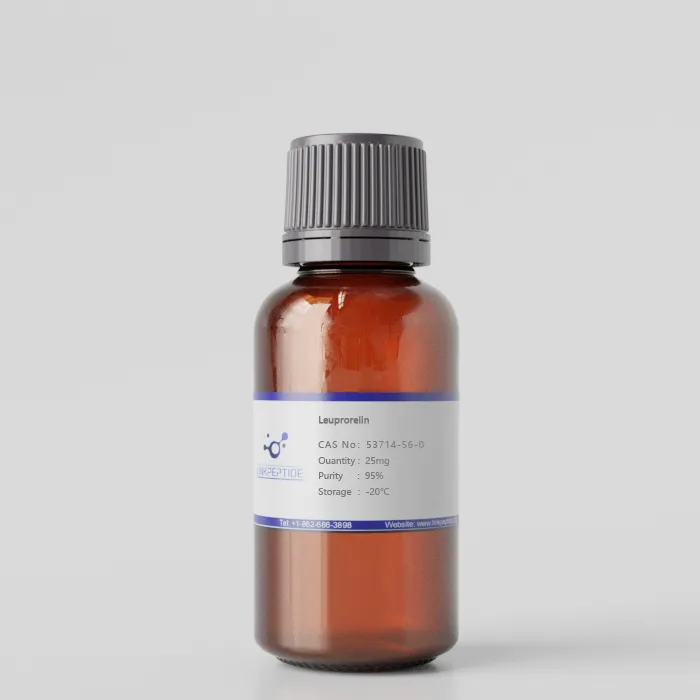
Product Name:Leuprorelin
Form:Acetate salt
Purity:95%
Storage:-20oC
Cas No:53714-56-0
Molar Mass:1209.4
Chemical Formula:C59H84N16O12
Synonyms:leuprolide
IUPAC Name:(2S)-N-[(2S)-1-[[(2S)-1-[[(2S)-1-[[(2S)-1-[[(2R)-1-[[(2S)-1-[[(2S)-5-(diaminomethylideneamino)-1-[(2S)-2-(ethylcarbamoyl)pyrrolidin-1-yl]-1-oxopentan-2-yl]amino]-4-methyl-1-oxopentan-2-yl]amino]-4-methyl-1-oxopentan-2-yl]amino]-3-(4-hydroxyphenyl)-1-oxopropan-2-yl]amino]-3-hydroxy-1-oxopropan-2-yl]amino]-3-(1H-indol-3-yl)-1-oxopropan-2-yl]amino]-3-(1H-imidazol-5-yl)-1-oxopropan-2-yl]-5-oxopyrrolidine-2-carboxamide
SMILES:CCNC(=O)[C@@H]1CCCN1C(=O)[C@H](CCCN=C(N)N)NC(=O)[C@H](CC(C)C)NC(=O)[C@@H](CC(C)C)NC(=O)[C@H](CC2=CC=C(C=C2)O)NC(=O)[C@H](CO)NC(=O)[C@H](CC3=CNC4=CC=CC=C43)NC(=O)[C@H](CC5=CN=CN5)NC(=O)[C@@H]6CCC(=O)N6
InChIKey:GFIJNRVAKGFPGQ-LIJARHBVSA-N
InChI:InChI=1S/C59H84N16O12/c1-6-63-57(86)48-14-10-22-75(48)58(87)41(13-9-21-64-59(60)61)68-51(80)42(23-32(2)3)69-52(81)43(24-33(4)5)70-53(82)44(25-34-15-17-37(77)18-16-34)71-56(85)47(30-76)74-54(83)45(26-35-28-65-39-12-8-7-11-38(35)39)72-55(84)46(27-36-29-62-31-66-36)73-50(79)40-19-20-49(78)67-40/h7-8,11-12,15-18,28-29,31-33,40-48,65,76-77H,6,9-10,13-14,19-27,30H2,1-5H3,(H,62,66)(H,63,86)(H,67,78)(H,68,80)(H,69,81)(H,70,82)(H,71,85)(H,72,84)(H,73,79)(H,74,83)(H4,60,61,64)/t40-,41-,42-,43+,44-,45-,46-,47-,48-/m0/s1
Sequence:XHWSYLLRP
Target:GnRH
Application:Leuprorelin, also known as leuprolide acetate, is a gonadotropin-releasing hormone (GnRH) agonist used to suppress gonadotropin secretion, leading to decreased testosterone and estrogen levels. It is widely used in hormone-sensitive cancers such as prostate cancer and breast cancer, as well as in conditions like endometriosis, uterine fibroids, and central precocious puberty (CPP). Leuprorelin is also investigated for its role in infertility treatments and transgender hormone therapy. Current research explores its applications in neurodegenerative diseases, osteoporosis prevention, and metabolic disorders, expanding its potential beyond endocrinology and oncology into aging-related and neurological conditions.
Current Research:Leuprorelin is a long-acting GnRH agonist that functions by initially stimulating, then downregulating, the pituitary gland??s secretion of luteinizing hormone (LH) and follicle-stimulating hormone (FSH). This suppresses the production of testosterone and estrogen, making it a widely used therapy for hormone-sensitive diseases. While its primary clinical applications are in oncology, gynecology, and endocrinology, emerging research is exploring neurological, metabolic, and inflammatory disorders. Prostate Cancer and Androgen Deprivation Therapy (ADT) Leuprorelin is a mainstay in androgen deprivation therapy (ADT) for advanced prostate cancer. Tumor progression control: By reducing testosterone, Leuprorelin slows tumor growth and metastasis. Intermittent vs. continuous ADT: Current studies compare intermittent ADT regimens with continuous therapy to minimize side effects such as osteoporosis and cardiovascular risks. Combination therapies: Research explores Leuprorelin with antiandrogens and immunotherapy to enhance cancer treatment efficacy. Breast Cancer and Estrogen-Sensitive Tumors Leuprorelin is used in hormone-receptor-positive (HR+) premenopausal breast cancer as part of ovarian suppression therapy. Adjunct to aromatase inhibitors: It is commonly used with aromatase inhibitors (e.g., letrozole, anastrozole) to enhance hormonal blockade. Long-term impact on bone health and cardiovascular function is being studied to optimize therapy duration. Endometriosis and Gynecological Disorders Leuprorelin effectively treats estrogen-dependent conditions such as: Endometriosis: By suppressing estrogen, it helps reduce pain and lesion growth. New research is evaluating add-back therapy (low-dose estrogen/progestin) to minimize side effects. Uterine fibroids: Studies show that Leuprorelin shrinks fibroid size before surgery, improving outcomes. Polycystic ovary syndrome (PCOS): Investigations focus on Leuprorelin??s role in modulating LH/FSH imbalance in PCOS. Pediatric Endocrinology: Central Precocious Puberty (CPP) Leuprorelin is a first-line treatment for CPP, delaying early puberty by suppressing gonadotropin release. Long-term fertility and bone health effects in CPP-treated individuals are a focus of current research. Neurodegenerative and Neurological Research Recent studies suggest Leuprorelin may have neuroprotective effects, particularly in: Alzheimer??s disease (AD): Research indicates that Leuprorelin may reduce beta-amyloid accumulation and improve cognitive function. Parkinson??s disease (PD): Leuprorelin has been studied for its potential to modulate dopamine signaling and slow disease progression. Osteoporosis and Metabolic Health Since GnRH suppression affects bone metabolism, Leuprorelin is being studied for its impact on bone density and strategies to prevent osteoporosis in long-term users. Bone-protective strategies: Studies suggest bisphosphonates and selective estrogen receptor modulators (SERMs) may counteract Leuprorelin-induced bone loss. Metabolic implications: Research explores Leuprorelin??s effects on insulin resistance and lipid metabolism in long-term users. Emerging Research Areas Transgender hormone therapy: Used as part of puberty suppression in gender-affirming care. Chronic inflammatory diseases: Potential role in immune modulation and inflammatory pain conditions. Fertility preservation: Studies assess its role in gonadotoxicity prevention during chemotherapy. As research expands, Leuprorelin??s applications in neurodegeneration, endocrinology, and oncology continue to evolve, offering potential breakthroughs in cancer therapy, reproductive health, and neuroprotection.
Get a Quote
 LinkPeptide