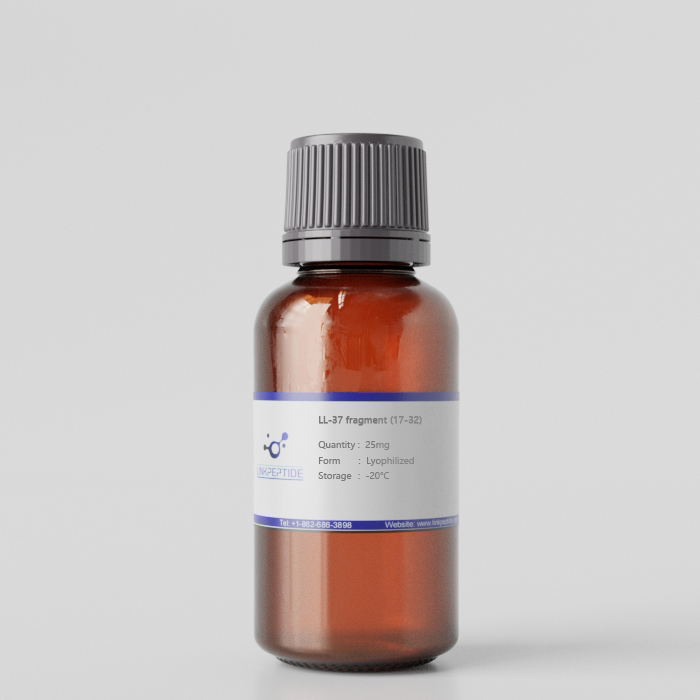
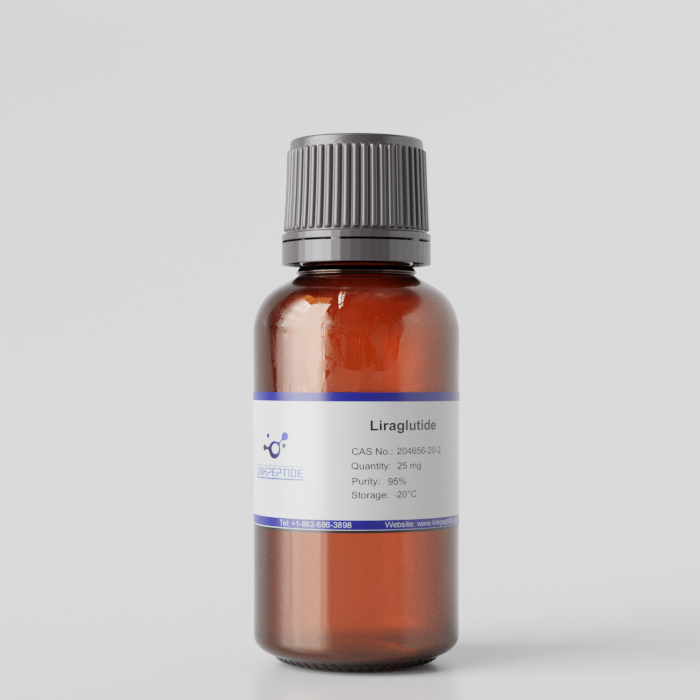
Product Name: LL-37 fragment (17-32)
Sequence One Letter Code: FKRIVQRIKDFLRNLV
Sequence Three Letter Code: H-Phe-Lys-Arg-Ile-Val-Gln-Arg-Ile-Lys-Asp-Phe-Leu-Arg-Asn-Leu-Val-OH
Chemical Formula:C95H161N29O21
Molecular Weight: 2045.6
Purity: 95%
Form: Lyophilized
Storage Conditions: - 20 °C
Research Area: Cancer Disease Research
Source / Species: human
Conjugation: Unconjugated
Code Nacres: NA.26
Application: LL-37 Fragment (17–32) is a bioactive peptide derived from the central region of the human antimicrobial peptide LL-37. This fragment retains distinct biological activities and has been shown to modulate cellular signaling pathways. Notably, LL-37 (17–32) can reverse ABCG2-mediated multidrug resistance in cancer cells, suggesting a role in drug transport regulation. In addition to its antimicrobial properties, it interacts with cellular membranes and signaling networks. This peptide is widely used in research on antimicrobial peptide fragments, cancer biology, and membrane dynamics, as well as in studies exploring mechanisms of chemotherapy resistance and intracellular signaling modulation.
Current Research: LL-37 Fragment (17–32) is a bioactive peptide derived from the central region of the human cathelicidin LL-37, a key component of the innate immune system. While shorter than the full-length peptide, this fragment retains distinct biological activities, including antimicrobial effects and the ability to modulate cellular signaling pathways. Its defined sequence and functional versatility make it a valuable tool in studies of host defense peptides, membrane interactions, and cancer biology. Origin and Structural Characteristics LL-37 is the only human cathelicidin-derived antimicrobial peptide and plays a major role in innate immune defense. The (17–32) fragment corresponds to a central segment of LL-37 that contributes to: Amphipathic structure, enabling interaction with lipid membranes Cationic charge, facilitating binding to negatively charged surfaces Membrane-active properties, important for antimicrobial and signaling functions Despite its reduced length, LL-37 (17–32) maintains structural features that allow it to interact with both microbial membranes and mammalian cells. Antimicrobial and Membrane-Active Properties Like the parent peptide, LL-37 Fragment (17–32) exhibits membrane-targeting activity, which underlies its antimicrobial effects. It can: Associate with and disrupt microbial membranes Alter membrane permeability Interfere with pathogen viability These properties make it useful for studying mechanisms of antimicrobial peptide action, particularly in simplified systems focusing on functional domains of larger peptides. Modulation of Cellular Signaling Beyond antimicrobial activity, LL-37 (17–32) is known to influence intracellular signaling pathways. It can interact with cell membranes and receptors, leading to: Activation or modulation of signaling cascades Changes in gene expression and cellular responses Regulation of transport and stress-related pathways These signaling effects highlight its role as more than a simple antimicrobial agent, positioning it as a modulator of cellular function. Role in Multidrug Resistance and Cancer Biology One of the most notable findings associated with LL-37 Fragment (17–32) is its ability to reverse ABCG2-mediated multidrug resistance (MDR) in cancer cells. ABCG2 is a membrane transporter that actively effluxes chemotherapeutic agents, contributing to reduced drug efficacy. LL-37 (17–32) has been shown to: Inhibit or modulate ABCG2 transporter activity Increase intracellular accumulation of chemotherapeutic drugs Enhance sensitivity of cancer cells to treatment These properties make the peptide highly relevant for studying drug resistance mechanisms and potential therapeutic strategies. Applications in Research LL-37 Fragment (17–32) is widely used across multiple research areas due to its multifunctional nature. Common applications include: Studies of antimicrobial peptide fragments and structure–function relationships Investigation of membrane–peptide interactions and lipid dynamics Analysis of intracellular signaling pathways modulated by peptides Research on multidrug resistance and drug transporter regulation Cancer biology studies focusing on chemotherapy sensitization Its defined sequence allows researchers to isolate the effects of a specific functional domain within LL-37. Advantages as a Model Peptide Fragment Compared to the full-length LL-37, the (17–32) fragment offers several practical and experimental advantages: Simplified structure for mechanistic studies Retention of key functional activities Improved suitability for targeted assays Reduced complexity in interpreting results These features make it an effective tool for dissecting specific biological functions of antimicrobial peptides. A Versatile Tool for Studying Membrane Dynamics and Drug Resistance LL-37 Fragment (17–32) bridges the fields of innate immunity and cancer research, providing insights into both membrane disruption mechanisms and cellular transport regulation. Its ability to modulate ABCG2-mediated drug resistance highlights its potential relevance in chemotherapy research and therapeutic development. By supporting studies of antimicrobial activity, signaling modulation, and multidrug resistance, this peptide fragment continues to contribute to a deeper understanding of host defense mechanisms and cancer cell biology.
Get a Quote
 LinkPeptide