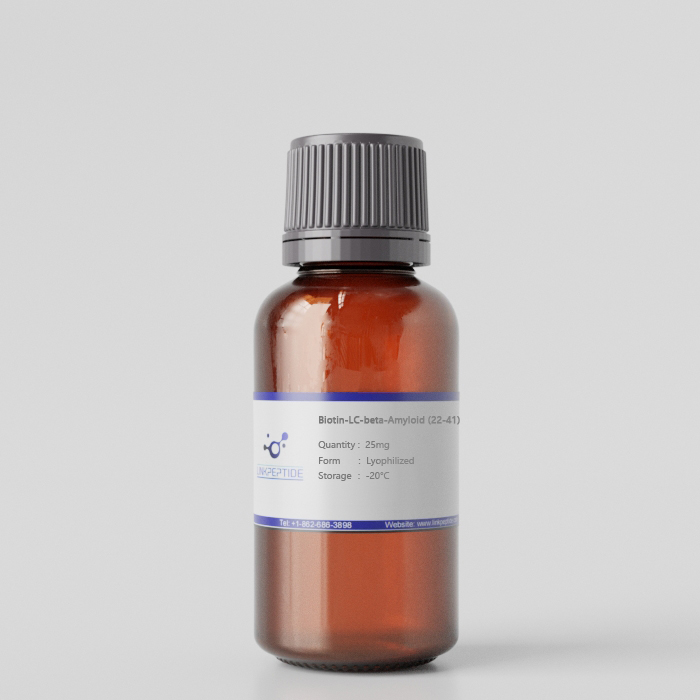
Product Name: [Lys(Ac)20]-Histone H4 (1-25)-GSGSK(Biotin)
Sequence One Letter Code: SGRGKGGKGLGKGGAKRHR-K(Ac)-VLRDN-GSGSK(Biotin)
Sequence Three Letter Code: H-Ser-Gly-Arg-Gly-Lys-Gly-Gly-Lys-Gly-Leu-Gly-Lys-Gly-Gly-Ala-Lys-Arg-His-Arg-Lys(Ac)-Val-Leu-Arg-Asp-Asn-Gly-Ser-Gly-Ser-Lys(Biotin)-OH
Molecular Weight: 3274.9
Purity: 95%
Form: Lyophilized
Storage Conditions: - 20 °C
Research Area: epigenetics
Source / Species: human
Conjugation: Conjugated
Conjugation Type: Biotins
Code Nacres: NA.26
Application: [Lys(Ac)20]-Histone H4 (1–25)-GSGSK(Biotin) is a synthetic peptide representing the N-terminal 25 amino acids of histone H4 with site-specific acetylation at lysine 20. Histone acetylation is a key post-translational modification that regulates chromatin structure and transcriptional activity by reducing histone–DNA interactions and promoting recruitment of acetyl-lysine binding proteins. Acetylation at H4K20 has been implicated in chromatin organization, DNA damage response, and transcriptional control. The peptide also contains a C-terminal GSGSK linker with a biotin tag, enabling efficient affinity capture and detection in streptavidin-based assays. This peptide is commonly used in pull-down experiments and interaction studies to investigate acetylation-dependent chromatin regulation and protein recognition mechanisms.
Current Research: Histone acetylation is one of the most important post-translational modifications controlling chromatin structure and gene expression. By neutralizing the positive charge of lysine residues, acetylation reduces the strength of histone–DNA interactions and facilitates the recruitment of chromatin-associated proteins that regulate transcription. Synthetic histone peptides containing specific acetylation marks provide powerful tools for dissecting these regulatory mechanisms. [Lys(Ac)20]-Histone H4 (1–25)-GSGSK(Biotin) is a synthetic peptide corresponding to the N-terminal 25 amino acids of histone H4, featuring site-specific acetylation at lysine 20 (H4K20Ac). The peptide also includes a C-terminal GSGSK linker with a biotin tag, enabling efficient immobilization and enrichment in streptavidin-based experimental systems. This design allows researchers to analyze acetylation-dependent protein interactions and chromatin regulatory pathways in a controlled experimental context. Histone H4 and the Role of the N-Terminal Tail Histone H4 is one of the four core histone proteins that assemble into nucleosomes, the structural units that package DNA into chromatin. In nucleosomes, DNA wraps around an octamer composed of histones H2A, H2B, H3, and H4, forming a dynamic structure that regulates genome accessibility. The N-terminal tail of histone H4, encompassing roughly the first 20–30 amino acids, extends outward from the nucleosome surface and functions as a key regulatory platform. This region contains multiple lysine residues that undergo post-translational modifications such as acetylation, methylation, and phosphorylation. These modifications influence chromatin organization by altering histone–DNA interactions and by recruiting regulatory proteins that control transcription, DNA repair, and chromatin remodeling. Because of its central regulatory role, the histone H4 N-terminal region is frequently used in biochemical studies investigating epigenetic signaling pathways. Biological Significance of H4K20 Acetylation Lysine 20 of histone H4 (H4K20) is a well-characterized modification site that can undergo multiple modification states, including methylation and acetylation. While H4K20 methylation has been extensively studied, acetylation at H4K20 (H4K20Ac) has also been associated with important chromatin regulatory processes. Acetylation of lysine residues neutralizes their positive charge, weakening electrostatic interactions between histones and the negatively charged DNA backbone. This effect promotes a more open chromatin structure that allows transcription factors and regulatory complexes to access DNA. Research has linked H4K20 acetylation to several biological processes, including: Regulation of chromatin organization Coordination of DNA damage response pathways Control of transcriptional activity Modulation of nucleosome stability Like other histone acetylation marks, H4K20Ac can serve as a recognition signal for proteins containing acetyl-lysine binding domains, such as bromodomains, which help recruit transcriptional coactivators and chromatin remodeling complexes. Design of the GSGSK(Biotin) Peptide The [Lys(Ac)20]-Histone H4 (1–25)-GSGSK(Biotin) peptide is engineered to preserve the native histone sequence surrounding the modification site while incorporating features that facilitate biochemical assays. Key structural components include: Histone H4 residues 1–25, representing the regulatory N-terminal tail Acetylation at lysine 20, mimicking the H4K20Ac epigenetic modification A C-terminal GSGSK linker, providing flexible separation between the peptide and the affinity tag Biotin conjugation at the lysine residue, enabling capture through streptavidin binding The GSGSK linker helps ensure that the biotin tag remains accessible without interfering with protein recognition of the histone sequence. Advantages of Biotinylated Histone Peptides Biotinylation is widely used in molecular biology because the interaction between biotin and streptavidin is extremely strong and specific. This interaction enables peptides to be immobilized reliably on assay platforms such as beads, plates, or biosensor surfaces. For histone peptides, biotinylation provides several advantages: Pull-down assays to identify acetylation-dependent binding proteins Affinity purification of chromatin-associated complexes Stable immobilization for biochemical and biophysical studies Compatibility with proteomics workflows, including mass spectrometry These features make biotinylated histone peptides highly effective tools for studying protein–histone interactions. Applications in Chromatin and Epigenetics Research The [Lys(Ac)20]-Histone H4 (1–25)-GSGSK(Biotin) peptide is commonly used in experiments investigating acetylation-dependent chromatin regulation. Typical applications include: Protein interaction studies Researchers use the peptide in pull-down assays to identify proteins that recognize the H4K20Ac modification. Chromatin remodeling research The peptide helps investigate how acetylated histone tails influence the recruitment of chromatin remodeling complexes. Acetyl-lysine recognition analysis Scientists can examine how bromodomain-containing proteins and other acetyl-lysine readers interact with modified histone substrates. DNA damage response studies Because H4K20 modifications are involved in genome maintenance, the peptide can be used to explore pathways associated with chromatin responses to DNA damage. Supporting Research on Acetylation-Dependent Chromatin Regulation Histone acetylation is a key component of the epigenetic system that governs gene expression and chromatin organization. Understanding how specific acetylation marks influence chromatin-associated protein recruitment is essential for deciphering these regulatory networks. The [Lys(Ac)20]-Histone H4 (1–25)-GSGSK(Biotin) peptide provides a convenient experimental platform for studying these processes. By combining a defined histone acetylation mark with a biotin affinity tag, the peptide enables efficient interaction studies and biochemical assays that help researchers explore how acetylation-dependent signaling pathways regulate chromatin structure and transcriptional activity.
Get a Quote
 LinkPeptide
![[Lys(Ac)20]-Histone H4 (1-25)-GSGSK(Biotin)](https://www.linkpeptide.com/wp-content/uploads/2026/06/LysAc20-Histone-H4-1-25-GSGSKBiotin.jpg)