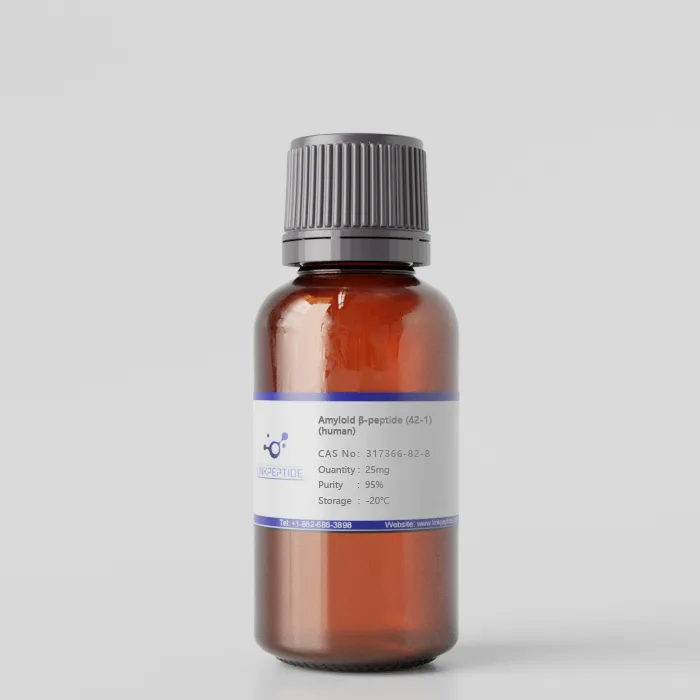
Product Name: [Lys(Me1)4]-Histone H3 (1-21)
Sequence One Letter Code: ART-K(Me1)-QTARKSTGGKAPRKQLA
Sequence Three Letter Code: H-Ala-Arg-Thr-Lys(Me1)-Gln-Thr-Ala-Arg-Lys-Ser-Thr-Gly-Gly-Lys-Ala-Pro-Arg-Lys-Gln-Leu-Ala-OH
Molecular Weight: 2268.8
Purity: 95%
Form: Lyophilized
Storage Conditions: - 20 °C
Research Area: epigenetics
Source / Species: human
Conjugation: Unconjugated
Code Nacres: NA.26
Application: [Lys(Me1)4]-Histone H3 (1–21) is a synthetic peptide representing the N-terminal region of histone H3 with monomethylation at lysine 4 (H3K4me1), an important epigenetic modification associated with transcription start sites and active or primed enhancers. Genome-wide studies have shown that H3K4me1 is strongly enriched at regulatory elements involved in cell-type–specific gene expression. This histone mark plays a key role in chromatin accessibility, enhancer activation, and transcriptional potential. As a result, the peptide serves as a useful tool for investigating enhancer biology, chromatin remodeling, and histone modification–dependent regulation of gene expression. It is commonly used in studies examining chromatin-binding proteins, epigenetic signaling pathways, and mechanisms controlling gene regulation in development, differentiation, and disease.
Current Research: Epigenetic modifications of histone proteins play a central role in regulating gene expression without altering the underlying DNA sequence. Among these modifications, methylation of lysine residues on histone H3 has emerged as a critical determinant of chromatin structure and transcriptional activity. [Lys(Me1)4]-Histone H3 (1–21) is a synthetic peptide that mimics the N-terminal region of histone H3 containing monomethylation at lysine 4 (H3K4me1), a well-characterized epigenetic marker associated with transcriptionally active or poised regulatory elements. Because of its relevance to chromatin biology and gene regulation, this peptide has become a valuable research tool in studies of enhancer function, chromatin remodeling, and epigenetic signaling pathways. H3K4 Methylation and Epigenetic Control of Gene Expression Histone proteins package DNA into nucleosomes, forming the structural foundation of chromatin. Chemical modifications to histone tails—such as methylation, acetylation, and phosphorylation—serve as regulatory signals that influence chromatin accessibility and transcriptional activity. Lysine 4 on histone H3 (H3K4) is one of the most extensively studied histone modification sites, and it can exist in three methylation states: monomethylation (H3K4me1), dimethylation (H3K4me2), and trimethylation (H3K4me3). Each methylation state is associated with distinct genomic features. While H3K4me3 is typically enriched at active promoters, H3K4me1 is strongly associated with enhancer regions, particularly those that regulate cell-type–specific gene expression. These enhancer elements play a crucial role in controlling when and where genes are activated, enabling cells to respond to developmental cues, environmental signals, and physiological changes. The presence of H3K4me1 marks genomic regions with regulatory potential and helps recruit chromatin-binding proteins that modulate transcriptional activity. As a result, this modification is widely recognized as an important epigenetic signature of active or primed enhancers. Structure and Design of [Lys(Me1)4]-Histone H3 (1–21) The [Lys(Me1)4]-Histone H3 (1–21) peptide corresponds to the first 21 amino acids of the histone H3 N-terminal tail, a region rich in regulatory modification sites. In this synthetic construct, lysine at position 4 is specifically monomethylated, faithfully reproducing the H3K4me1 epigenetic mark found in chromatin. By recreating this modification in a defined peptide format, researchers can study interactions between histone marks and chromatin-associated proteins in a controlled experimental environment. This design enables precise investigation of how H3K4me1 influences protein recognition, chromatin architecture, and transcriptional regulation. Synthetic histone peptides such as this are frequently used in biochemical assays because they allow scientists to isolate the effect of a single modification without interference from other chromatin components. Consequently, the peptide provides a simplified yet highly informative model for studying epigenetic signaling mechanisms. Role of H3K4me1 in Enhancer Activation and Chromatin Accessibility Enhancers are DNA regulatory elements that increase transcription of target genes, often acting at long genomic distances. Their activity is closely linked to specific histone modification patterns, with H3K4me1 serving as a hallmark of enhancer regions across many cell types. Genome-wide chromatin immunoprecipitation sequencing (ChIP-seq) studies have demonstrated that H3K4me1 is enriched at regulatory elements involved in lineage-specific gene expression. These regions often display additional histone modifications, such as H3K27ac, that further define enhancer activity states. H3K4me1 contributes to enhancer function in several ways: Promoting chromatin accessibility, allowing transcription factors to bind DNA Recruiting chromatin remodelers and epigenetic reader proteins Facilitating the assembly of transcriptional regulatory complexes Maintaining enhancers in a primed state ready for activation Through these mechanisms, H3K4me1 plays a pivotal role in shaping gene regulatory networks that drive cellular identity and developmental processes. Applications in Epigenetics and Chromatin Research Because of its biological relevance, [Lys(Me1)4]-Histone H3 (1–21) is widely used in research exploring the molecular basis of epigenetic regulation. The peptide is particularly valuable for identifying and characterizing proteins that recognize or interact with the H3K4me1 mark. Typical experimental applications include: Chromatin-binding and pull-down assays to identify histone mark readers Protein–peptide interaction studies involving chromatin regulatory complexes Epigenetic signaling pathway analysis Investigation of enhancer activation mechanisms Biochemical assays examining histone modification recognition Researchers also use modified histone peptides to investigate how specific epigenetic marks influence transcriptional regulation in different biological contexts. Insights into Development, Differentiation, and Disease Epigenetic modifications such as H3K4me1 are deeply involved in controlling gene expression programs during cell differentiation and organismal development. Proper enhancer activity ensures that genes are activated at the correct time and in the appropriate cell type. Disruption of histone modification patterns has been linked to a variety of diseases, including cancer, neurological disorders, and developmental abnormalities. Altered enhancer landscapes can lead to inappropriate gene activation or silencing, contributing to pathological processes. By enabling precise examination of H3K4me1-dependent interactions, [Lys(Me1)4]-Histone H3 (1–21) helps researchers explore the molecular mechanisms underlying epigenetic regulation and disease-associated chromatin changes. Advancing Research in Chromatin Biology Synthetic histone peptides remain essential tools for dissecting the complex signaling networks that govern chromatin dynamics and transcriptional control. By faithfully reproducing the H3K4me1 epigenetic mark within the N-terminal histone H3 sequence, [Lys(Me1)4]-Histone H3 (1–21) provides a powerful platform for studying enhancer biology, chromatin-binding proteins, and epigenetic regulatory pathways. As the field of epigenetics continues to expand, tools like this peptide will remain critical for uncovering how histone modifications coordinate gene expression and shape cellular function across development and disease.
Get a Quote
 LinkPeptide
![[Lys(Me1)4]-Histone H3 (1-21)](https://www.linkpeptide.com/wp-content/uploads/2026/06/LysMe14-Histone-H3-1-21.jpg)