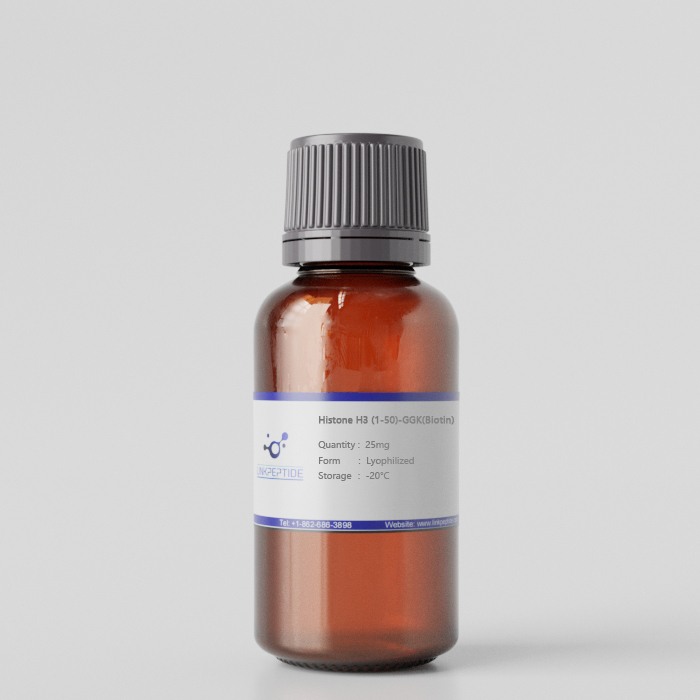
Product Name: [Lys(Me3)12]-Histone H4(1-21)-GGK(Biotin)
Sequence One Letter Code: Ac-SGRGKGGKGLG-K(Me3)-GGAKRHRKV-GGK(Biotin)
Sequence Three Letter Code: Ac-Ser-Gly-Arg-Gly-Lys-Gly-Gly-Lys-Gly-Leu-Gly-Lys(Me3)-Gly-Gly-Ala-Lys-Arg-His-Arg-Lys-Val-Gly-Gly-Lys(Biotin)-OH
Molecular Weight: 2645.3
Purity: 95%
Form: Lyophilized
Storage Conditions: - 20 °C
Research Area: epigenetics
Source / Species: human
Conjugation: Conjugated
Conjugation Type: Biotins
Code Nacres: NA.26
Application: This synthetic peptide corresponds to histone H4 residues 1–21 and contains trimethylation at lysine 12, a chromatin modification implicated in transcriptional regulation. The N-terminus is acetylated, and the C-terminus is modified with a glycine–glycine linker followed by a biotinylated lysine to enable streptavidin-based affinity capture. Trimethylation at H4K12 influences chromatin structure and modulates recruitment of methyl-lysine reader proteins. This peptide is well suited for binding assays, chromatin-associated protein interaction studies, and validation of methylation-specific antibodies. It provides a defined substrate for biochemical investigations into histone methylation dynamics and epigenetic signaling mechanisms.
Current Research: Epigenetic regulation relies heavily on chemical modifications of histone proteins that influence chromatin organization and gene expression without altering the underlying DNA sequence. Among these regulatory marks, lysine methylation plays a central role in controlling chromatin accessibility and recruiting specialized effector proteins that interpret epigenetic signals. Synthetic histone peptides containing defined modifications have become essential tools for dissecting these mechanisms in vitro. A representative example is the histone H4 (1–21) peptide containing trimethylation at lysine 12 (H4K12me3), which incorporates additional structural features—including N-terminal acetylation and a C-terminal biotin tag—to facilitate biochemical interaction studies. Histone H4 and the Role of N-Terminal Tail Modifications Histone H4 is one of the four core histone proteins that assemble into nucleosomes, the fundamental structural units of chromatin. Each nucleosome consists of approximately 147 base pairs of DNA wrapped around a histone octamer containing two copies each of H2A, H2B, H3, and H4. The N-terminal tails of histones extend outward from the nucleosome core, providing accessible platforms for regulatory modifications. These tails are subject to numerous post-translational modifications (PTMs), including acetylation, methylation, phosphorylation, and ubiquitination. Such modifications influence chromatin structure by altering histone–DNA interactions and by recruiting chromatin-associated proteins that regulate transcription, DNA repair, and replication. The H4 N-terminal region spanning residues 1–21 contains several lysine residues that are frequently modified in vivo. Because of its regulatory importance, this region is commonly used in biochemical studies aimed at understanding how histone modifications influence chromatin function. Functional Significance of H4K12 Trimethylation Within the H4 N-terminal tail, lysine 12 (K12) represents a site capable of undergoing methylation. In its trimethylated form (H4K12me3), the lysine side chain carries three methyl groups that alter its chemical properties while preserving its positive charge. Trimethylation can influence chromatin biology in several ways. One important mechanism involves the recruitment of methyl-lysine reader proteins, which contain specialized recognition domains that bind specific methylated residues on histones. These interactions can guide the assembly of chromatin regulatory complexes that modulate transcriptional activity or chromatin structure. By affecting protein recruitment and nucleosome stability, H4K12 trimethylation contributes to the broader network of histone modifications that collectively regulate epigenetic signaling pathways. Structural Design of the Synthetic Peptide The synthetic H4 (1–21) K12me3 peptide replicates the first 21 amino acids of the human histone H4 N-terminal tail while incorporating defined chemical modifications that enhance experimental usability. The N-terminus is acetylated, a modification that stabilizes the peptide and better reflects the biochemical state often observed in histone tails. Acetylation neutralizes the positive charge of the terminal amine, reducing nonspecific interactions and improving reproducibility in biochemical assays. At the C-terminus, the peptide contains a glycine–glycine linker followed by a biotinylated lysine residue. This design provides a flexible spacer between the histone sequence and the biotin tag, ensuring that the histone region remains accessible for interactions with proteins or antibodies. Biotin has extremely high affinity for streptavidin and avidin, enabling efficient immobilization of the peptide on streptavidin-coated beads, plates, or biosensor surfaces. This feature is particularly valuable for affinity capture and pull-down experiments. Applications in Chromatin Interaction Studies Biotinylated histone peptides are widely used to investigate protein–chromatin interactions. In a typical pull-down assay, the peptide is immobilized via the biotin–streptavidin interaction and then incubated with nuclear extracts or purified chromatin-binding proteins. Proteins that specifically recognize the modified histone sequence can be captured and subsequently analyzed by techniques such as immunoblotting or mass spectrometry. Using the H4K12me3 peptide, researchers can identify and characterize proteins that selectively bind trimethylated lysine residues on histone H4. Such studies help reveal the molecular mechanisms by which epigenetic marks are interpreted by cellular machinery. These experiments also contribute to mapping the interaction networks that regulate chromatin remodeling and transcriptional control. Validation of Modification-Specific Antibodies Another important application of modified histone peptides is antibody validation. Antibodies designed to detect specific histone modifications must distinguish between closely related modification states, such as mono-, di-, and trimethylation at the same lysine residue. Synthetic peptides containing defined modifications provide precise standards for testing antibody specificity. By comparing antibody binding to modified and unmodified peptides, researchers can verify that an antibody accurately recognizes the intended epigenetic mark. The H4K12me3 peptide therefore serves as a reliable reference reagent for evaluating antibodies used in techniques such as western blotting, ELISA, and chromatin immunoprecipitation (ChIP). Supporting Research on Histone Methylation Dynamics Beyond binding assays and antibody testing, defined histone peptides also support investigations into histone methylation dynamics. Enzymes responsible for adding or removing methyl groups—such as histone methyltransferases and demethylases—can be studied using synthetic substrates that mimic native histone tails. Because the peptide contains a precisely defined trimethylated lysine, it enables controlled biochemical experiments examining how chromatin-associated proteins recognize or interact with methylated histone regions. These studies contribute to a broader understanding of epigenetic signaling pathways, which regulate processes such as gene expression, cellular differentiation, and genome stability. Conclusion The biotinylated histone H4 (1–21) peptide containing trimethylated lysine 12 provides a well-defined reagent for exploring chromatin biology and epigenetic regulation. By reproducing a key segment of the histone H4 N-terminal tail and incorporating experimental features such as N-terminal acetylation and a biotin capture tag, the peptide enables efficient investigation of histone–protein interactions. Its applications span binding assays, chromatin interaction studies, antibody validation, and mechanistic analyses of histone methylation signaling. As researchers continue to unravel the complex language of histone modifications, synthetic peptides like H4K12me3 remain indispensable tools for understanding how epigenetic marks shape chromatin structure and cellular function.
Get a Quote
 LinkPeptide
![[Lys(Me3)12]-Histone H4(1-21)-GGK(Biotin)](https://www.linkpeptide.com/wp-content/uploads/2026/06/LysAc12-16-LysMe320-Histone-H4-1-25-GSGSKBiotin.jpg)

![Ser(OGlcNAc)]400-KWK-Tau (388-411)-KK(Biotin)-NH2](https://www.linkpeptide.com/wp-content/uploads/2026/06/SerOGlcNAc400-KWK-Tau-388-411-KKBiotin-NH2.jpg "Ser(OGlcNAc)]400-KWK-Tau (388-411)-KK(Biotin)-NH2")