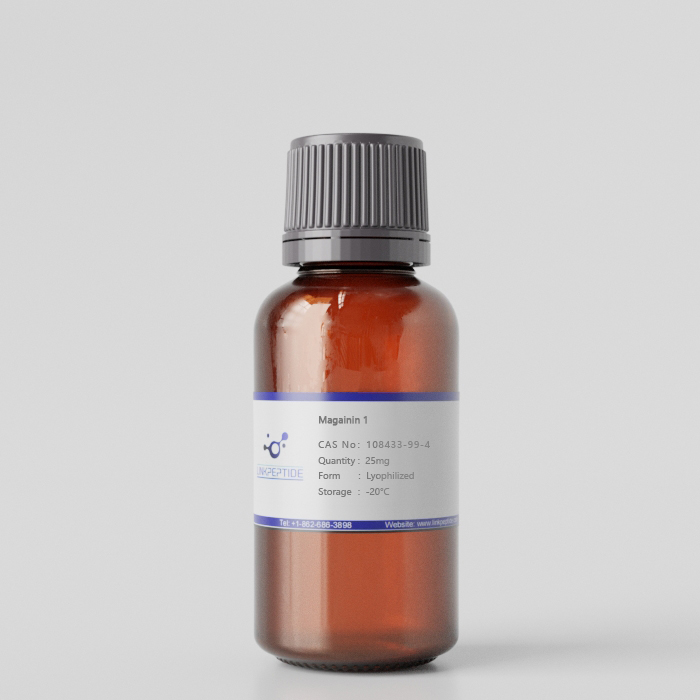
Product Name: Magainin 1
Sequence One Letter Code: GIGKFLHSAGKFGKAFVGEIMKS
Sequence Three Letter Code: H-Gly-Ile-Gly-Lys-Phe-Leu-His-Ser-Ala-Gly-Lys-Phe-Gly-Lys-Ala-Phe-Val-Gly-Glu-Ile-Met-Lys-Ser-OH
Cas No: 108433-99-4
Chemical Formula:C112H177N29O28S
Molecular Weight: 2410
Purity: 95%
Form: Lyophilized
Storage Conditions: - 20 °C
Research Area: Infection Disease Research
SMILES: CC[C@H](C)[C@@H](C(=O)NCC(=O)N[C@@H](CCCCN)C(=O)N[C@@H](CC1=CC=CC=C1)C(=O)N[C@@H](CC(C)C)C(=O)N[C@@H](CC2=CN=CN2)C(=O)N[C@@H](CO)C(=O)N[C@@H](C)C(=O)NCC(=O)N[C@@H](CCCCN)C(=O)N[C@@H](CC3=CC=CC=C3)C(=O)NCC(=O)N[C@@H](CCCCN)C(=O)N[C@@H](C)C(=O)N[C@@H](CC4=CC=CC=C4)C(=O)N[C@@H](C(C)C)C(=O)NCC(=O)N[C@@H](CCC(=O)O)C(=O)N[C@@H]([C@@H](C)CC)C(=O)N[C@@H](CCSC)C(=O)N[C@@H](CCCCN)C(=O)N[C@@H](CO)C(=O)O)NC(=O)CN
IUPAC: (4S)-4-[[2-[[(2S)-2-[[(2S)-2-[[(2S)-2-[[(2S)-6-amino-2-[[2-[[(2S)-2-[[(2S)-6-amino-2-[[2-[[(2S)-2-[[(2S)-2-[[(2S)-2-[[(2S)-2-[[(2S)-2-[[(2S)-6-amino-2-[[2-[[(2S,3S)-2-[(2-aminoacetyl)amino]-3-methylpentanoyl]amino]acetyl]amino]hexanoyl]amino]-3-phenylpropanoyl]amino]-4-methylpentanoyl]amino]-3-(1H-imidazol-5-yl)propanoyl]amino]-3-hydroxypropanoyl]amino]propanoyl]amino]acetyl]amino]hexanoyl]amino]-3-phenylpropanoyl]amino]acetyl]amino]hexanoyl]amino]propanoyl]amino]-3-phenylpropanoyl]amino]-3-methylbutanoyl]amino]acetyl]amino]-5-[[(2S,3S)-1-[[(2S)-1-[[(2S)-6-amino-1-[[(1S)-1-carboxy-2-hydroxyethyl]amino]-1-oxohexan-2-yl]amino]-4-methylsulfanyl-1-oxobutan-2-yl]amino]-3-methyl-1-oxopentan-2-yl]amino]-5-oxopentanoic acid
INCHIKEY: OFIZOVDANLLTQD-ZVNXOKPXSA-N
INCHI:
InChI=1S/C112H177N29O28S/c1-12-65(7)93(139-86(144)54-117)110(166)122-59-89(147)128-75(39-25-29-46-115)100(156)135-81(51-70-33-19-15-20-34-70)105(161)133-79(49-63(3)4)104(160)136-83(53-72-55-118-62-123-72)106(162)137-84(60-142)108(164)124-67(9)95(151)119-56-87(145)127-74(38-24-28-45-114)99(155)134-80(50-69-31-17-14-18-32-69)97(153)120-57-88(146)126-73(37-23-27-44-113)98(154)125-68(10)96(152)132-82(52-71-35-21-16-22-36-71)107(163)140-92(64(5)6)109(165)121-58-90(148)129-77(41-42-91(149)150)103(159)141-94(66(8)13-2)111(167)131-78(43-48-170-11)102(158)130-76(40-26-30-47-116)101(157)138-85(61-143)112(168)169/h14-22,31-36,55,62-68,73-85,92-94,142-143H,12-13,23-30,37-54,56-61,113-117H2,1-11H3,(H,118,123)(H,119,151)(H,120,153)(H,121,165)(H,122,166)(H,124,164)(H,125,154)(H,126,146)(H,127,145)(H,128,147)(H,129,148)(H,130,158)(H,131,167)(H,132,152)(H,133,161)(H,134,155)(H,135,156)(H,136,160)(H,137,162)(H,138,157)(H,139,144)(H,140,163)(H,141,159)(H,149,150)(H,168,169)/t65-,66-,67-,68-,73-,74-,75-,76-,77-,78-,79-,80-,81-,82-,83-,84-,85-,92-,93-,94-/m0/s1
Source / Species: Xenopus
Conjugation: Unconjugated
Code Nacres: NA.26
Application: Magainin 1 is a 23-amino-acid antimicrobial peptide originally isolated from the skin of Xenopus laevis. It is part of the innate immune defense system and exhibits broad-spectrum activity against bacteria, fungi, protozoa, and certain viruses. Magainin 1 disrupts microbial membranes through non-specific interactions, leading to rapid cell lysis. In addition to its antibacterial properties, it shows antiparasitic activity and inhibitory effects against herpes simplex viruses. Due to its membrane-active mechanism, it is widely used in antimicrobial research to study host defense peptides, membrane disruption, and peptide-based therapeutic development.
Current Research: Magainin 1 is a 23-amino-acid antimicrobial peptide (AMP) originally isolated from the skin of the African clawed frog, Xenopus laevis. As part of the organism’s innate immune defense system, it provides rapid protection against invading pathogens. Magainin 1 is widely recognized for its broad-spectrum antimicrobial activity and has become a key model peptide in studies of host defense mechanisms and membrane-active therapeutics. Structural Features and Amphipathic Nature Magainin 1 adopts an amphipathic α-helical structure when interacting with lipid membranes. This structural arrangement allows the peptide to: Partition into lipid bilayers Align hydrophobic residues with membrane interiors Expose hydrophilic residues to the aqueous environment This amphipathic configuration is essential for its ability to interact with and disrupt microbial membranes in a non-specific yet highly effective manner. Mechanism of Antimicrobial Action Unlike many conventional antibiotics that target specific molecular pathways, Magainin 1 exerts its effects through direct membrane disruption. Its mechanism involves: Electrostatic interaction with negatively charged microbial membranes Insertion into the lipid bilayer Formation of transient pores or membrane destabilization Leakage of cellular contents leading to rapid cell lysis This physical mode of action reduces the likelihood of resistance development and enables activity against a wide range of microorganisms. Broad-Spectrum Antimicrobial Activity Magainin 1 demonstrates activity against multiple classes of pathogens, including: Gram-positive and Gram-negative bacteria Fungi Protozoa and parasites Certain enveloped viruses, including herpes simplex viruses Its ability to target diverse organisms highlights its role as a first-line defense molecule in innate immunity. Antiviral and Antiparasitic Effects In addition to antibacterial activity, Magainin 1 has been shown to: Inhibit viral entry and replication, particularly in enveloped viruses Disrupt protozoan membranes, contributing to antiparasitic effects These properties make it a valuable tool for studying non-traditional antimicrobial mechanisms beyond bacterial targets. Applications in Antimicrobial and Biomedical Research Magainin 1 is extensively used in research focused on antimicrobial peptides and membrane biology. Its well-characterized activity and mechanism make it a standard model in this field. Common applications include: Studies of host defense peptides (HDPs) and innate immunity Investigation of membrane–peptide interactions and lipid dynamics Development of peptide-based antimicrobial therapeutics Evaluation of antimicrobial resistance mechanisms Screening of synthetic AMP analogues and derivatives These studies contribute to the development of next-generation anti-infective agents. Role in Peptide-Based Drug Development Because Magainin 1 acts through membrane disruption rather than specific enzymatic targets, it has inspired the design of novel therapeutics aimed at overcoming antibiotic resistance. Researchers use Magainin 1 as a template to: Design optimized antimicrobial peptides with improved stability and selectivity Enhance activity while reducing cytotoxicity Develop formulations for clinical and topical applications Its mechanism provides a foundation for exploring broad-spectrum antimicrobial strategies. A Foundational Model for Membrane-Active Peptides Magainin 1 remains a cornerstone in the study of antimicrobial peptides and membrane-targeting mechanisms. Its ability to rapidly disrupt microbial membranes, combined with its broad activity profile, makes it an indispensable tool for investigating innate immune defenses and peptide-based therapeutics. Through its continued use in biochemical, biophysical, and translational research, Magainin 1 supports advances in understanding membrane biology, host–pathogen interactions, and innovative approaches to combating infectious diseases.
Get a Quote
 LinkPeptide