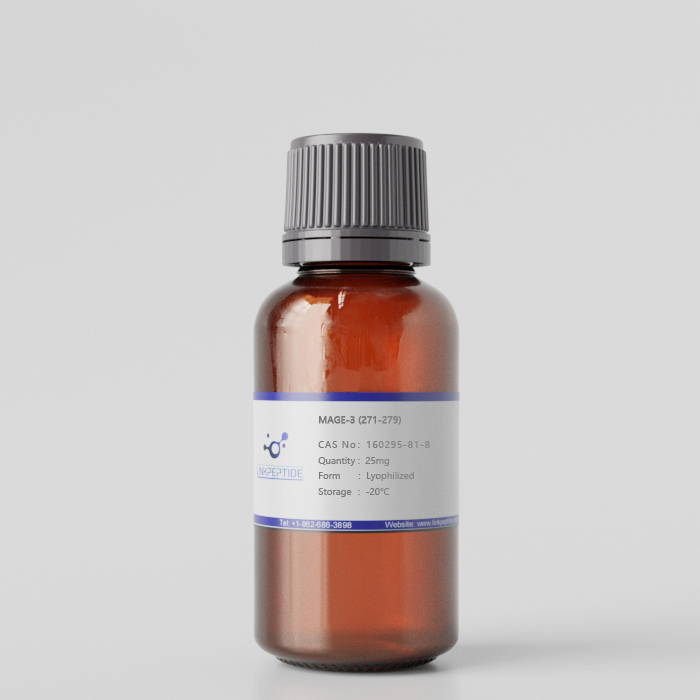
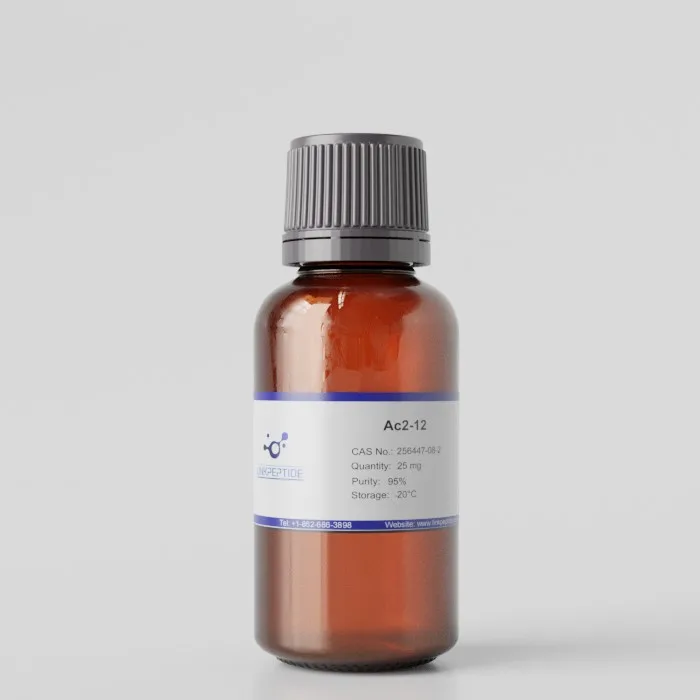
Product Name: MAGE-3 (271-279)
Sequence One Letter Code: FLWGPRALV
Sequence Three Letter Code: H-Phe-Leu-Trp-Gly-Pro-Arg-Ala-Leu-Val-OH
Cas No: 160295-81-8
Chemical Formula:C53H79N13O10
Molecular Weight: 1058.4
Purity: 95%
Form: Lyophilized
Storage Conditions: - 20 °C
Research Area: Inflammation and Immunology Research
SMILES: C[C@@H](C(=O)N[C@@H](CC(C)C)C(=O)N[C@@H](C(C)C)C(=O)O)NC(=O)[C@H](CCCN=C(N)N)NC(=O)[C@@H]1CCCN1C(=O)CNC(=O)[C@H](CC2=CNC3=CC=CC=C32)NC(=O)[C@H](CC(C)C)NC(=O)[C@H](CC4=CC=CC=C4)N
IUPAC: (2S)-2-[[(2S)-2-[[(2S)-2-[[(2S)-2-[[(2S)-1-[2-[[(2S)-2-[[(2S)-2-[[(2S)-2-amino-3-phenylpropanoyl]amino]-4-methylpentanoyl]amino]-3-(1H-indol-3-yl)propanoyl]amino]acetyl]pyrrolidine-2-carbonyl]amino]-5-(diaminomethylideneamino)pentanoyl]amino]propanoyl]amino]-4-methylpentanoyl]amino]-3-methylbutanoic acid
INCHIKEY: PQGCYSRGXCORLN-RJXLGPPMSA-N
INCHI:
InChI=1S/C53H79N13O10/c1-29(2)23-39(63-46(69)36(54)25-33-15-9-8-10-16-33)49(72)64-41(26-34-27-58-37-18-12-11-17-35(34)37)47(70)59-28-43(67)66-22-14-20-42(66)51(74)61-38(19-13-21-57-53(55)56)48(71)60-32(7)45(68)62-40(24-30(3)4)50(73)65-44(31(5)6)52(75)76/h8-12,15-18,27,29-32,36,38-42,44,58H,13-14,19-26,28,54H2,1-7H3,(H,59,70)(H,60,71)(H,61,74)(H,62,68)(H,63,69)(H,64,72)(H,65,73)(H,75,76)(H4,55,56,57)/t32-,36-,38-,39-,40-,41-,42-,44-/m0/s1
Source / Species: human
Conjugation: Unconjugated
Code Nacres: NA.26
Application: MAGE-3 (271–279) is a synthetic nonamer peptide derived from the melanoma-associated antigen MAGE-3 and represents a well-defined HLA-A0201–restricted CD8⁺ T cell epitope. MAGE-3 belongs to the cancer–testis antigen family, characterized by high tumor expression and limited distribution in normal adult tissues. This peptide is recognized by cytotoxic T lymphocytes in an HLA-A0201 context and is widely used to study tumor antigen presentation and anti-tumor immune responses. It supports investigations into T cell activation, immune monitoring, and antigen-specific cytotoxicity assays. MAGE-3 (271–279) is also applied in cancer vaccine development and adoptive T cell therapy research. Its well-characterized immunogenicity makes it a reliable model epitope in translational tumor immunology and immunotherapeutic strategy development.
Current Research: MAGE-3 (271–279) remains a highly studied HLA-A*02:01–restricted CD8⁺ T cell epitope within translational tumor immunology. Derived from the cancer–testis antigen MAGE-A3, this nonamer peptide (FLWGPRALV) is naturally processed and presented on tumor cells expressing MAGE-A3, including melanoma, non-small cell lung cancer, head and neck squamous cell carcinoma, bladder cancer, and certain sarcomas. Because cancer–testis antigens exhibit restricted expression in normal adult tissues—primarily immune-privileged germline cells—MAGE-A3 epitopes continue to be attractive immunotherapeutic targets. Current research has shifted from simple peptide vaccination strategies toward integrated approaches that combine precise antigen selection, immune checkpoint blockade, and engineered T cell therapies. Earlier large-scale vaccine trials demonstrated that while MAGE-A3 peptides can induce measurable immune responses, clinical benefit was inconsistent. As a result, contemporary work emphasizes optimizing antigen presentation, patient stratification based on tumor expression levels, and improving T cell functional quality rather than relying solely on peptide immunogenicity. A major area of investigation involves defining the natural processing and presentation of MAGE-3 (271–279) on tumor cells. Immunopeptidomics and mass spectrometry–based MHC ligand profiling are used to confirm epitope display under physiological conditions. These approaches help distinguish high-affinity predicted binders from peptides genuinely presented at sufficient density to trigger effective cytotoxic T lymphocyte (CTL) responses. Quantitative analysis of peptide–MHC stability and surface half-life has become central to determining therapeutic viability. Adoptive T cell therapy represents one of the most active translational applications of this epitope. MAGE-A3–specific T cell receptors (TCRs) are isolated from antigen-reactive CD8⁺ T cells and engineered into patient-derived lymphocytes. Advances in single-cell sequencing and paired TCRα/β chain identification now allow precise selection of clonotypes with favorable functional profiles. Importantly, current engineering strategies prioritize specificity and safety over maximal affinity. Past experience with affinity-enhanced TCRs targeting MAGE-A3 revealed off-target toxicities due to cross-reactivity with structurally similar peptides, underscoring the necessity for comprehensive preclinical cross-reactivity screening. In parallel, research is examining tumor microenvironment influences on MAGE-3 (271–279)–specific T cell function. Chronic antigen exposure can induce T cell exhaustion, characterized by upregulation of inhibitory receptors such as PD-1 and LAG-3. Combination strategies integrating MAGE-targeted TCR therapies with immune checkpoint inhibitors are under evaluation to restore effector function and improve tumor control. Studies also assess metabolic fitness, persistence, and tissue infiltration capacity of engineered T cells. Another active field involves epigenetic regulation of MAGE-A3 expression. Because cancer–testis antigens are often regulated by DNA methylation, hypomethylating agents can enhance tumor expression of MAGE-A3, potentially increasing epitope presentation and improving responsiveness to immunotherapy. This has led to investigation of combination regimens pairing epigenetic modulators with T cell–based approaches. Additionally, MAGE-3 (271–279) serves as a standardized model epitope for immune monitoring. HLA-A*02:01 tetramers loaded with this peptide enable precise quantification of antigen-specific CD8⁺ T cells in peripheral blood and tumor samples. Functional assays measuring cytokine production, cytotoxic granule release, and tumor cell lysis provide mechanistic insight into T cell potency. Overall, current research positions MAGE-3 (271–279) not merely as a vaccine antigen but as a validated molecular target within sophisticated immunotherapeutic platforms. Ongoing work continues to refine antigen selection, TCR specificity, safety profiling, and combination treatment strategies to maximize anti-tumor efficacy while minimizing off-target risk.
Get a Quote
 LinkPeptide