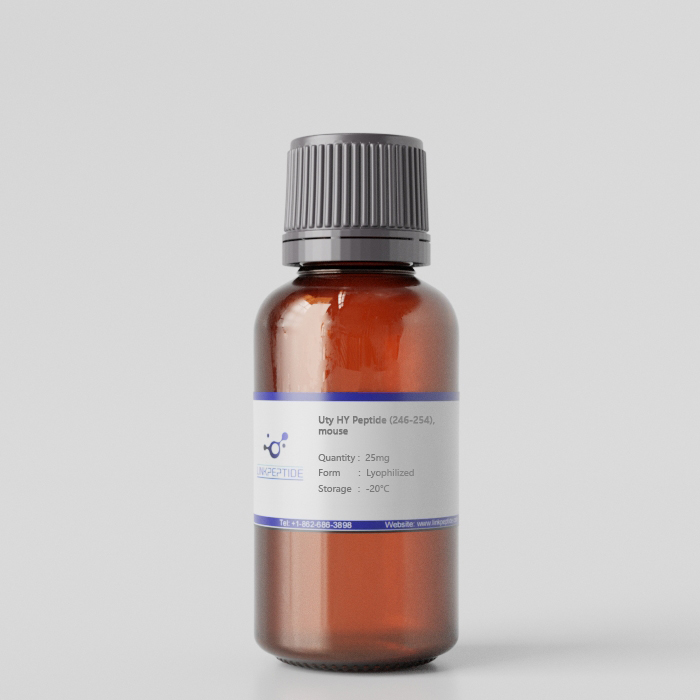
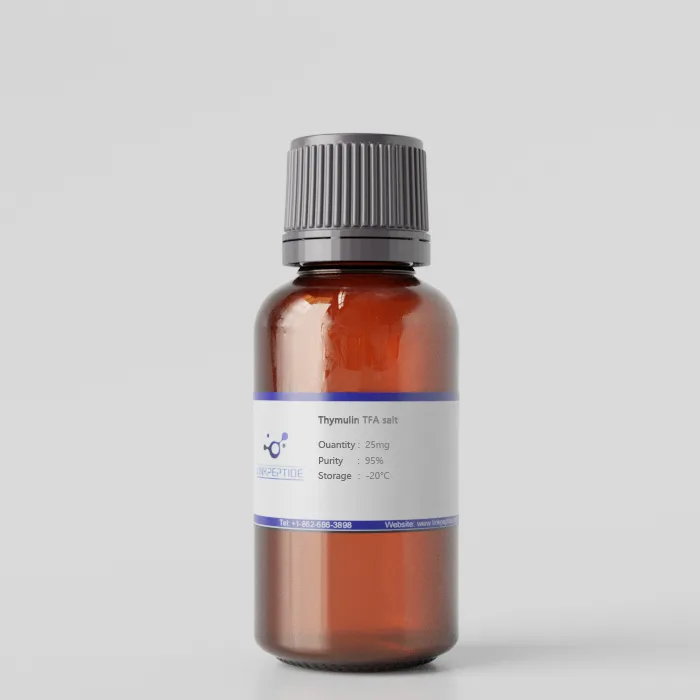
Product Name: Uty HY Peptide (246-254), mouse
Sequence One Letter Code: WMHHNMDLI
Sequence Three Letter Code: H-Trp-Met-His-His-Asn-Met-Asp-Leu-Ile-OH
Chemical Formula:C53H77N15O13S2
Molecular Weight: 1196.5
Purity: 95%
Form: Lyophilized
Storage Conditions: - 20 °C
Research Area: Inflammation and Immunology Research
Source / Species: mouse
Conjugation: Unconjugated
Code Nacres: NA.26
Application: Uty H-Y Peptide (246–254), mouse (WMHHNMDLI) is a synthetic nonapeptide derived from the ubiquitously transcribed tetratricopeptide repeat protein UTY encoded on the Y chromosome and represents a well-characterized male-specific minor histocompatibility antigen (H-Y). This epitope is presented by the murine MHC class I molecule H-2Dᵇ and is widely used in mouse immunology models to investigate antigen processing and presentation, CD8⁺ cytotoxic T lymphocyte activation, and effector function. As a prototypical Y chromosome–encoded antigen, it plays a central role in studies of sex-mismatched immune responses, graft-versus-host disease (GVHD), transplant rejection, and immune tolerance. The Uty (246–254) peptide serves as a standard H-2Dᵇ-restricted epitope for evaluating antigen-specific T cell responses in vitro and in vivo, providing a robust tool for dissecting mechanisms of T cell–mediated immunity in murine systems.
Current Research: Uty H-Y Peptide (246–254), mouse, is a synthetic nonapeptide epitope with the sequence WMHHNMDLI, derived from the ubiquitously transcribed tetratricopeptide repeat protein UTY (Y chromosome). This peptide is a classic male-specific minor histocompatibility antigen (H-Y) in mice and is presented by the H-2Dᵇ MHC class I molecule, making it a dependable model antigen for probing MHC I antigen presentation, CD8⁺ T cell priming/effector function, and T cell–mediated graft outcomes. Because the UTY-derived H-Y system has been extensively validated across murine strains and experimental formats, the Uty H-Y peptide is frequently used as a benchmark epitope when investigators need a consistent, well-defined antigen to compare across conditions, adjuvants, donor/recipient combinations, or immunomodulatory interventions. Scientific background and relevance Minor histocompatibility antigens (mHAgs) are polymorphic peptides that can trigger alloreactive T cell responses even when donor and recipient are MHC-matched. In the H-Y setting, male-derived peptides presented on MHC molecules can be recognized as “non-self” by female immune systems, providing a powerful and biologically relevant framework to study sex-linked immune recognition. The Uty H-Y epitope WMHHNMDLI is among the most widely used H-Y determinants because it elicits robust H-2Dᵇ–restricted CD8⁺ T cell responses. This makes it valuable not only for transplantation immunology, but also for fundamental studies of TCR specificity, immunodominance, and peripheral tolerance. Key research applications 1) Antigen presentation and MHC I processing Uty H-Y peptide is ideal for dissecting the rules governing MHC I loading, peptide–MHC stability, and antigen dose thresholds. It is commonly applied to antigen-presenting cells (APCs) to generate defined peptide–MHC complexes and quantify downstream T cell activation with minimal ambiguity about antigen identity. 2) CD8⁺ T cell activation, differentiation, and effector function As a standard epitope, WMHHNMDLI is frequently used to track antigen-specific CD8⁺ T cells and evaluate cytotoxicity, cytokine production, and memory formation. Typical readouts include IFN-γ/TNF-α ELISpot or intracellular cytokine staining, proliferation assays, and target-cell killing formats (flow cytometry–based or reporter-based systems). 3) Transplantation models: rejection vs tolerance The H-Y mismatch model is a mainstay for examining how antigen-specific T cells mediate graft damage—or how regulatory pathways induce tolerance. Uty H-Y peptide enables controlled stimulation of H-Y–reactive T cells and facilitates mechanistic studies involving costimulation blockade, checkpoint pathways, Treg activity, or tolerogenic APC programming. 4) Sex-linked immune recognition and immunodominance Because it is Y-chromosome encoded, Uty H-Y peptide supports investigations into sex differences in immune responses, epitope hierarchy, and antigen competition. It is also useful for validating experimental systems where a male-specific antigen is required as a clear biological discriminator. Experimental compatibility The Uty H-Y peptide is widely used in: In vitro restimulation of splenocytes or purified CD8⁺ T cells Peptide-pulsed dendritic cell or APC assays Tetramer/Multimer staining (H-2Dᵇ/WMHHNMDLI) to enumerate antigen-specific CD8⁺ T cells Cytotoxicity assays using peptide-loaded target cells In vivo priming/boosting workflows (often paired with adjuvants or delivery platforms) Handling and preparation tips For best performance, prepare peptide stocks using sterile technique and an appropriate solvent system based on your formulation preferences (commonly aqueous buffers with minimal organic co-solvent when needed). Aliquot stocks to reduce freeze–thaw cycles, and confirm experimental concentration ranges empirically, since optimal dosing depends on APC type, culture duration, and the sensitivity of your readout (e.g., cytokine vs killing).
Get a Quote
 LinkPeptide