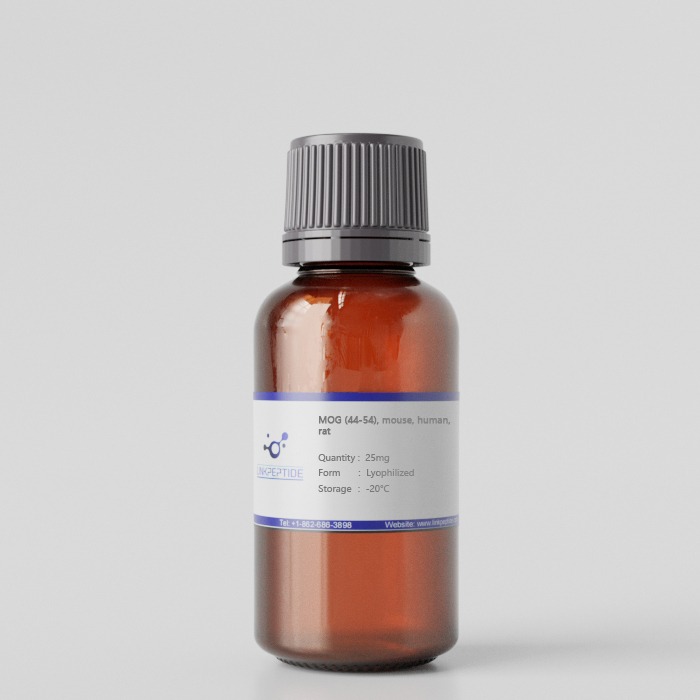
Product Name: MOG (44-54), mouse, human, rat
Sequence One Letter Code: FSRVVHLYRNG
Sequence Three Letter Code: H-Phe-Ser-Arg-Val-Val-His-Leu-Tyr-Arg-Asn-Gly-OH
Chemical Formula:C61H94N20O15
Molecular Weight: 1347.6
Purity: 95%
Form: Lyophilized
Storage Conditions: - 20 °C
Research Area: Inflammation and Immunology Research
Source / Species: Human, mouse, rat
Conjugation: Unconjugated
Code Nacres: NA.26
Application: MOG (44–54) is an 11–amino acid peptide derived from myelin oligodendrocyte glycoprotein and represents the minimal CD8⁺ T cell epitope within the larger MOG (35–55) region. The sequence is conserved across mouse, human, and rat, enabling cross-species immunological studies. MOG (44–54) binds to CD8⁺ T cell receptors and stimulates antigen-specific T cell proliferation in vitro. It is widely used in models of central nervous system autoimmunity, including experimental autoimmune encephalomyelitis (EAE), a preclinical model of multiple sclerosis. The peptide facilitates investigation of T cell activation, effector differentiation, and immune-mediated demyelination. It is also employed to study tolerance mechanisms and therapeutic modulation of autoreactive T cells. MOG (44–54) remains a key tool in neuroimmunology and autoimmune disease research.
Current Research: MOG (44–54) remains a critical epitope in contemporary neuroimmunology, particularly for dissecting CD8⁺ T cell–mediated mechanisms of central nervous system (CNS) autoimmunity. Derived from myelin oligodendrocyte glycoprotein (MOG), this 11–amino acid sequence represents the minimal cytotoxic T cell epitope within the broader MOG (35–55) immunodominant region. Its conservation across mouse, rat, and human facilitates cross-species modeling and strengthens its translational relevance to multiple sclerosis (MS). Current research increasingly emphasizes the role of CD8⁺ T cells in MS pathology, complementing the historically dominant focus on CD4⁺ T cells. In experimental autoimmune encephalomyelitis (EAE) models, MOG (44–54) is used to prime antigen-specific CD8⁺ T cells that infiltrate the CNS, recognize MHC class I–presented MOG peptides, and mediate direct cytotoxicity toward oligodendrocytes and myelin-producing cells. These models help define how antigen presentation within the CNS—by microglia, infiltrating dendritic cells, or stressed oligodendrocytes—contributes to local T cell reactivation and tissue injury. Advanced studies employing MOG (44–54)–loaded MHC class I tetramers enable precise tracking of autoreactive CD8⁺ T cell expansion, migration, and differentiation. Single-cell transcriptomics and TCR sequencing have revealed clonal expansion patterns and effector phenotypes associated with demyelinating pathology. Investigations into metabolic reprogramming, checkpoint receptor expression (e.g., PD-1, CTLA-4), and tissue-resident memory (T_RM) formation are clarifying how autoreactive CD8⁺ T cells persist within the CNS. The peptide is also instrumental in tolerance and immunotherapy research. Strategies including peptide-coupled nanoparticles, tolerogenic dendritic cells, and altered peptide ligands are being evaluated to induce anergy, deletion, or regulatory T cell responses specific to MOG epitopes. These antigen-specific approaches aim to suppress pathogenic immunity without broad immunosuppression. Furthermore, MOG (44–54) supports investigations into epitope spreading and cross-presentation, key processes in disease progression. As inflammation exposes additional myelin antigens, understanding how initial CD8⁺ responses expand to other epitopes is central to modeling chronic autoimmune neurodegeneration. Overall, MOG (44–54) provides a defined and mechanistically informative platform for studying cytotoxic T cell involvement in demyelination, CNS immune surveillance, and antigen-specific therapeutic modulation. Its continued application advances both basic understanding and translational strategies targeting autoimmune diseases of the nervous system.
Get a Quote
 LinkPeptide