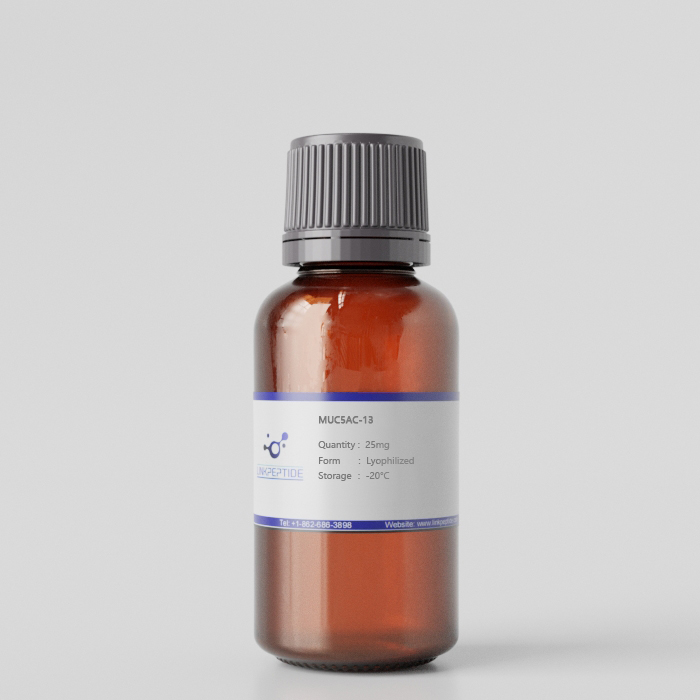
Product Name: MUC5AC-13
Sequence One Letter Code: GTTPSPVPTTST-T*-SAP (* = GalNAc-modified residue)
Sequence Three Letter Code: H-Gly-Thr-Thr-Pro-Ser-Pro-Val-Pro-Thr-Thr-Ser-Thr-Thr*-Ser-Ala-Pro-OH (Thr* = GalNac labeled Thr)
Molecular Weight: 1704.9
Purity: 95%
Form: Lyophilized
Storage Conditions: - 20 °C
Research Area: Cancer Disease Research
Source / Species: human
Conjugation: Unconjugated
Code Nacres: NA.26
Application: MUC5AC-13 is a synthetic glycopeptide derived from the human MUC5AC mucin protein containing a defined O-linked N-acetylgalactosamine (GalNAc) modification at threonine 13. This site-specific glycosylation mimics mucin-type O-glycan initiation catalyzed by polypeptide N-acetylgalactosaminyltransferases (GalNAc-Ts). MUC5AC is expressed in gastric and tracheobronchial mucosa and is aberrantly glycosylated in multiple epithelial cancers. This glycopeptide provides a controlled substrate for studying GalNAc transferase specificity, mucin glycosylation pathways, and tumor-associated carbohydrate antigen formation. It supports investigations into epithelial biology, cancer-associated glycosylation changes, and enzyme-substrate recognition mechanisms in glycoprotein research.
Current Research: MUC5AC-13 is a synthetic glycopeptide derived from the human MUC5AC mucin protein and incorporates a defined O-linked N-acetylgalactosamine (GalNAc) modification at threonine 13. This site-specific glycosylation event reproduces the initiating step of mucin-type O-glycosylation, in which polypeptide N-acetylgalactosaminyltransferases (GalNAc-Ts) transfer GalNAc from UDP-GalNAc to serine or threonine residues within protein substrates. By presenting a single, precisely installed GalNAc residue, MUC5AC-13 serves as a structurally defined model for investigating early-stage O-glycan biosynthesis. MUC5AC is a high-molecular-weight gel-forming mucin predominantly expressed in gastric epithelium and tracheobronchial mucosa. It contributes to mucus barrier formation, epithelial lubrication, and host defense. The tandem repeat regions of mucins, including MUC5AC, are densely populated with serine and threonine residues that undergo extensive O-glycosylation. These glycan modifications profoundly influence mucin conformation, hydration properties, protease resistance, and interactions with microbes and immune factors. Aberrant glycosylation of MUC5AC is a hallmark of multiple epithelial malignancies, including gastric, pancreatic, lung, and colorectal cancers. Tumor-associated alterations often include truncated O-glycan structures such as the Tn antigen (GalNAcα-Ser/Thr), sialyl-Tn, and related short glycoforms resulting from dysregulated glycosyltransferase expression. The presence of Tn antigens reflects incomplete elongation of the initial GalNAc residue and is frequently associated with aggressive tumor phenotypes, altered cell adhesion, and immune recognition changes. MUC5AC-13, bearing a defined GalNAc at Thr13, mimics this early glycosylation state and provides a relevant substrate for studying tumor-associated carbohydrate antigen formation. In enzymology research, MUC5AC-13 functions as a controlled substrate for analyzing GalNAc-T isoform specificity. The GalNAc-T family comprises multiple isoenzymes with distinct but overlapping peptide recognition motifs and hierarchical glycosylation patterns. Some isoforms preferentially glycosylate naked peptide sequences, whereas others recognize pre-glycosylated substrates and extend glycosylation to neighboring sites. By using a glycopeptide containing a single GalNAc modification, researchers can evaluate enzyme-substrate recognition, kinetic parameters, and site-specific glycosylation propagation under defined conditions. The peptide is also applicable in structural and biophysical studies. Techniques such as NMR spectroscopy, mass spectrometry, and X-ray crystallography can be employed to investigate how GalNAc-Ts interact with partially glycosylated mucin substrates. These approaches help define peptide sequence determinants, flanking residue contributions, and conformational effects induced by initial O-GalNAc installation. Additionally, MUC5AC-13 supports development of glycoproteomics workflows aimed at identifying O-glycosylation patterns in complex biological samples. In cancer biology, MUC5AC-13 provides a useful tool for probing antibody recognition of tumor-associated glycoepitopes. Many therapeutic antibodies and diagnostic reagents target truncated O-glycans presented on mucin backbones. A structurally defined glycopeptide standard enables validation of antibody specificity toward GalNAc-modified threonine residues within a native-like mucin sequence context. This supports biomarker assay development and immunological studies investigating glycan-dependent antigenicity. Beyond oncology, MUC5AC glycosylation is relevant to epithelial barrier biology and inflammatory conditions. Altered mucin glycosylation affects mucus viscosity, microbial colonization, and susceptibility to infection. The MUC5AC-13 glycopeptide allows controlled investigation of how initial O-glycan structures influence protein–protein and protein–microbe interactions at mucosal surfaces. Overall, MUC5AC-13 is a structurally defined, site-specifically glycosylated mucin fragment that models the initiation step of mucin-type O-glycosylation. By enabling detailed examination of GalNAc transferase specificity, mucin glycosylation pathways, and tumor-associated carbohydrate antigen formation, it serves as a valuable research tool in glycoprotein enzymology, epithelial biology, and cancer-associated glycosylation studies.
Get a Quote
 LinkPeptide