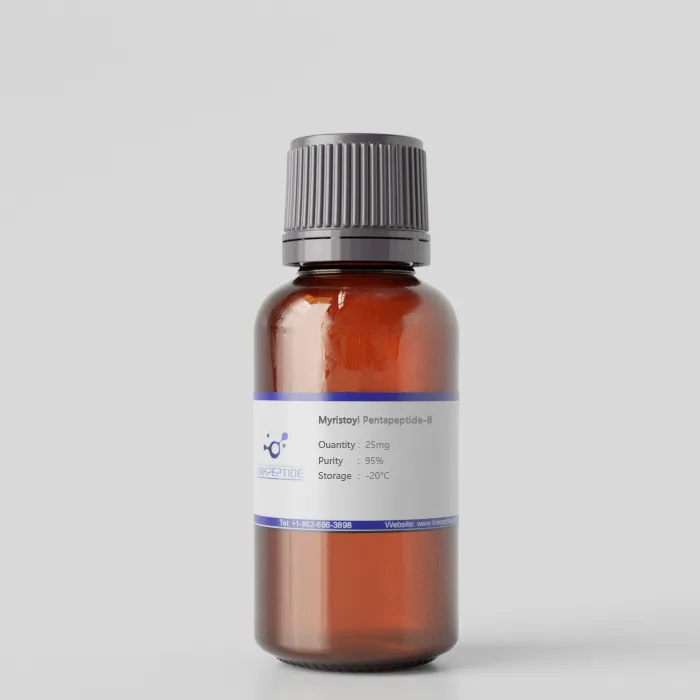
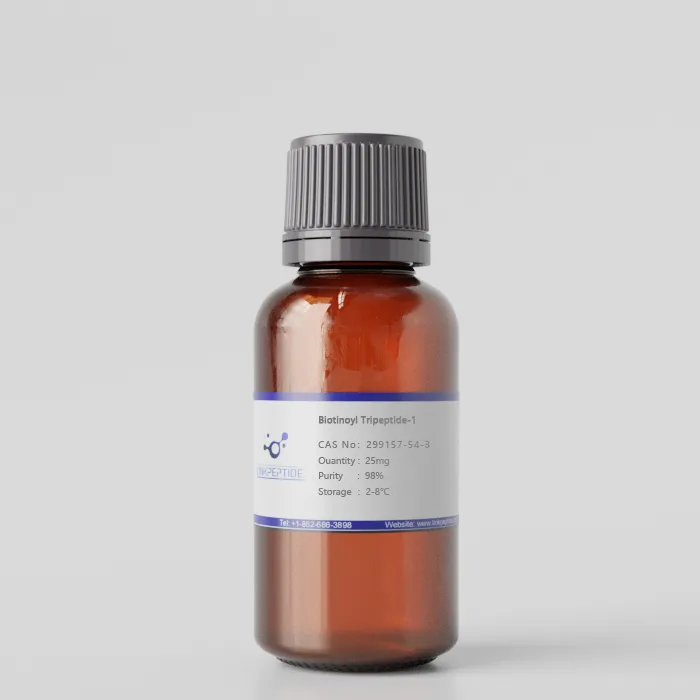
Product Name: Myristoyl Pentapeptide-8
Purity: 95%
Storage: Keep in dark and cool dry place -5~8 degree Celsius
Sequence: H-Tyr-D-Ala-Gly-Phe-Leu-OH
Molar Mass: 569.65
Chemical Formula: C29H39N5O7
Application:
Myristoyl Pentapeptide-8 is a lipidated bioactive peptide designed to enhance skin penetration and support visible rejuvenation. By coupling a five–amino acid sequence with a myristoyl group, it promotes improved stability and affinity for the skin’s lipid barrier. In cosmetic research, Myristoyl Pentapeptide-8 is valued for its ability to help refine texture, support firmness, and reduce the appearance of early fine lines. It also aids in promoting smoother, more resilient skin through optimized cellular communication. Ideal for serums, creams, and targeted anti-aging treatments, this peptide contributes to a revitalized, youthful-looking complexion.
Current Research:
Myristoyl Pentapeptide-8: Research Overview
Myristoyl Pentapeptide-8 is a synthetic lipopeptide composed of a five–amino-acid sequence covalently attached to a myristoyl (C14) fatty acid at the N-terminus. This structure combines a short, signaling-capable peptide backbone with a lipophilic tail that enhances membrane association, increases resistance to enzymatic degradation, and improves residence time in the stratum corneum and follicular or epidermal compartments. Within cosmetic science, Myristoyl Pentapeptide-8 is typically classified as a signal/conditioning peptide investigated for roles in skin structure support, hair fiber conditioning, and repair-related processes.
The peptide portion of Myristoyl Pentapeptide-8 is a defined pentapeptide sequence containing both polar and hydrophobic residues, enabling interaction with proteins and lipid environments. The myristoyl moiety:
Increases overall hydrophobicity and affinity for lipid bilayers.
Promotes anchoring of the peptide at the surface of cell membranes and within lipid domains of the stratum corneum.
Enhances resistance to proteolytic cleavage relative to the corresponding non-acylated peptide.
The resulting amphiphilic molecule behaves as a small signaling ligand embedded in a lipophilic carrier, a design strategy common to several cosmetic lipopeptides.
Research and technical documentation around Myristoyl Pentapeptide-8 emphasize affinity for keratinized tissues, including hair fibers and the stratum corneum. The peptide is described as capable of associating with keratin structures and interacting with damaged regions of the cuticle or cortex in hair, or with compromised barrier regions in the outer epidermis.
In hair-related models, lipopeptides with similar architecture demonstrate:
Improved surface alignment and reduced friction at the hair fiber interface.
Increased resistance to mechanical damage under repeated combing.
Enhanced smoothness and gloss linked to more uniform cuticle coverage.
Myristoyl Pentapeptide-8 is positioned within this context as a biofunctional conditioning agent with an underlying peptide signal component rather than a purely film-forming polymer.
While detailed mechanistic datasets specific to Myristoyl Pentapeptide-8 are limited in the public domain, the structural class (myristoylated short peptide) suggests potential signaling effects on skin cells:
The peptide backbone may interact with receptors or binding sites on keratinocytes and fibroblasts, influencing pathways associated with cell communication and structural protein expression.
Myristoylation enhances local concentration near cell membranes, facilitating engagement with surface receptors or lipid raft–associated signaling complexes.
In broader lipopeptide research, related myristoylated oligopeptides have been shown to modulate markers such as collagen, fibronectin, and integrins in dermal fibroblasts, as well as differentiation markers in keratinocytes. Myristoyl Pentapeptide-8 is generally grouped with this class of matrix- and structure-supporting peptides, although its exact target profile is less extensively characterized.
In cutaneous models, lipopeptides are commonly evaluated for:
Effects on barrier recovery and transepidermal water loss after experimental disruption.
Changes in stratum corneum cohesion and surface microrelief.
Improvement in tactile and optical properties (smoothness, uniformity, reduced roughness).
Myristoyl Pentapeptide-8 is typically associated with conditioning and repair concepts, particularly where repetitive mechanical or chemical stress is involved (for example, hair coloring, heat styling, surfactant exposure). The peptide’s design aims to combine:
A structural affinity component (myristoyl + peptide interaction with keratin or lipid domains).
A biological signal component (peptide sequence capable of modulating cell- or matrix-related processes at low concentrations).
From a formulation standpoint, Myristoyl Pentapeptide-8 shows:
Good solubility in mixed systems containing lipids, surfactants, or co-solvents.
Preferential localization in oil phases or at oil–water interfaces in emulsions.
Stability improvements versus non-acylated analogues due to reduced enzymatic accessibility.
It is typically incorporated:
In the cool-down phase of emulsions to minimize thermal degradation.
Into microemulsions, liposomes, or other delivery vehicles when enhanced penetration into the viable epidermis or along the hair fiber is desired.
At low active levels, as is standard for bioactive peptides in cosmetic formulations.
Current use and research positioning place Myristoyl Pentapeptide-8 within several overlapping themes:
Lipopeptide-based conditioning: interaction with keratin structures in hair or stratum corneum.
Signal-peptide–inspired support of structure, aligning it with peptides that influence extracellular matrix or keratinocyte behavior.
Repair and protection under mechanical or chemical stress, especially in hair care and structural-support skin care.
Because most available information comes from ingredient-technology and combined-formula studies rather than isolated academic work, Myristoyl Pentapeptide-8 is best described as a myristoylated pentapeptide designed for conditioning and structure-support applications, belonging to the broader class of amphiphilic cosmetic lipopeptides rather than as a single, deeply characterized molecular target.
Get a Quote
 LinkPeptide