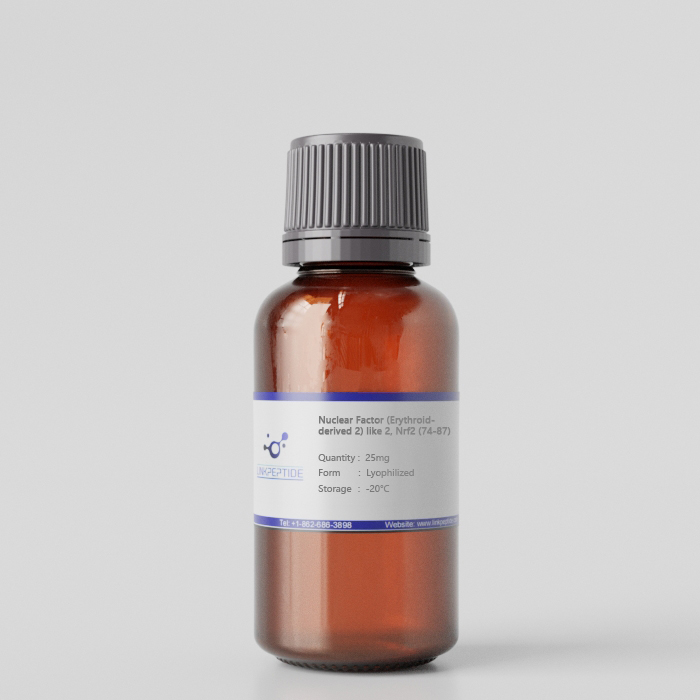
Product Name: Nuclear Factor (Erythroid-derived 2) like 2, Nrf2 (74-87)
Sequence One Letter Code: LQLDEETGEFLPIQ
Sequence Three Letter Code: H-Leu-Gln-Leu-Asp-Glu-Glu-Thr-Gly-Glu-Phe-Leu-Pro-Ile-Gln-OH
Chemical Formula:C73H114N16O26
Molecular Weight: 1631.8
Purity: 95%
Form: Lyophilized
Storage Conditions: - 20 °C
Research Area: Inflammation and Immunology Research
Source / Species: human, rat, bovine
Conjugation: Unconjugated
Code Nacres: NA.26
Application: This peptide is derived from residues 74–87 of nuclear factor erythroid-derived 2-like 2 (Nrf2) and lies within the Neh2 regulatory domain responsible for interaction with the Keap1 adaptor protein. The sequence contains the conserved DxETGE motif that mediates high-affinity binding to Keap1. Under normal conditions, Keap1 targets Nrf2 for ubiquitination and proteasomal degradation, thereby controlling cellular antioxidant responses. By competing with endogenous Nrf2 for Keap1 binding, this peptide is used to study mechanisms regulating Nrf2 stabilization and activation. It supports research into oxidative stress signaling, redox homeostasis, and cytoprotective gene regulation. The peptide is widely used in studies exploring therapeutic strategies targeting oxidative stress, inflammation, and metabolic disease.
Current Research: Cellular defense against oxidative stress relies on tightly controlled signaling pathways that regulate antioxidant gene expression. One of the most important regulators of this response is nuclear factor erythroid-derived 2-like 2 (Nrf2), a transcription factor that activates a wide range of cytoprotective genes. Under normal physiological conditions, Nrf2 activity is suppressed through interaction with the adaptor protein Kelch-like ECH-associated protein 1 (Keap1), which promotes Nrf2 degradation. Synthetic peptides derived from regulatory regions of Nrf2 are widely used to study this interaction and the mechanisms controlling antioxidant signaling. The Nrf2 (74–87) peptide, originating from the Neh2 regulatory domain of Nrf2, provides a defined sequence that mimics the Keap1-binding interface and supports mechanistic studies of oxidative stress responses. The Keap1–Nrf2 Regulatory System The Keap1–Nrf2 pathway is a central component of cellular defense mechanisms against oxidative damage and electrophilic stress. Nrf2 functions as a transcription factor that regulates the expression of genes involved in: Antioxidant defense Detoxification of reactive compounds Cellular redox balance Stress adaptation and metabolic regulation When activated, Nrf2 translocates to the nucleus and binds to antioxidant response elements (AREs) within the promoters of target genes. This interaction stimulates transcription of numerous protective proteins, including enzymes involved in glutathione metabolism, reactive oxygen species detoxification, and xenobiotic metabolism. However, under basal conditions, Nrf2 levels are kept low through continuous ubiquitination and proteasomal degradation mediated by Keap1. Role of the Neh2 Domain in Nrf2 Regulation The regulatory interaction between Nrf2 and Keap1 occurs primarily within the Neh2 domain located near the N-terminus of the Nrf2 protein. This domain contains specific motifs that enable Nrf2 to bind Keap1 and become incorporated into an E3 ubiquitin ligase complex. Within the Neh2 domain, a short sequence containing the conserved DxETGE motif is responsible for high-affinity binding to Keap1. This motif functions as a key recognition element that allows Keap1 to position Nrf2 for ubiquitination and subsequent degradation by the proteasome. As a result, the Keap1–Nrf2 interaction serves as a molecular switch controlling the stability and activity of Nrf2. When oxidative stress modifies Keap1 or disrupts this interaction, Nrf2 escapes degradation and accumulates in the nucleus, activating antioxidant gene expression. Structural Features of the Nrf2 (74–87) Peptide The Nrf2 (74–87) peptide corresponds to a sequence within the Neh2 regulatory region that includes the DxETGE motif, the key element responsible for Keap1 binding. By reproducing this binding interface in a synthetic format, the peptide provides a simplified experimental system for studying the interaction between Nrf2 and Keap1. In biochemical assays, the peptide can compete with endogenous Nrf2 for binding to Keap1. This competitive interaction allows researchers to investigate how Keap1 recognizes Nrf2 and how disruptions in this interaction influence Nrf2 stabilization. Because the peptide represents a defined binding segment, it is particularly useful for structure–function studies, binding assays, and inhibitor screening experiments. Applications in Oxidative Stress and Redox Biology Research The Nrf2 (74–87) peptide is widely used in experiments examining how cells regulate responses to oxidative stress. Typical research applications include: Protein–protein interaction assays exploring the Keap1–Nrf2 binding interface Competitive binding studies analyzing disruption of the Keap1 regulatory complex Biochemical assays investigating mechanisms of Nrf2 stabilization Screening experiments evaluating compounds that influence Keap1–Nrf2 signaling These approaches help researchers identify factors that modulate antioxidant defense pathways. Relevance to Disease and Therapeutic Research Dysregulation of oxidative stress responses is implicated in a wide range of diseases, including neurodegenerative disorders, chronic inflammation, metabolic disease, and cancer. The Keap1–Nrf2 pathway is therefore an important focus of biomedical research aimed at enhancing cellular resistance to oxidative damage. By enabling controlled study of the Keap1–Nrf2 interaction, the Nrf2 (74–87) peptide supports investigations into therapeutic strategies that target this pathway. Researchers use the peptide to understand how disrupting Keap1 binding can stabilize Nrf2 and promote expression of protective genes. Insights gained from these studies contribute to the development of approaches aimed at modulating oxidative stress signaling in disease contexts. Advancing Research on Cellular Stress Responses The Keap1–Nrf2 signaling system is one of the most important cellular mechanisms for maintaining redox homeostasis and protecting against environmental stress. Understanding how this pathway is regulated at the molecular level is essential for developing new strategies to enhance cytoprotective responses. The Nrf2 (74–87) peptide, containing the conserved DxETGE motif, provides a practical tool for studying the interaction between Nrf2 and Keap1. By enabling detailed investigation of protein recognition, signaling regulation, and antioxidant response pathways, this peptide continues to support research in oxidative stress biology, inflammation, and metabolic disease mechanisms.
Get a Quote
 LinkPeptide