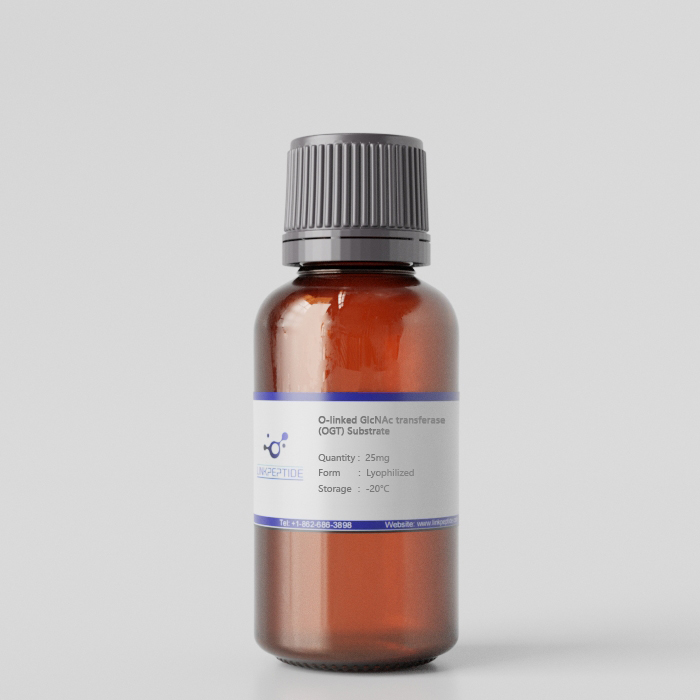
Product Name: O-linked GlcNAc transferase (OGT) Substrate
Sequence One Letter Code: KKKYPGGSTPVSSANMM
Sequence Three Letter Code: H-Lys-Lys-Lys-Tyr-Pro-Gly-Gly-Ser-Thr-Pro-Val-Ser-Ser-Ala-Asn-Met-Met-OH
Chemical Formula:C76H127N21O24S2
Molecular Weight: 1783.2
Purity: 95%
Form: Lyophilized
Storage Conditions: - 20 °C
Research Area: peptide substrate
Source / Species: human
Conjugation: Unconjugated
Code Nacres: NA.26
Application: This synthetic peptide substrate is designed for the study of O-linked N-acetylglucosamine transferase (OGT), the sole eukaryotic enzyme responsible for catalyzing O-GlcNAcylation of serine and threonine residues on nuclear and cytoplasmic proteins. OGT transfers GlcNAc from UDP-GlcNAc to target proteins, thereby coupling cellular nutrient status to signaling, transcriptional regulation, and stress responses. This peptide is suitable for in vitro enzymatic assays, kinetic characterization, and inhibitor screening applications. It supports mechanistic investigations of O-GlcNAc cycling and cross-talk with phosphorylation. The substrate is widely used in studies of metabolic regulation, epigenetic control, and disease-associated alterations in protein glycosylation, including cancer, diabetes, and neurodegenerative disorders.
Current Research: Post-translational modifications (PTMs) are fundamental mechanisms that regulate protein activity, signaling networks, and gene expression. Among these modifications, O-linked β-N-acetylglucosamine (O-GlcNAc) glycosylation has emerged as a key regulatory process in eukaryotic cells. Unlike classical glycosylation occurring in the secretory pathway, O-GlcNAcylation takes place within the nucleus and cytoplasm, dynamically modifying serine and threonine residues on a wide range of intracellular proteins. Synthetic peptide substrates designed for O-linked N-acetylglucosamine transferase (OGT) provide valuable tools for studying this process under controlled biochemical conditions. O-GlcNAcylation as a Dynamic Regulatory Modification O-GlcNAcylation is catalyzed by O-linked N-acetylglucosamine transferase (OGT), the sole enzyme in eukaryotic cells responsible for transferring N-acetylglucosamine (GlcNAc) to target proteins. OGT uses UDP-GlcNAc as the donor substrate, attaching the sugar moiety to serine or threonine residues through an O-linked glycosidic bond. This modification is reversible and highly dynamic. Removal of the GlcNAc group is mediated by a second enzyme, O-GlcNAcase (OGA). Together, OGT and OGA regulate a cycle of addition and removal that resembles phosphorylation–dephosphorylation cycles controlling many signaling pathways. Because O-GlcNAcylation occurs on thousands of proteins, including transcription factors, metabolic enzymes, and cytoskeletal components, it plays a broad role in coordinating cellular functions. Linking Nutrient Status to Cellular Signaling One of the defining features of O-GlcNAcylation is its sensitivity to cellular metabolic state. The substrate UDP-GlcNAc is produced through the hexosamine biosynthetic pathway (HBP), which integrates inputs from glucose, amino acids, fatty acids, and nucleotide metabolism. As a result, O-GlcNAcylation acts as a metabolic sensor, linking nutrient availability to cellular signaling and transcriptional regulation. When nutrient levels increase, UDP-GlcNAc concentrations rise, promoting increased OGT activity and higher levels of O-GlcNAcylated proteins. Through this mechanism, cells can adjust transcription, stress responses, and metabolic pathways in accordance with environmental and nutritional conditions. Synthetic Peptide Substrates for OGT Research Investigating OGT activity in complex biological systems can be challenging due to the large number of potential protein substrates and regulatory factors. Synthetic peptide substrates offer a simplified experimental platform for analyzing OGT-mediated glycosylation. These peptides contain serine or threonine residues positioned within sequence contexts recognized by OGT, allowing the enzyme to transfer GlcNAc from UDP-GlcNAc under controlled in vitro conditions. Because the peptide sequence is precisely defined, researchers can examine how sequence motifs influence enzyme recognition and catalytic efficiency. Such substrates are widely used in biochemical assays designed to measure OGT activity, characterize enzyme kinetics, and evaluate regulatory mechanisms governing O-GlcNAcylation. Applications in Enzymatic and Kinetic Assays Synthetic OGT substrates are particularly useful for in vitro enzymatic assays that quantify the transfer of GlcNAc to peptide targets. By monitoring product formation over time, researchers can determine important parameters such as catalytic rates, substrate affinity, and enzyme efficiency. Kinetic analyses using defined peptide substrates help clarify how OGT recognizes different sequence motifs and how changes in peptide composition influence glycosylation efficiency. These studies contribute to understanding the substrate specificity and catalytic mechanism of OGT. Peptide-based assays also allow researchers to examine how cofactors, interacting proteins, or metabolic conditions influence OGT activity. Screening for OGT Modulators and Inhibitors Because dysregulated O-GlcNAcylation is implicated in numerous diseases, OGT has become an important target for therapeutic research. Synthetic peptide substrates provide a convenient platform for screening small molecules that affect OGT activity. In inhibitor screening assays, candidate compounds are evaluated based on their ability to reduce glycosylation of the peptide substrate in the presence of OGT and UDP-GlcNAc. These experiments help identify molecules that modulate OGT activity and may serve as starting points for drug discovery. Cross-Talk Between O-GlcNAcylation and Phosphorylation A key aspect of O-GlcNAc signaling is its functional interplay with phosphorylation, another major post-translational modification of serine and threonine residues. In many proteins, O-GlcNAcylation and phosphorylation occur on the same or neighboring residues, leading to regulatory competition or cooperation between the two modifications. This cross-talk influences signaling pathways, transcription factor activity, and stress responses. Synthetic peptide substrates allow researchers to investigate how glycosylation affects phosphorylation patterns and vice versa, providing insight into the regulatory networks that integrate these modifications. Relevance to Disease and Cellular Regulation Alterations in O-GlcNAcylation have been associated with a range of pathological conditions. Elevated O-GlcNAc levels have been observed in cancer cells, where the modification may influence cell proliferation, metabolism, and transcriptional regulation. In diabetes, increased glucose flux through the hexosamine pathway can lead to excessive O-GlcNAcylation and altered insulin signaling. In the nervous system, O-GlcNAcylation plays roles in neuronal development, synaptic function, and protein stability. Dysregulation of O-GlcNAc cycling has been implicated in neurodegenerative diseases, including conditions associated with abnormal protein aggregation. Because OGT activity lies at the center of these processes, peptide substrates that enable detailed biochemical analysis are valuable for understanding disease-related changes in protein glycosylation. Conclusion Synthetic peptide substrates designed for O-linked N-acetylglucosamine transferase (OGT) provide powerful tools for investigating the dynamic process of O-GlcNAcylation. By offering a defined and controllable system for enzymatic assays, these peptides support studies of enzyme kinetics, substrate specificity, and inhibitor screening. Through applications in biochemical research, signaling pathway analysis, and disease-related studies, OGT peptide substrates contribute to a deeper understanding of how nutrient sensing, epigenetic regulation, and post-translational modification networks coordinate cellular function.
Get a Quote
 LinkPeptide