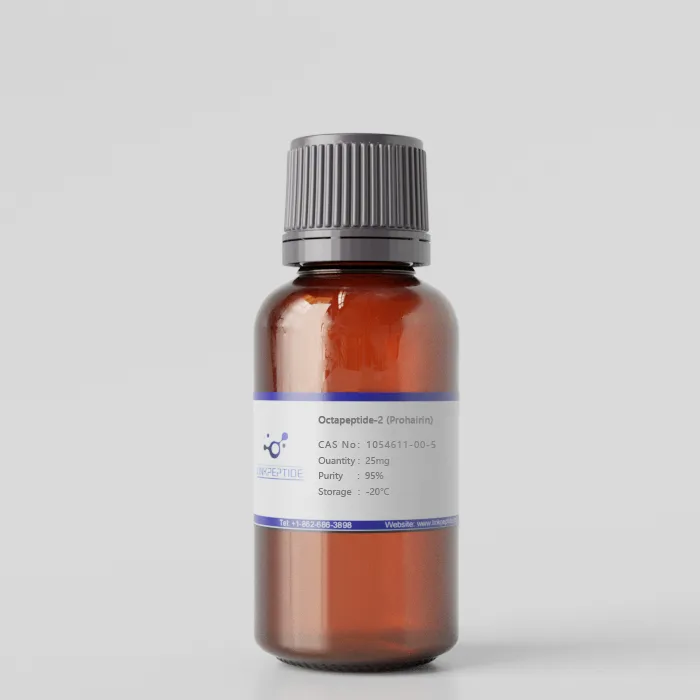
Product Name: Octapeptide-2 (Prohairin)
Cas No: 1054611-00-5
Purity: 95%
Storage: Keep in dark and cool dry place -5~8 degree Celsius
Sequence: Ac-KLKKTETQ-NH2
Molar Mass: 975.1
Chemical Formula: C42H78N12O14
IUPAC Name: (2S)-5-amino-2-[[(2S,3R)-2-[[(2S)-2-[[(2S,3R)-2-[[(2S)-6-amino-2-[[(2S)-6-amino-2-[[(2S)-2-[[(2S)-2,6-diaminohexanoyl]amino]-4-methylpentanoyl]amino]hexanoyl]amino]hexanoyl]amino]-3-hydroxybutanoyl]amino]-4-carboxybutanoyl]amino]-3-hydroxybutanoyl]amino]-5-oxopentanoic acid
SMILES: C[C@H]([C@@H](C(=O)N[C@@H](CCC(=O)O)C(=O)N[C@@H]([C@@H](C)O)C(=O)N[C@@H](CCC(=O)N)C(=O)O)NC(=O)[C@H](CCCCN)NC(=O)[C@H](CCCCN)NC(=O)[C@H](CC(C)C)NC(=O)[C@H](CCCCN)N)O
InChIKey: TWFSRAUPLWPVHY-XJFPVSOYSA-N
InChI: InChI=1S/C42H78N12O14/c1-22(2)21-30(52-35(60)25(46)11-5-8-18-43)39(64)49-26(12-6-9-19-44)36(61)48-27(13-7-10-20-45)37(62)53-33(23(3)55)40(65)50-28(15-17-32(58)59)38(63)54-34(24(4)56)41(66)51-29(42(67)68)14-16-31(47)57/h22-30,33-34,55-56H,5-21,43-46H2,1-4H3,(H2,47,57)(H,48,61)(H,49,64)(H,50,65)(H,51,66)(H,52,60)(H,53,62)(H,54,63)(H,58,59)(H,67,68)/t23-,24-,25+,26+,27+,28+,29+,30+,33+,34+/m1/s1
Application:
Octapeptide-2 (Prohairin) is a biomimetic peptide designed to support hair vitality and scalp health by promoting optimal communication within the follicular environment. Composed of eight amino acids, it is widely used in cosmetic research focused on encouraging stronger, fuller-looking hair and improving resistance to breakage. Octapeptide-2 helps support studies on follicle stimulation, scalp rejuvenation, and the appearance of increased density. Its excellent water solubility and formulation flexibility make it ideal for serums, tonics, and leave-on treatments targeting thinning hair, weakened follicles, and overall scalp resilience.
Current Research:
Octapeptide-2 (Prohairin): Research Overview
Octapeptide-2 is a synthetic biomimetic peptide modeled on functional domains of thymosin β4, a naturally occurring actin-binding protein involved in cell migration, tissue regeneration, and follicular repair. The peptide consists of an eight–amino-acid sequence designed to preserve the regenerative motifs of the parent protein while offering greater molecular stability, improved solubility, and predictable performance in topical formulations. Research identifies Octapeptide-2 as an active agent that influences cellular signaling pathways relevant to hair follicle maintenance, keratinocyte organization, and microenvironmental repair.
Studies examining the biological role of thymosin β4 analogues highlight their capacity to modulate cytoskeletal dynamics through actin polymerization, supporting enhanced motility of epithelial cells and dermal fibroblasts. Octapeptide-2 retains these functional characteristics, enabling improved migration of follicular keratinocytes and supporting structural recovery of the hair bulb region. This activity is linked to increased expression of proteins associated with follicle health, including laminin, collagen IV, and integrins that anchor the hair shaft within the follicular niche.
Research indicates that Octapeptide-2 can support activation of hair follicle stem cell populations located in the bulge and dermal papilla zones. These regions are responsible for initiating the transition from telogen to anagen. Experimental data show enhanced proliferation rates of hair-matrix cells in the presence of thymosin β4–derived sequences, suggesting that the octapeptide variant contributes to improved cellular turnover and progression into active growth phases. Mechanistic studies describe upregulation of growth-associated markers, including basic fibroblast growth factor (bFGF), vascular endothelial growth factor (VEGF), and keratinocyte growth factor (KGF), all of which contribute to follicular regeneration.
Another focus of research involves modulation of micro-inflammation within the follicular environment. Low-grade inflammatory signaling is implicated in weakening of the follicular sheath, degradation of extracellular matrix components, and premature entry into catagen. Thymosin β4 analogues, including the octapeptide derivative, have been shown to regulate inflammatory mediators such as IL-1β and TNF-α in model systems, contributing to a more stable environment for hair-matrix cell activity. Reduction in protease activity around the follicle is also documented, helping maintain structural proteins and the dermal–epidermal junction.
In vitro wound-healing assays frequently serve as models for evaluating regenerative behavior. Octapeptide-2 demonstrates accelerated closure in scratch assays, reflecting its influence on cytoskeletal organization and directional movement of keratinocytes. Because hair follicles rely on coordinated migration during anagen initiation and shaft formation, these results provide mechanistic support for follicular repair effects attributed to the peptide. Enhanced angiogenic signaling has also been reported in studies involving thymosin β4–related fragments, suggesting improved microcirculation around the follicle and increased nutrient availability.
Research using ex vivo hair-follicle cultures shows improved follicle diameter, increased cellular density in the bulb region, and sustained anagen-phase duration when exposed to thymosin β4–mimetic peptides. These findings align with observations of thicker emerging hair fibers and improved structural uniformity. Additional data suggest potential protection of melanocyte activity in the follicular matrix, contributing to maintenance of pigmentation, although this remains an emerging research area not fully characterized.
In cosmetic scientific literature, Octapeptide-2 is classified as a growth-factor–mimicking peptide capable of supporting follicular renewal processes that decline with age, environmental stress, and microvascular insufficiency. Its molecular simplicity enables stable incorporation into aqueous systems, and its small size favors diffusion into the upper follicular canal. Research also explores synergistic potential with other peptides that influence Wnt/β-catenin, DKK-1, or ECM-support pathways, positioning Octapeptide-2 as a component of multi-pathway hair-regeneration systems.
Collectively, current research characterizes Octapeptide-2 as a functional peptide that interfaces with cellular pathways governing follicular regeneration, epithelial migration, extracellular matrix stability, and inflammatory modulation. Its documented effects in model systems support continued exploration of its role in cosmetic hair-density enhancement, scalp microenvironment improvement, and maintenance of healthy follicle cycling.
Get a Quote
 LinkPeptide