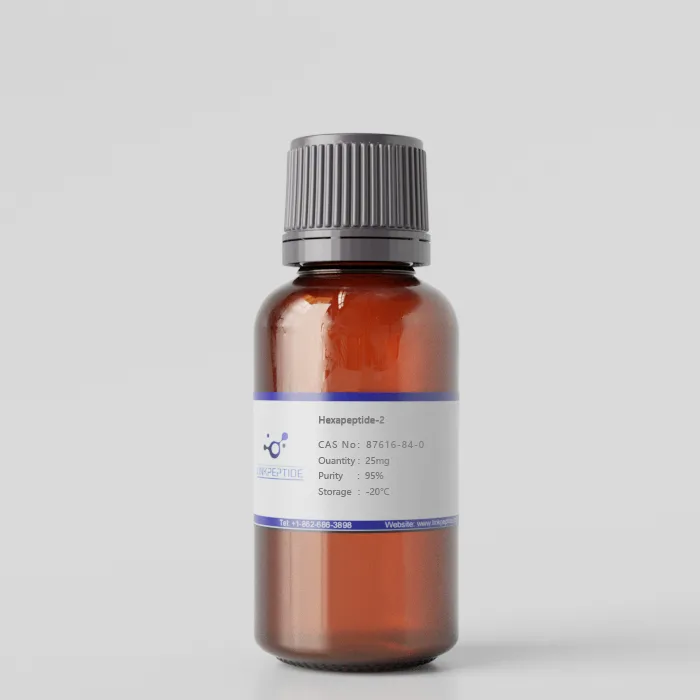
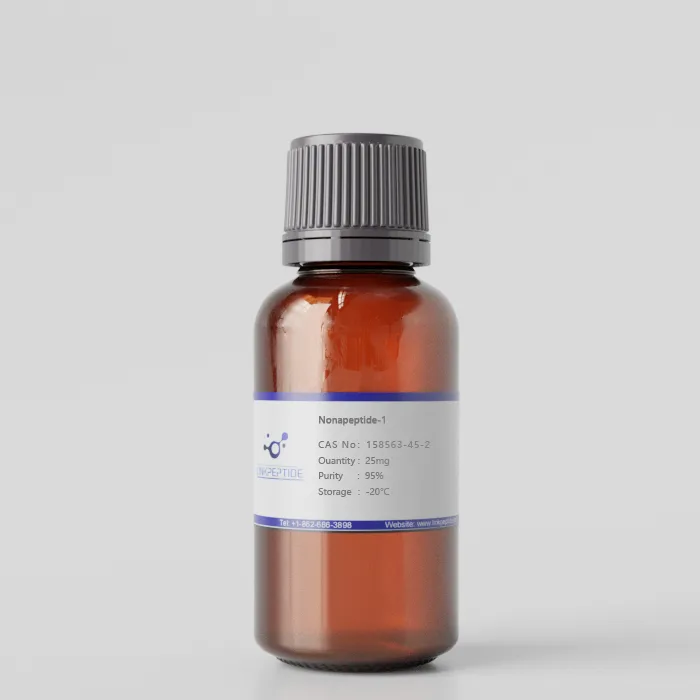
Product Name:Hexapeptide-2
Form:Acetate salt
Purity:95%
Storage:-20oC
Cas No:87616-84-0
Molar Mass:873
Chemical Formula:C46H56N12O6
Synonyms:Ghrp-6
IUPAC Name:(2S)-6-amino-2-[[(2R)-2-[[(2S)-2-[[(2S)-2-[[(2R)-2-[[(2S)-2-amino-3-(1H-imidazol-5-yl)propanoyl]amino]-3-(1H-indol-3-yl)propanoyl]amino]propanoyl]amino]-3-(1H-indol-3-yl)propanoyl]amino]-3-phenylpropanoyl]amino]hexanamide
SMILES:C[C@@H](C(=O)N[C@@H](CC1=CNC2=CC=CC=C21)C(=O)N[C@H](CC3=CC=CC=C3)C(=O)N[C@@H](CCCCN)C(=O)N)NC(=O)[C@@H](CC4=CNC5=CC=CC=C54)NC(=O)[C@H](CC6=CN=CN6)N
InChIKey:WZHKXNSOCOQYQX-FUAFALNISA-N
InChI:InChI=1S/C46H56N12O6/c1-27(54-44(62)39(20-29-23-51-35-15-7-5-13-32(29)35)57-43(61)34(48)22-31-25-50-26-53-31)42(60)56-40(21-30-24-52-36-16-8-6-14-33(30)36)46(64)58-38(19-28-11-3-2-4-12-28)45(63)55-37(41(49)59)17-9-10-18-47/h2-8,11-16,23-27,34,37-40,51-52H,9-10,17-22,47-48H2,1H3,(H2,49,59)(H,50,53)(H,54,62)(H,55,63)(H,56,60)(H,57,61)(H,58,64)/t27-,34-,37-,38+,39+,40-/m0/s1
Sequence:HWAWFK
Application:Hexapeptide-2 is a synthetic bioactive peptide designed to inhibit melanin production, making it a key ingredient in cosmetic and dermatological applications for skin brightening and hyperpigmentation treatment. It functions by targeting the melanocyte-stimulating hormone (MSH) pathway, reducing tyrosinase activity, which leads to a decrease in melanin synthesis. Hexapeptide-2 is widely used in whitening creams, anti-aging formulations, and spot-correcting serums to promote a more even skin tone. Current research explores its antioxidant and anti-inflammatory properties, positioning it as a promising ingredient in dermatological therapies for melasma, sun damage, and post-inflammatory hyperpigmentation (PIH).
Current Research:Hexapeptide-2 is a synthetic oligopeptide that functions as a melanogenesis inhibitor, primarily used in cosmetic dermatology and skincare formulations for hyperpigmentation treatment and skin tone correction. By interfering with melanocyte-stimulating hormone (MSH) signaling, it reduces tyrosinase activity, thereby limiting melanin production. Beyond its role in skin brightening, research is investigating its potential applications in oxidative stress regulation, anti-aging, and inflammatory skin conditions. Mechanism of Action in Melanin Inhibition Hexapeptide-2 acts by blocking MSH binding to melanocortin receptors (MC1R) on melanocytes, leading to: Reduced melanin synthesis: By inhibiting tyrosinase, the key enzyme in melanin production, Hexapeptide-2 helps lighten dark spots, age spots, and post-inflammatory hyperpigmentation (PIH). Even skin tone: Studies indicate that consistent use in cosmeceutical formulations can lead to a brighter and more uniform complexion. Alternative to hydroquinone: Research suggests that Hexapeptide-2 may serve as a safer alternative to hydroquinone, with fewer side effects like irritation and rebound hyperpigmentation. Cosmetic and Dermatological Applications Hexapeptide-2 is widely included in: Skin-lightening creams and serums: Used to reduce hyperpigmentation, melasma, and dark spots caused by UV damage or hormonal changes. Anti-aging formulations: Due to its ability to enhance skin radiance and reduce uneven pigmentation, it is commonly combined with retinoids, vitamin C, and niacinamide. Post-inflammatory hyperpigmentation (PIH) treatments: Research supports its efficacy in treating hyperpigmentation caused by acne scars, eczema, or psoriasis. Antioxidant and Anti-Inflammatory Properties Recent studies explore Hexapeptide-2??s antioxidant benefits, showing potential for: Reducing oxidative stress in skin cells: By neutralizing free radicals, it may help prevent UV-induced skin damage. Inflammation modulation: Preliminary research suggests it may calm irritated skin and reduce redness, making it beneficial for sensitive and reactive skin types. Emerging Research Areas Melanocyte-targeted therapies: Research is investigating its role in treating pigmentary disorders like vitiligo by selectively modulating melanocyte function. Skin barrier repair: Some studies suggest that Hexapeptide-2 may contribute to improving skin hydration and barrier function, enhancing overall skin health. Combination with laser and chemical peels: Dermatological research explores how Hexapeptide-2 may enhance post-procedure recovery and prevent rebound hyperpigmentation. With its growing applications, Hexapeptide-2 continues to be a valuable ingredient in dermatology and skincare, offering a safe and effective solution for hyperpigmentation, aging, and oxidative skin damage.
Get a Quote
 LinkPeptide