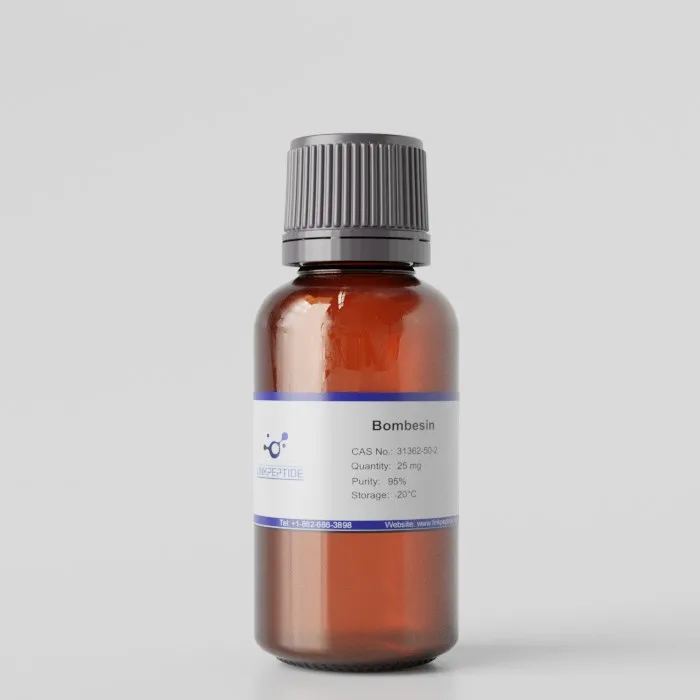
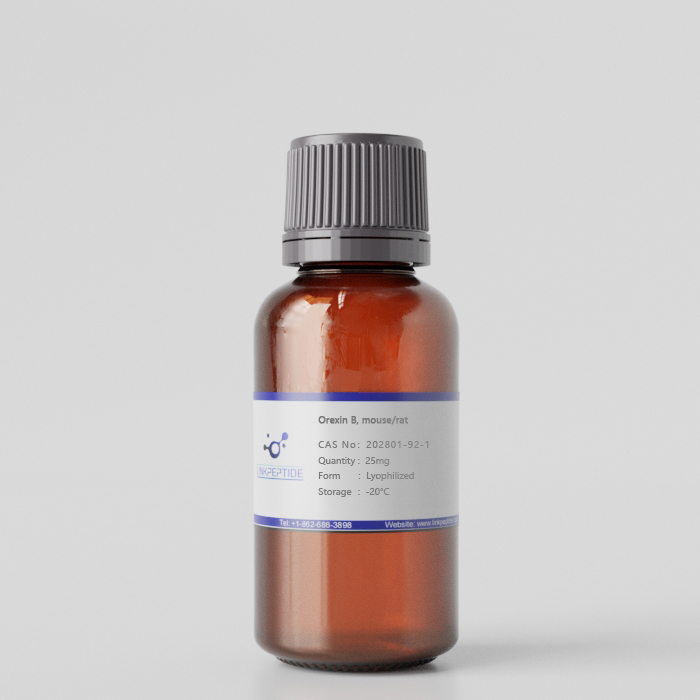
Product Name: Orexin B, mouse/rat
Sequence One Letter Code: RPGPPGLQGRLQRLLQANGNHAAGILTM-NH2
Sequence Three Letter Code: Arg-Pro-Gly-Pro-Pro-Gly-Leu-Gln-Gly-Arg-Leu-Gln-Arg-Leu-Leu-Gln-Ala-Asn-Gly-Asn-His-Ala-Ala-Gly-Ile-Leu-Thr-Met-NH2
Cas No: 202801-92-1
Chemical Formula:C126H215N45O34S1
Molecular Weight: 2936.6
Purity: 95%
Form: Lyophilized
Storage Conditions: - 20 °C
Research Area: Endocrinology Disease Research
SMILES: CC[C@H](C)[C@@H](C(=O)N[C@@H](CC(C)C)C(=O)N[C@@H]([C@@H](C)O)C(=O)N[C@@H](CCSC)C(=O)N)NC(=O)CNC(=O)[C@H](C)NC(=O)[C@H](C)NC(=O)[C@H](CC1=CNC=N1)NC(=O)[C@H](CC(=O)N)NC(=O)CNC(=O)[C@H](CC(=O)N)NC(=O)[C@H](C)NC(=O)[C@H](CCC(=O)N)NC(=O)[C@H](CC(C)C)NC(=O)[C@H](CC(C)C)NC(=O)[C@H](CCCNC(=N)N)NC(=O)[C@H](CCC(=O)N)NC(=O)[C@H](CC(C)C)NC(=O)[C@H](CCCNC(=N)N)NC(=O)CNC(=O)[C@H](CCC(=O)N)NC(=O)[C@H](CC(C)C)NC(=O)CNC(=O)[C@@H]2CCCN2C(=O)[C@@H]3CCCN3C(=O)CNC(=O)[C@@H]4CCCN4C(=O)[C@H](CCCNC(=N)N)N
IUPAC: (2S)-N-[2-[[(2S)-1-[[(2S)-1-[[(2S)-5-amino-1-[[(2S)-1-[[(2S)-1-[[(2S)-1-[[(2S)-5-amino-1-[[(2S)-1-[[(2S)-4-amino-1-[[2-[[(2S)-4-amino-1-[[(2S)-1-[[(2S)-1-[[(2S)-1-[[2-[[(2S,3S)-1-[[(2S)-1-[[(2S,3R)-1-[[(2S)-1-amino-4-methylsulfanyl-1-oxobutan-2-yl]amino]-3-hydroxy-1-oxobutan-2-yl]amino]-4-methyl-1-oxopentan-2-yl]amino]-3-methyl-1-oxopentan-2-yl]amino]-2-oxoethyl]amino]-1-oxopropan-2-yl]amino]-1-oxopropan-2-yl]amino]-3-(1H-imidazol-4-yl)-1-oxopropan-2-yl]amino]-1,4-dioxobutan-2-yl]amino]-2-oxoethyl]amino]-1,4-dioxobutan-2-yl]amino]-1-oxopropan-2-yl]amino]-1,5-dioxopentan-2-yl]amino]-4-methyl-1-oxopentan-2-yl]amino]-4-methyl-1-oxopentan-2-yl]amino]-5-carbamimidamido-1-oxopentan-2-yl]amino]-1,5-dioxopentan-2-yl]amino]-4-methyl-1-oxopentan-2-yl]amino]-5-carbamimidamido-1-oxopentan-2-yl]amino]-2-oxoethyl]-2-[[(2S)-2-[[2-[[(2S)-1-[(2S)-1-[2-[[(2S)-1-[(2S)-2-amino-5-carbamimidamidopentanoyl]pyrrolidine-2-carbonyl]amino]acetyl]pyrrolidine-2-carbonyl]pyrrolidine-2-carbonyl]amino]acetyl]amino]-4-methylpentanoyl]amino]pentanediamide
INCHIKEY: RLVZFBVFVIDDPQ-GWQFQBPDSA-N
INCHI:
InChI=1S/C126H215N45O34S/c1-18-65(12)99(120(202)166-82(49-64(10)11)117(199)168-100(69(16)172)121(203)156-72(101(133)183)37-44-206-17)167-97(181)57-144-102(184)66(13)150-103(185)67(14)152-111(193)83(50-70-53-140-59-149-70)165-116(198)85(52-93(132)177)155-95(179)55-146-106(188)84(51-92(131)176)161-104(186)68(15)151-107(189)76(32-35-90(129)174)159-114(196)80(47-62(6)7)164-115(197)81(48-63(8)9)163-109(191)74(27-21-40-143-126(138)139)157-110(192)77(33-36-91(130)175)160-113(195)79(46-61(4)5)162-108(190)73(26-20-39-142-125(136)137)153-94(178)54-145-105(187)75(31-34-89(128)173)158-112(194)78(45-60(2)3)154-96(180)56-147-118(200)87-29-23-43-171(87)123(205)88-30-24-41-169(88)98(182)58-148-119(201)86-28-22-42-170(86)122(204)71(127)25-19-38-141-124(134)135/h53,59-69,71-88,99-100,172H,18-52,54-58,127H2,1-17H3,(H2,128,173)(H2,129,174)(H2,130,175)(H2,131,176)(H2,132,177)(H2,133,183)(H,140,149)(H,144,184)(H,145,187)(H,146,188)(H,147,200)(H,148,201)(H,150,185)(H,151,189)(H,152,193)(H,153,178)(H,154,180)(H,155,179)(H,156,203)(H,157,192)(H,158,194)(H,159,196)(H,160,195)(H,161,186)(H,162,190)(H,163,191)(H,164,197)(H,165,198)(H,166,202)(H,167,181)(H,168,199)(H4,134,135,141)(H4,136,137,142)(H4,138,139,143)/t65-,66-,67-,68-,69+,71-,72-,73-,74-,75-,76-,77-,78-,79-,80-,81-,82-,83-,84-,85-,86-,87-,88-,99-,100-/m0/s1
Source / Species: mouse, rat
Conjugation: Unconjugated
Code Nacres: NA.26
Application: Orexin B, mouse/rat is a neuropeptide ligand of the orexin-2 receptor (OxR2) and a key regulator of sleep–wake cycles, arousal, and energy homeostasis. Produced by hypothalamic neurons, orexin B selectively activates OxR2-mediated signaling pathways, distinguishing it from orexin A, which binds both OxR1 and OxR2. This peptide is widely used in neurobiology research to study wakefulness regulation, sleep disorders, metabolic signaling, and central autonomic control. Orexin B supports receptor binding assays, electrophysiological studies, and investigations into narcolepsy and circadian rhythm mechanisms. It is a valuable tool for analyzing orexin receptor pharmacology and neural circuit regulation of arousal.
Current Research: Orexin B (hypocretin-2) is a hypothalamic neuropeptide derived from the prepro-orexin precursor and functions as a selective endogenous ligand for the orexin-2 receptor (OxR2). The orexin system plays a fundamental role in stabilizing wakefulness, coordinating arousal, and integrating metabolic and autonomic signals. Unlike orexin A, which activates both OxR1 and OxR2, orexin B exhibits preferential affinity for OxR2, making it a critical tool for dissecting receptor subtype–specific signaling mechanisms. The importance of OxR2 in sleep regulation is underscored by genetic and clinical studies demonstrating that impaired orexin signaling leads to narcolepsy with cataplexy, characterized by fragmented sleep–wake states and sudden loss of muscle tone. Current research emphasizes the role of OxR2-mediated signaling in maintaining consolidated wakefulness. Orexin B is widely used in receptor pharmacology studies to evaluate ligand-induced activation of Gq/11-coupled pathways, intracellular calcium mobilization, and downstream MAPK/ERK signaling. In heterologous expression systems and primary neuronal cultures, the peptide enables precise characterization of receptor kinetics, signaling bias, and desensitization profiles. These studies are particularly relevant for the development of next-generation OxR2-selective agonists intended for treatment of narcolepsy and hypersomnolence disorders. Electrophysiological investigations further highlight the functional significance of orexin B in arousal circuitry. Application of orexin B increases excitatory synaptic transmission and firing rates in monoaminergic neurons within the locus coeruleus, dorsal raphe nucleus, and tuberomammillary nucleus. These brain regions are central to vigilance, attention, and autonomic regulation. By selectively activating OxR2, orexin B allows researchers to distinguish receptor-specific contributions to neuronal excitability and network stability. This approach has clarified how orexin deficiency disrupts wake-promoting pathways and contributes to sleep instability. Beyond sleep regulation, orexin signaling interfaces with metabolic homeostasis and energy balance. Hypothalamic orexin neurons are sensitive to glucose levels, leptin, and ghrelin, integrating peripheral metabolic signals with central arousal states. Orexin B is used in experimental models to evaluate OxR2-dependent modulation of sympathetic output, thermogenesis, and feeding behavior. Studies suggest that selective OxR2 activation may influence energy expenditure and glucose metabolism, expanding interest in orexin pathways beyond sleep disorders to include metabolic and cardiometabolic research. The orexin system also intersects with stress and reward circuitry. OxR2 signaling contributes to activation of hypothalamic–pituitary–adrenal (HPA) axis responses and modulation of dopaminergic pathways involved in motivation and addiction. Orexin B is applied in behavioral and neurochemical studies to examine how selective OxR2 engagement influences stress resilience, drug-seeking behavior, and affective states. These investigations support broader exploration of orexin-targeted therapies in neuropsychiatric and substance use disorders. Pharmacological research has increasingly focused on receptor subtype selectivity and biased signaling. While dual orexin receptor antagonists are clinically approved for insomnia, selective OxR2 agonists are under investigation for treatment of narcolepsy. Orexin B provides a well-defined endogenous ligand for benchmarking compound activity, evaluating receptor occupancy, and validating in vitro and in vivo assay systems. Its use enables differentiation between OxR1- and OxR2-mediated effects and supports translational studies linking receptor pharmacodynamics to behavioral outcomes. Collectively, current research underscores the central role of OxR2 signaling in arousal stability, metabolic integration, and neuroendocrine regulation. Orexin B, mouse/rat serves as a critical reagent for receptor characterization, electrophysiological studies, behavioral modeling, and drug discovery efforts targeting the orexin system. Its selective activation profile makes it indispensable for dissecting the neural circuitry and molecular mechanisms underlying sleep–wake control and related physiological processes.
Get a Quote
 LinkPeptide

![[Ala17]-MCH](https://www.linkpeptide.com/wp-content/uploads/2024/08/Ala17-MCH-jpg.webp "[Ala17]-MCH")