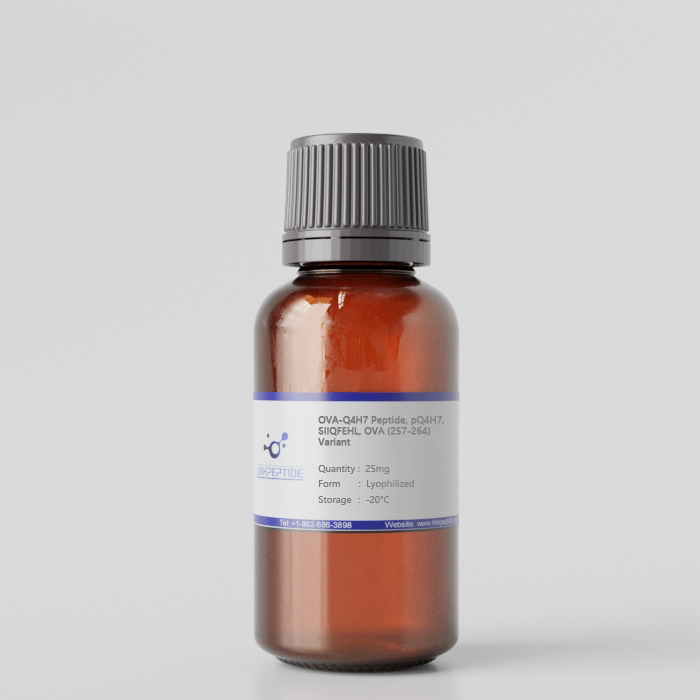
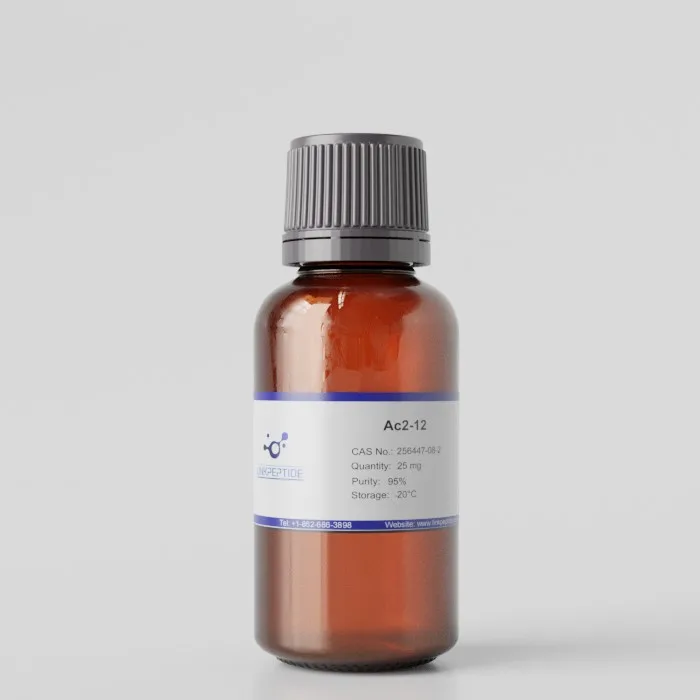
Product Name: OVA-Q4H7 Peptide, pQ4H7, SIIQFEHL, OVA (257-264) Variant
Sequence One Letter Code: SIIQFEHL
Sequence Three Letter Code: H-Ser-Ile-Ile-Gln-Phe-Glu-His-Leu-OH
Chemical Formula:C46H71N11O13
Molecular Weight: 986.2
Purity: 95%
Form: Lyophilized
Storage Conditions: - 20 °C
Research Area: Inflammation and Immunology Research
Source / Species: chicken
Conjugation: Unconjugated
Code Nacres: NA.26
Application: OVA-Q4H7 Peptide (SIIQFEHL) is a variant of the well-known ovalbumin epitope SIINFEKL, containing a single amino acid substitution that alters T-cell receptor signaling. This peptide is presented by MHC class I molecule H-2Kb and is widely used in murine immunology models to study CD8⁺ T-cell responses. Compared to the native epitope, Q4H7 exhibits modified immunogenicity, making it useful for investigating T-cell activation thresholds, signal strength, and immune tolerance. It is commonly applied in studies of antigen presentation, T-cell differentiation, and immune modulation. This peptide supports research into adaptive immunity, T-cell signaling, and mechanisms underlying immune recognition and response.
Current Research: The OVA-Q4H7 peptide (SIIQFEHL) is a modified version of the classical ovalbumin-derived epitope SIINFEKL, one of the most extensively studied model antigens in immunology. Presented by the MHC class I molecule H-2Kb, this peptide is widely used in murine systems to investigate CD8⁺ T-cell activation, antigen recognition, and immune signaling dynamics. The single amino acid substitution in Q4H7 alters its interaction with the T-cell receptor (TCR), providing a powerful tool for studying how subtle changes in peptide structure influence immune responses. Variant Peptides and T-Cell Receptor Signaling T-cell activation is highly dependent on the affinity and stability of peptide–MHC (pMHC) complexes and their interaction with T-cell receptors. Even minor changes in peptide sequence can significantly impact: TCR binding strength (affinity/avidity) Duration of signaling (dwell time) Downstream signaling pathways and functional outcomes The OVA-Q4H7 peptide contains a single amino acid substitution relative to SIINFEKL, resulting in altered TCR engagement. This makes it a variant or altered peptide ligand (APL), which can modulate T-cell responses rather than simply activating or failing to activate them. Presentation by H-2Kb and CD8⁺ T-Cell Recognition Like the native SIINFEKL epitope, OVA-Q4H7 is presented on the cell surface by H-2Kb MHC class I molecules, enabling recognition by antigen-specific CD8⁺ T cells. This compatibility allows researchers to directly compare immune responses elicited by the native and variant peptides within the same experimental system. Because the peptide–MHC binding framework remains largely intact, differences in immune response can be attributed primarily to changes in TCR signaling, rather than differences in antigen presentation efficiency. Modulating T-Cell Activation and Signal Strength One of the most important applications of OVA-Q4H7 is in studying how T-cell activation thresholds are regulated. Compared to the native SIINFEKL peptide, Q4H7 typically induces: Reduced or altered TCR signaling intensity Changes in cytokine production profiles Differences in proliferation and differentiation outcomes These properties make it an ideal tool for dissecting how T cells interpret signals of varying strength and quality. By comparing responses to strong agonists (like SIINFEKL) and weaker or altered ligands (like Q4H7), researchers can better understand how signal strength influences T-cell fate decisions. Applications in Immune Tolerance and Differentiation Altered peptide ligands such as OVA-Q4H7 are particularly valuable for studying immune tolerance mechanisms. Because they can deliver suboptimal or partial activation signals, they are often used to explore: T-cell anergy (functional unresponsiveness) Peripheral tolerance mechanisms Regulatory T-cell induction Exhaustion and dysfunction in chronic stimulation settings Additionally, Q4H7 can be used to investigate how variations in TCR signaling affect CD8⁺ T-cell differentiation, including the development of effector versus memory phenotypes. Applications in Immunological Research The OVA-Q4H7 peptide is widely used across multiple areas of immunology due to its well-characterized behavior and compatibility with established OVA model systems. Common applications include: T-cell activation and signaling studies Comparative analysis of altered peptide ligands (APLs) Investigation of antigen presentation and pMHC stability Studies of immune tolerance and T-cell anergy Evaluation of differentiation pathways in CD8⁺ T cells Because it enables controlled modulation of TCR signaling, it is especially useful in mechanistic studies of adaptive immunity. Insights into Immune Recognition and Response The use of variant peptides like OVA-Q4H7 has significantly advanced understanding of how T cells distinguish between different antigenic signals. These studies have revealed that T-cell responses are not binary but instead exist along a spectrum of activation states, influenced by signal strength, duration, and context. Such insights are critical for understanding immune responses in infections, cancer, and autoimmunity, where subtle differences in antigen recognition can have major biological consequences. A Powerful Tool for Studying T-Cell Signaling Dynamics The OVA-Q4H7 peptide (SIIQFEHL) provides a refined experimental system for probing the nuances of T-cell activation. By introducing a single amino acid change into a well-established antigenic framework, it allows researchers to dissect how TCR signaling strength and quality shape immune outcomes. Through its application in studies of antigen presentation, T-cell differentiation, and immune tolerance, OVA-Q4H7 continues to be an essential tool for advancing research in adaptive immunity and immune regulation.
Get a Quote
 LinkPeptide