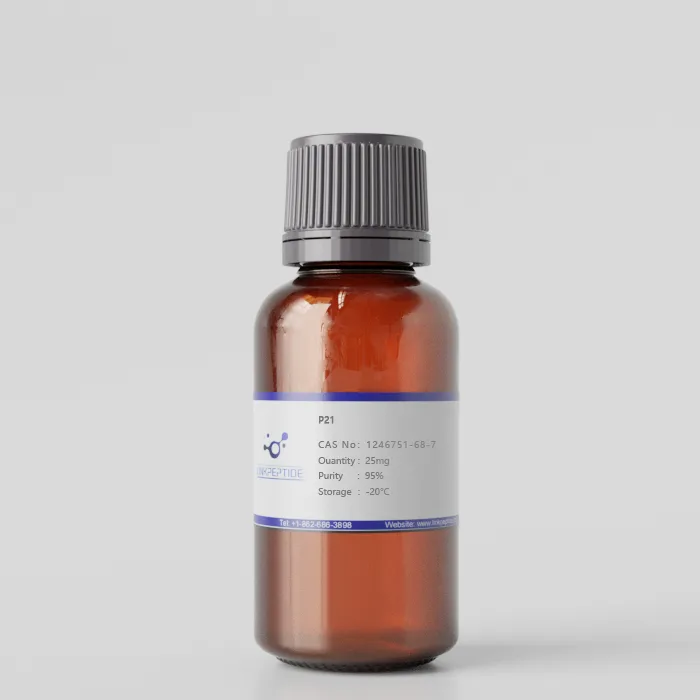
Product Name:P21
Cas No:1246751-68-7
Purity:95%
Chemical Formula:C27H42N6O8
Molar Mass:578.7
Synonyms:P-21 nootropic peptide; VV8CZC8PAS; Ac-dggl-adamatanylglycine-NH2
IUPAC Name:(3S)-3-acetamido-4-[[2-[[2-[[(2S)-1-[(3-carbamoyl-1-adamantyl)amino]-4-methyl-1-oxopentan-2-yl]amino]-2-oxoethyl]amino]-2-oxoethyl]amino]-4-oxobutanoic acid
SMILES:CC(C)C[C@@H](C(=O)NC12CC3CC(C1)CC(C3)(C2)C(=O)N)NC(=O)CNC(=O)CNC(=O)[C@H](CC(=O)O)NC(=O)C
InChIKey:LUJZBZPLIRWWGJ-ZKHAZHQOSA-N
InChI:InChI=1S/C27H42N6O8/c1-14(2)4-18(24(40)33-27-9-16-5-17(10-27)8-26(7-16,13-27)25(28)41)32-21(36)12-29-20(35)11-30-23(39)19(6-22(37)38)31-15(3)34/h14,16-19H,4-13H2,1-3H3,(H2,28,41)(H,29,35)(H,30,39)(H,31,34)(H,32,36)(H,33,40)(H,37,38)/t16,17,18-,19-,26,27/m0/s1
Storage:-20 degree Celsius
Sequence:DGGL
Application:P-21 is a synthetic nootropic peptide engineered to promote neuroplasticity, memory formation, and neural repair. It is structurally related to Cerebrolysin-derived fragments and includes active regions that mimic brain-derived neurotrophic factor (BDNF) activity. P-21 enhances synaptogenesis, supports neuronal survival, and modulates cholinergic and glutamatergic transmission. It has been studied for use in models of age-related cognitive decline, Alzheimer’s disease, traumatic brain injury (TBI), and stroke recovery. P-21 is a highly selective research tool for exploring long-term potentiation (LTP) and brain resilience mechanisms in neurodegenerative and nootropic peptide studies.
Current Research:
Introduction: What Is P-21? P-21 is a synthetic neuropeptide developed as a nootropic and neurotrophic agent, primarily designed to emulate the regenerative and cognitive-enhancing actions of Cerebrolysin, a well-known peptide mixture used in stroke and dementia research. Unlike Cerebrolysin, which contains a broad spectrum of peptide fragments, P-21 is a defined sequence designed to target key neurotrophic pathways with greater specificity and improved pharmacological consistency. Its sequence incorporates active domains that mimic BDNF activity, thereby promoting neuron growth, survival, and synaptic remodeling—all of which are critical for learning and memory. Mechanism of Action: BDNF-Like Neurotrophic Modulation P-21 is believed to work by: Upregulating BDNF (Brain-Derived Neurotrophic Factor) and NGF (Nerve Growth Factor) signaling Enhancing CREB phosphorylation, a transcription factor linked to memory consolidation Promoting synaptic plasticity, the physiological basis of long-term memory Supporting axon growth, dendritic spine formation, and neurogenesis in hippocampal regions These mechanisms make P-21 particularly relevant in models involving hippocampal degeneration, such as Alzheimer’s disease, aging, and chronic stress. Cognitive Enhancement and Memory Research Preclinical studies suggest that P-21 improves learning speed, working memory, and spatial memory. It has been tested in animal models using: Morris water maze Passive avoidance test Novel object recognition tasks P-21-treated animals consistently perform better than controls, with evidence pointing toward enhanced long-term potentiation (LTP)—the electrophysiological signature of learning. Its effects appear to be non-stimulatory, offering gradual but durable cognitive enhancement, unlike traditional psychostimulants. Neurodegeneration and Alzheimer’s Disease Models P-21 is under investigation for its potential in Alzheimer’s and other dementias, where BDNF levels are pathologically reduced. In animal models: P-21 reduces amyloid-beta–induced neurotoxicity Attenuates tau hyperphosphorylation Preserves synaptic density Improves cognitive performance under neurotoxic challenge It also modulates microglial activity and reduces inflammatory cytokines, showing a dual neuroprotective and anti-inflammatory profile. Stroke and Traumatic Brain Injury (TBI) Like Cerebrolysin, P-21 is being evaluated in ischemic and traumatic CNS injury models, where it promotes: Axonal sprouting and functional recovery Angiogenesis and revascularization of damaged tissue Enhanced motor coordination and cognitive rehabilitation It supports post-injury remodeling, making it suitable for studies on stroke recovery, neuroplasticity induction, and brain rehabilitation. Chronic Stress, Aging, and Resilience Cognitive deficits from chronic stress and aging are often associated with hippocampal shrinkage and reduced BDNF. P-21 may reverse or buffer these effects by: Restoring dendritic complexity Supporting hippocampal neurogenesis Reducing glucocorticoid-induced neuronal atrophy This places P-21 in line with anti-aging nootropics aimed at preserving cognitive flexibility and mental performance during prolonged stress or aging. Formulation and Delivery Although research is ongoing, P-21 is typically studied via: Intranasal delivery, for non-invasive CNS targeting Subcutaneous injection, for systemic neurotrophic effects Emerging oral analogs with protective encapsulation strategies Its longer half-life and improved stability compared to native neurotrophic peptides make it a flexible tool in both acute injury models and chronic cognitive research. Conclusion: A Precision Nootropic for Neurorestoration P-21 represents a refined approach to neurotrophic peptide therapy, targeting core mechanisms of learning, memory, and regeneration. With its BDNF-mimetic action, enhanced synaptic plasticity, and neuroprotective properties, P-21 is a powerful candidate for addressing cognitive impairment, aging, and neurodegeneration. As interest in targeted nootropics and peptide-based neurotherapeutics grows, P-21 offers a robust, research-focused tool for next-generation brain health strategies.
Reference:
Get a Quote
 LinkPeptide