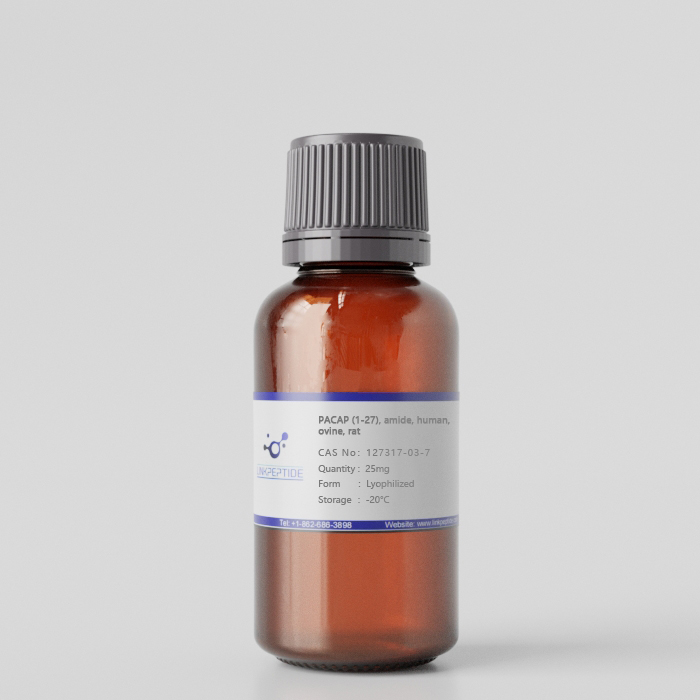
Product Name: PACAP (1-27), amide, human, ovine, rat
Sequence One Letter Code: HSDGIFTDSYSRYRKQMAVKKYLAAVL-NH2
Sequence Three Letter Code: H-His-Ser-Asp-Gly-Ile-Phe-Thr-Asp-Ser-Tyr-Ser-Arg-Tyr-Arg-Lys-Gln-Met-Ala-Val-Lys-Lys-Tyr-Leu-Ala-Ala-Val-Leu-NH2
Cas No: 127317-03-7
Chemical Formula:C142H224N40O39S
Molecular Weight: 3147.8
Purity: ≥ 95%
Form: Lyophilized
Storage Conditions: - 20 °C
SMILES: CCC(C)C(C(=O)NC(CC1=CC=CC=C1)C(=O)NC(C(C)O)C(=O)NC(CC(=O)O)C(=O)NC(CO)C(=O)NC(CC2=CC=C(C=C2)O)C(=O)NC(CO)C(=O)NC(CCCNC(=N)N)C(=O)NC(CC3=CC=C(C=C3)O)C(=O)NC(CCCNC(=N)N)C(=O)NC(CCCCN)C(=O)NC(CCC(=O)N)C(=O)NC(CCSC)C(=O)NC(C)C(=O)NC(C(C)C)C(=O)NC(CCCCN)C(=O)NC(CCCCN)C(=O)NC(CC4=CC=C(C=C4)O)C(=O)NC(CC(C)C)C(=O)NC(C)C(=O)NC(C)C(=O)NC(C(C)C)C(=O)NC(CC(C)C)C(=O)N)NC(=O)CNC(=O)C(CC(=O)O)NC(=O)C(CO)NC(=O)C(CC5=CN=CN5)N
IUPAC: 4-[[2-[[1-[[1-[[1-[[1-[[1-[[1-[[1-[[1-[[1-[[1-[[6-amino-1-[[5-amino-1-[[1-[[1-[[1-[[6-amino-1-[[6-amino-1-[[1-[[1-[[1-[[1-[[1-[(1-amino-4-methyl-1-oxopentan-2-yl)amino]-3-methyl-1-oxobutan-2-yl]amino]-1-oxopropan-2-yl]amino]-1-oxopropan-2-yl]amino]-4-methyl-1-oxopentan-2-yl]amino]-3-(4-hydroxyphenyl)-1-oxopropan-2-yl]amino]-1-oxohexan-2-yl]amino]-1-oxohexan-2-yl]amino]-3-methyl-1-oxobutan-2-yl]amino]-1-oxopropan-2-yl]amino]-4-methylsulfanyl-1-oxobutan-2-yl]amino]-1,5-dioxopentan-2-yl]amino]-1-oxohexan-2-yl]amino]-5-carbamimidamido-1-oxopentan-2-yl]amino]-3-(4-hydroxyphenyl)-1-oxopropan-2-yl]amino]-5-carbamimidamido-1-oxopentan-2-yl]amino]-3-hydroxy-1-oxopropan-2-yl]amino]-3-(4-hydroxyphenyl)-1-oxopropan-2-yl]amino]-3-hydroxy-1-oxopropan-2-yl]amino]-3-carboxy-1-oxopropan-2-yl]amino]-3-hydroxy-1-oxobutan-2-yl]amino]-1-oxo-3-phenylpropan-2-yl]amino]-3-methyl-1-oxopentan-2-yl]amino]-2-oxoethyl]amino]-3-[[2-[[2-amino-3-(1H-imidazol-5-yl)propanoyl]amino]-3-hydroxypropanoyl]amino]-4-oxobutanoic acid
INCHIKEY: RZGBUJXSKLDAFE-UHFFFAOYSA-N
INCHI:
InChI=1S/C142H224N40O39S/c1-16-75(10)113(179-108(191)66-156-120(201)102(63-109(192)193)173-135(216)104(67-183)176-119(200)88(146)62-84-65-153-70-157-84)139(220)174-101(58-80-28-18-17-19-29-80)133(214)182-114(79(14)186)140(221)175-103(64-110(194)195)132(213)178-106(69-185)136(217)172-100(61-83-39-45-87(189)46-40-83)131(212)177-105(68-184)134(215)164-93(34-27-54-155-142(151)152)126(207)170-98(59-81-35-41-85(187)42-36-81)129(210)163-92(33-26-53-154-141(149)150)124(205)161-89(30-20-23-50-143)122(203)165-94(47-48-107(147)190)127(208)166-95(49-55-222-15)121(202)159-78(13)118(199)180-111(73(6)7)137(218)167-91(32-22-25-52-145)123(204)162-90(31-21-24-51-144)125(206)171-99(60-82-37-43-86(188)44-38-82)130(211)169-97(57-72(4)5)128(209)160-76(11)116(197)158-77(12)117(198)181-112(74(8)9)138(219)168-96(115(148)196)56-71(2)3/h17-19,28-29,35-46,65,70-79,88-106,111-114,183-189H,16,20-27,30-34,47-64,66-69,143-146H2,1-15H3,(H2,147,190)(H2,148,196)(H,153,157)(H,156,201)(H,158,197)(H,159,202)(H,160,209)(H,161,205)(H,162,204)(H,163,210)(H,164,215)(H,165,203)(H,166,208)(H,167,218)(H,168,219)(H,169,211)(H,170,207)(H,171,206)(H,172,217)(H,173,216)(H,174,220)(H,175,221)(H,176,200)(H,177,212)(H,178,213)(H,179,191)(H,180,199)(H,181,198)(H,182,214)(H,192,193)(H,194,195)(H4,149,150,154)(H4,151,152,155)
Source / Species: human, ovine, rat
Conjugation: Unconjugated
Code Nacres: NA.26
Application: PACAP-27 is the amidated N-terminal fragment of PACAP-38, a neuropeptide originally isolated from bovine hypothalamus and highly conserved across humans and rodents. It shares structural homology with vasoactive intestinal polypeptide but is a more potent stimulator of adenylate cyclase activity. PACAP-27 activates type I PACAP receptors, increasing intracellular cAMP accumulation and calcium signaling. This peptide is widely used in neuroscience, endocrinology, and receptor signaling research. PACAP-27 is especially valuable for studying neuroprotection, neurotransmission, neuroendocrine regulation, peptide receptor pharmacology, and intracellular signaling pathways mediated by PACAP receptors.
Get a Quote
 LinkPeptide