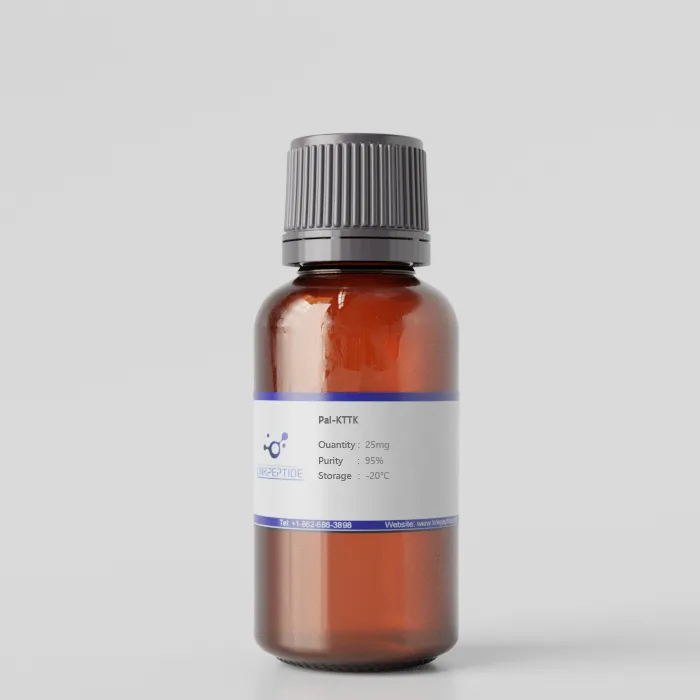
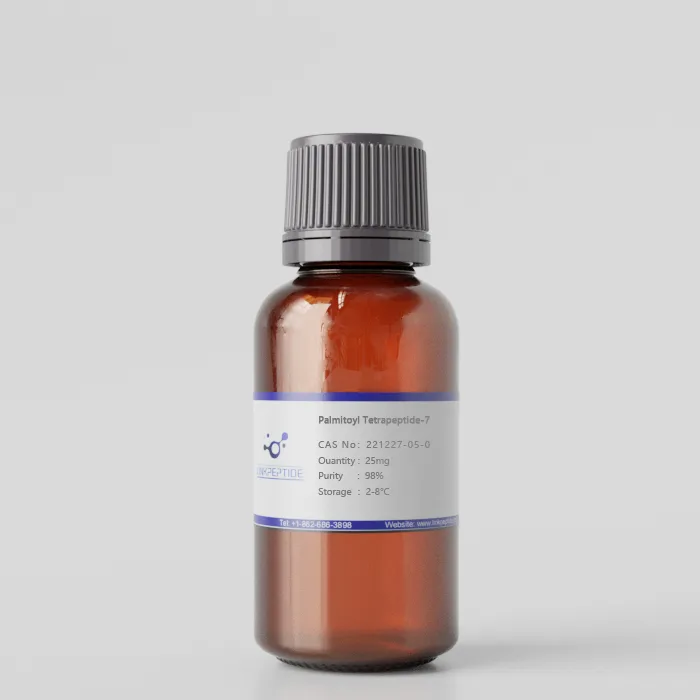
Product Name: Pal-KTTK
Purity: 95%
Storage: Keep in dark and cool dry place -5~8 degree Celsius
Sequence: Pal-Lys-Thr-Thr-Lys
Application:
Pal-KTTK is a palmitoylated tetrapeptide designed to enhance skin penetration and support visible anti-aging benefits. By combining the KTTK peptide sequence with a lipidic palmitoyl group, it improves stability and affinity for the skin barrier, enabling targeted activity within the deeper layers. In cosmetic research, Pal-KTTK is valued for helping promote firmness, refine texture, and reduce the appearance of fine lines through improved extracellular matrix support. Its strong compatibility with serums, emulsions, and advanced anti-wrinkle treatments makes it ideal for formulations aimed at restoring smoothness, elasticity, and a more youthful-looking complexion.
Current Research:
Pal-KTTK (Palmitoyl Tetrapeptide-KTTK): Research Overview
Pal-KTTK is a synthetic lipo-tetrapeptide composed of a four–amino-acid sequence (Lys–Thr–Thr–Lys) conjugated to a palmitoyl (C16) fatty acid chain at the N-terminus. This design combines the signaling capability of a small, cationic/polar peptide with enhanced lipophilicity and membrane affinity provided by the palmitoyl moiety. The molecule is part of the broader class of acylated signal peptides investigated for their activity on extracellular matrix (ECM) regulation, dermal repair, and cutaneous stress-response pathways.
The tetrapeptide KTTK contains:
Two lysine residues providing a positive charge and electrostatic interaction potential with cell membranes and extracellular proteins.
Two threonine residues offering hydrogen-bonding capability and polarity.
A palmitoyl fatty acid that increases hydrophobicity, improves stratum corneum penetration, and protects the peptide from proteolytic degradation.
This amphiphilic profile allows Pal-KTTK to anchor in lipid environments while still interacting with aqueous-phase biological targets. Its relatively small molecular size supports diffusion within epidermal and superficial dermal regions when delivered in suitable carriers.
Research on acylated short peptides with similar charge distribution and length indicates a role in ECM support and fibroblast signaling. Pal-KTTK is generally grouped within signal peptides that influence dermal protein turnover. Model systems evaluating this molecular class show:
Increased synthesis of type I collagen, the major structural collagen in the dermis.
Upregulation of fibronectin, which mediates cell adhesion and matrix assembly.
Normalization of MMP/TIMP balance, contributing to reduced matrix degradation.
Because the lysine-rich sequence can interact electrostatically with ECM components and cell-surface receptors, Pal-KTTK is placed within pathways that modulate fibroblast behavior and tissue renewal.
Tetrapeptides and pentapeptides containing threonine/lysine patterns have been evaluated for effects on the dermal–epidermal junction. In reconstructed skin models, peptides of this class contribute to:
Increased expression of laminin and collagen IV, structural components of the basement membrane.
Improved anchoring fiber organization, influencing epidermal–dermal cohesion.
Smoother and more continuous DEJ morphology under imaging analysis.
These findings suggest that Pal-KTTK may participate in supporting DEJ integrity, which is relevant to mechanical strength, wrinkle formation, and tissue resilience.
Short lipo-peptides with cationic residues have documented activity on keratinocyte communication pathways. Observed outcomes in related systems include:
Enhanced keratinocyte viability and metabolic activity under mild stress.
Improved expression of barrier-related markers associated with the granular layer.
Better organization of stratum corneum layers in reconstructed epidermis.
These observations connect Pal-KTTK to barrier maintenance, an important consideration in environments experiencing UV, pollution, or surfactant-induced stress.
While direct anti-inflammatory datasets for Pal-KTTK specifically are limited, analogous palmitoylated tetrapeptides show modulation of:
Low-grade inflammatory signaling involving IL-1 family cytokines.
Oxidative-stress markers related to reactive oxygen species accumulation.
Cellular stress-response pathways that influence senescence-associated changes.
The structural relevance lies in the histone- and matrix-associated binding potential of lysine residues, which can indirectly influence regulatory processes in stressed keratinocytes or fibroblasts.
In cosmetic science, Pal-KTTK is positioned within research frameworks that examine:
Structural visualization (collagen density, ECM uniformity).
Surface microrelief changes (wrinkle depth, textural evenness).
Barrier recovery after controlled disruption.
Firmness and elasticity indices measured by biomechanical assays.
Its activity is understood not as a singular mechanistic effect, but as a composite influence on ECM synthesis, DEJ structure, and epidermal support pathways driven by the combination of peptide sequence and lipid anchoring.
Pal-KTTK is:
Lipophilic, favoring incorporation into emulsions, lipid carriers, liposomes, and nanoemulsions.
Generally added during cool-down stages to preserve peptide integrity.
Stable under standard cosmetic pH conditions when protected from oxidation.
Used at low concentrations consistent with high-potency signaling peptides.
Its amphiphilic nature allows partitioning into both aqueous and lipid microdomains, useful for targeted delivery to the upper dermis or viable epidermis.
Summary
Pal-KTTK (Palmitoyl Tetrapeptide-KTTK) is a palmitoylated signal tetrapeptide studied for roles in extracellular-matrix support, dermal–epidermal junction reinforcement, keratinocyte communication, and structural preservation under environmental or age-related stress. Its molecular architecture—short, positively charged peptide linked to a lipophilic tail—supports stability, membrane interaction, and bioactivity in cutaneous research models.
Get a Quote
 LinkPeptide