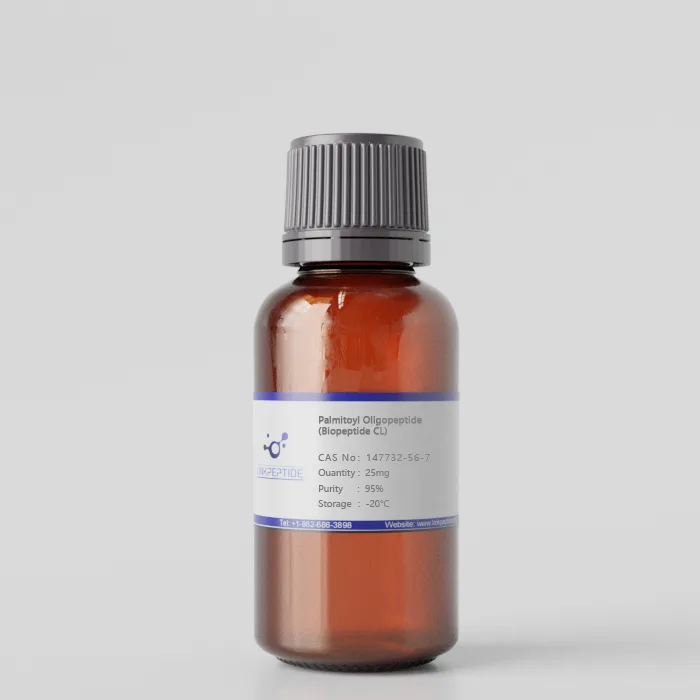
Product Name: Palmitoyl Oligopeptide (Biopeptide CL)
Cas No: 147732-56-7
Purity: 95%
Storage: Keep in dark and cool dry place -5~8 degree Celsius
Sequence: Pal-GHK (Pal-Tripeptide-1)
Molar Mass: 578.8
Chemical Formula: C30H54N6O5
IUPAC Name: (2S)-6-amino-2-[[(2S)-2-[[2-(hexadecanoylamino)acetyl]amino]-3-(1H-imidazol-5-yl)propanoyl]amino]hexanoic acid
SMILES: CCCCCCCCCCCCCCCC(=O)NCC(=O)N[C@@H](CC1=CN=CN1)C(=O)N[C@@H](CCCCN)C(=O)O
InChIKey: BYUQATUKPXLFLZ-UIOOFZCWSA-N
InChI: InChI=1S/C30H54N6O5/c1-2-3-4-5-6-7-8-9-10-11-12-13-14-18-27(37)33-22-28(38)35-26(20-24-21-32-23-34-24)29(39)36-25(30(40)41)17-15-16-19-31/h21,23,25-26H,2-20,22,31H2,1H3,(H,32,34)(H,33,37)(H,35,38)(H,36,39)(H,40,41)/t25-,26-/m0/s1
Application:
Palmitoyl Oligopeptide (Biopeptide CL) is a lipidated bioactive peptide designed to support visible skin firmness, smoothness, and rejuvenation. By enhancing penetration through its palmitoyl group, this peptide helps stimulate key components of the extracellular matrix, including collagen and glycosaminoglycans. In cosmetic research, Biopeptide CL is widely used to explore improved elasticity, reduced appearance of fine lines, and overall strengthening of the skin’s structural framework. Its excellent stability and formulation versatility make it ideal for anti-aging serums, creams, and targeted treatments aiming to deliver a firmer, more refined, youthful-looking complexion.
Current Research:
Palmitoyl Oligopeptide (Biopeptide CL): Research Overview
Palmitoyl Oligopeptide, widely known under the trade name Biopeptide CL, is a synthetic lipo-oligopeptide designed as a biomimetic signal fragment for dermal extracellular matrix (ECM) regulation. In most technical contexts it corresponds to Palmitoyl-Gly-Gln-Pro-Arg (Pal-GQPR), a four–amino-acid sequence derived from regions of the IgG heavy chain, conjugated to a palmitic acid (C16) at the N-terminus. The peptide is used in skin research as a matrix-acting signal peptide for collagen, fibronectin, and glycosaminoglycan support.
Biopeptide CL is built from:
Glycine (Gly) – small, flexible residue contributing to backbone mobility.
Glutamine (Gln) – polar, involved in hydrogen bonding and protein–protein interaction.
Proline (Pro) – cyclic residue imposing conformational constraints and often found in structural motifs.
Arginine (Arg) – positively charged at physiological pH, capable of electrostatic interaction with negatively charged proteins and glycosaminoglycans.
The palmitoyl group confers lipophilicity, enabling:
Insertion into stratum corneum lipid domains.
Improved residence time in the epidermal and superficial dermal regions.
Increased resistance to proteolytic degradation relative to the non-acylated peptide.
This amphiphilic design allows the peptide headgroup to remain exposed to the aqueous environment near cells while the lipid tail anchors the molecule in membranes and intercellular lipids.
Palmitoyl-GQPR is modeled on a fragment of the immunoglobulin G heavy chain, where short peptides released during physiological turnover can act as matrikine-like sequences—small protein fragments that signal tissue remodeling and repair. In skin, Biopeptide CL is investigated as a fibroblast- and ECM-signaling peptide, intended to reproduce aspects of this endogenous feedback.
In vitro studies with fibroblasts suggest that oligopeptides of this type can:
Modulate expression of genes associated with structural proteins.
Influence secretion of ECM components and adhesion molecules.
Interact indirectly with growth factor and cytokine networks that govern dermal remodeling.
Experimental data on Biopeptide CL and related palmitoylated oligopeptides report:
Increased synthesis of collagen type I and III, central to dermal tensile strength and resiliency.
Upregulation of fibronectin, which acts as a scaffold for matrix assembly and cell adhesion.
Enhancement of glycosaminoglycan and hyaluronic acid levels, contributing to dermal hydration and volume.
These effects are typically documented in cultured human fibroblasts or skin-organ models, where peptide exposure results in denser and more organized collagen/fibronectin networks compared with untreated controls.
The dermal–epidermal junction (DEJ) and papillary dermis are key targets for Biopeptide CL–type actives. ECM modulation at this level is associated with:
Improved continuity of basement-membrane components (laminins, collagen IV).
Better integration of collagen fibers immediately below the DEJ.
Enhanced mechanical coupling between epidermis and dermis, which supports resistance to shear and folding.
In ex vivo models, peptide-containing preparations are associated with a more homogeneous, fine, and dense matrix in the upper dermis, consistent with reinforcement of the DEJ region.
Cosmetic-style studies using formulations containing Palmitoyl Oligopeptide often measure:
Wrinkle depth and volume via profilometry or optical 3D imaging on crow’s feet or nasolabial folds.
Surface roughness and microrelief regularity, reflecting fine-line smoothing.
Firmness and elasticity indices (for example, using cutometry).
Observed improvements over several weeks of regular application are interpreted as the macroscopic expression of underlying matrix changes: increased collagen/fibronectin content, better ECM organization, and improved DEJ structure.
Biopeptide CL is also frequently studied in combination with other peptides (for example, tripeptide complexes or additional palmitoylated peptides) in multi-pathway systems aimed at simultaneously targeting collagen production, matrix protection, and epidermal renewal.
Matrix degradation in aging skin is influenced not only by reduced synthesis but also by chronic low-grade inflammation and oxidative stress. Biopeptide CL, through its ECM-supporting effect, is studied within broader frameworks that consider:
Normalization of MMP/TIMP balance, favoring matrix preservation.
Indirect effects on cellular stress responses by improving extracellular environment quality.
Contributions to “inflammaging” attenuation when used alongside antioxidants and barrier-supporting actives.
While direct anti-inflammatory actions are less characterized than its matrix effects, the peptide is conceptually integrated into strategies that address both structural and biochemical aspects of dermal aging.
Palmitoyl Oligopeptide (Biopeptide CL) is:
Lipophilic, usually supplied pre-dissolved in suitable cosmetic solvents or dispersions.
Incorporated into emulsions, serums, gels, or liposomal/nanoemulsion systems designed to enhance delivery to the DEJ and upper dermis.
Typically added in cool-down stages to preserve peptide integrity.
Used at low active levels, consistent with high-affinity signal peptides.
Proper formulation aims to maintain the lipopeptide’s stability, ensure its partitioning into relevant skin compartments, and optimize its interaction with fibroblasts and ECM structures.
Summary
Palmitoyl Oligopeptide (Biopeptide CL / Pal-GQPR) is a palmitoylated IgG-derived oligopeptide studied as a dermal signal peptide that supports collagen, fibronectin, and glycosaminoglycan production, reinforces DEJ and papillary dermis architecture, and contributes to improved structural and surface-aging parameters in experimental skin models.
Get a Quote
 LinkPeptide