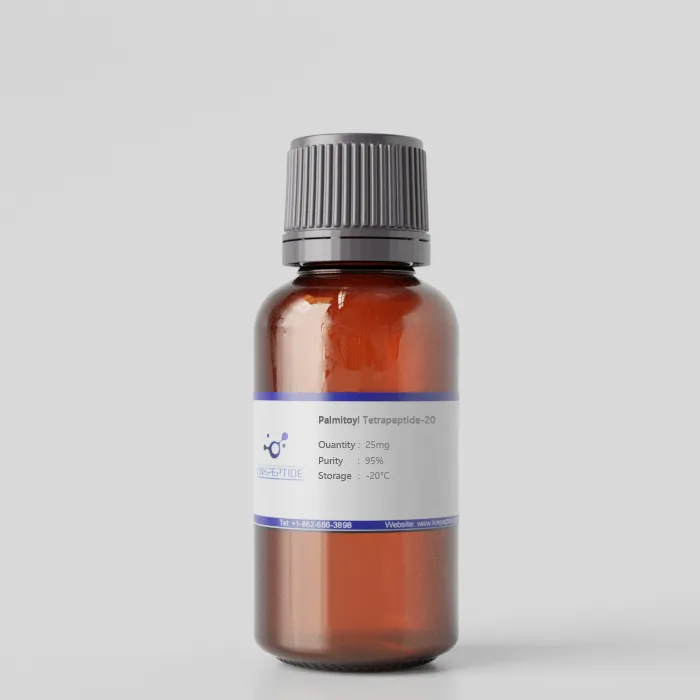
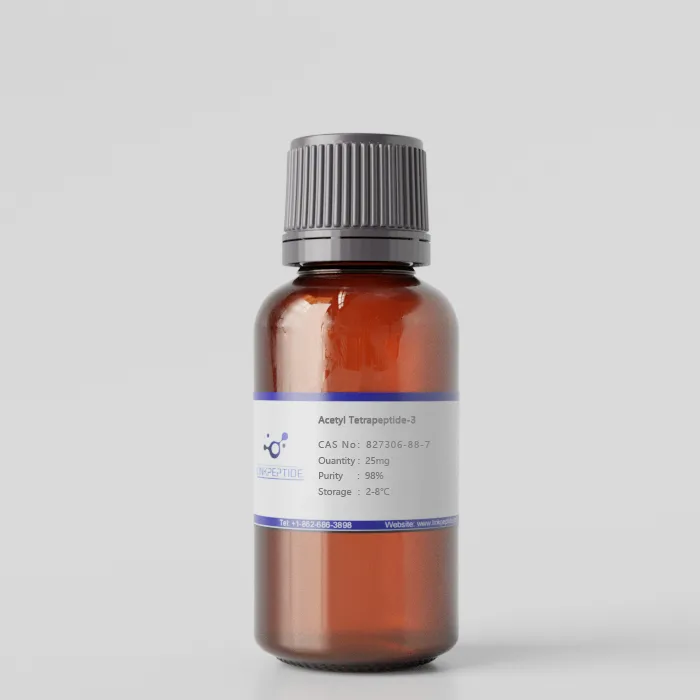
Product Name: Palmitoyl Tetrapeptide-20
Purity: 95%
Storage: Keep in dark and cool dry place -5~8 degree Celsius
Sequence: Pal-His-(D-Phe)-Arg-Trp-NH2
Molar Mass: 739
Chemical Formula: C38H70N6O8
Synonyms: PTP20; HY-P5247; CS-0863854
IUPAC Name: (2S)-6-amino-2-[[(2S)-6-amino-2-[[(2S)-4-carboxy-2-[[(2S)-1-hexadecanoylpyrrolidine-2-carbonyl]amino]butanoyl]amino]hexanoyl]amino]hexanoic acid
SMILES: CCCCCCCCCCCCCCCC(=O)N1CCC[C@H]1C(=O)N[C@@H](CCC(=O)O)C(=O)N[C@@H](CCCCN)C(=O)N[C@@H](CCCCN)C(=O)O
InChIKey: RDXSZDQGDFNPQD-YDPTYEFTSA-N
InChI: InChI=1S/C38H70N6O8/c1-2-3-4-5-6-7-8-9-10-11-12-13-14-23-33(45)44-28-19-22-32(44)37(50)42-30(24-25-34(46)47)36(49)41-29(20-15-17-26-39)35(48)43-31(38(51)52)21-16-18-27-40/h29-32H,2-28,39-40H2,1H3,(H,41,49)(H,42,50)(H,43,48)(H,46,47)(H,51,52)/t29-,30-,31-,32-/m0/s1
Application:
Palmitoyl Tetrapeptide-20 is a lipidated bioactive peptide engineered to enhance skin defense, firmness, and overall resilience. By combining a four–amino acid sequence with a palmitoyl group, it improves penetration and stability, making it highly effective in cosmetic research targeting strengthened barrier function and reduced signs of environmental stress. Palmitoyl Tetrapeptide-20 is commonly used to explore soothing activity, improved suppleness, and enhanced protection against pollution-induced dullness. Its strong compatibility with emulsions, serums, and advanced anti-aging formulations makes it ideal for treatments aimed at promoting smoother texture, renewed vitality, and a healthier-looking complexion.
Current Research:
Palmitoyl Tetrapeptide-20 (often abbreviated PTP20) is a synthetic lipopeptide designed as a biomimetic agonist of α-melanocyte–stimulating hormone (α-MSH). Structurally, it consists of a palmitic acid chain covalently attached to a tetrapeptide with the sequence Pro–Glu–Lys–Lys (Pal-Pro-Glu-Lys-Lys; single-letter PPEKK). The palmitoyl group provides a hydrophobic anchor, while the tetrapeptide segment is hydrophilic, giving the molecule amphiphilic properties and facilitating interaction with cell membranes and follicular structures.
Mechanism of action
Palmitoyl Tetrapeptide-20 functions as an α-MSH-mimetic ligand at the melanocortin 1 receptor (MC1R), expressed on follicular melanocytes. By binding MC1R with high affinity (reported AC50 around 0.16 nM), the peptide activates the canonical cAMP signaling cascade associated with melanogenesis. This activation leads to upregulation of microphthalmia-associated transcription factor (MITF), which in turn increases expression and activity of tyrosinase and related melanogenic enzymes, promoting synthesis of eumelanin and supporting maturation of melanosomes.
In co-culture models of normal human keratinocytes and melanocytes, Palmitoyl Tetrapeptide-20 at nanomolar concentrations has been shown to enhance melanosome transfer from melanocytes to keratinocytes by approximately 50%. This increased transfer is directly relevant to pigmentation of the hair shaft, as melanosomes must be efficiently transferred and incorporated into growing hair fibers to maintain visible color.
Oxidative stress and melanocyte protection
Hair greying is strongly associated with accumulation of hydrogen peroxide (H?O?) in the follicular microenvironment and a decline in endogenous antioxidant defenses, particularly catalase. Palmitoyl Tetrapeptide-20 has been reported to upregulate catalase expression and activity in follicular cells, resulting in a reduction of intracellular H?O? levels by up to about 30%. By decreasing oxidative stress, the peptide helps preserve melanocyte viability and functional capacity, reducing oxidative damage to cellular components involved in melanin synthesis.
Additional data indicate that Palmitoyl Tetrapeptide-20 can increase SIRT1 activity, linking the peptide to pathways involved in stress resistance, mitochondrial function, and cellular longevity. The combined effects on catalase and SIRT1 situate PTP20 at the intersection of pigment biology and redox homeostasis within the hair follicle.
Effects on hair pigmentation
In ex vivo and in vitro hair models, Palmitoyl Tetrapeptide-20 has been shown to promote melanin deposition within the hair shaft by acting at multiple stages of the pigmentation process: stimulation of melanogenesis via MC1R–cAMP–MITF signaling, enhancement of melanosome maturation, and increased transfer of pigmented melanosomes to keratinocytes forming the hair fiber. These mechanistic findings support its use in research aimed at delaying or reversing the progression of hair greying by maintaining eumelanin content and protecting follicular melanocytes from oxidative decline.
The peptide’s amphiphilic design is relevant here: the palmitoyl chain facilitates association with lipid domains in the follicular epithelium and hair shaft, potentially improving local concentration at the sites where melanosome transfer and hair fiber keratinization occur.
Skin-related findings
Beyond its primary focus on hair pigmentation, Palmitoyl Tetrapeptide-20 has also been described in the context of skin research as a signaling peptide capable of modulating fibroblast activity. Reports attribute to PTP20 an ability to stimulate synthesis of structural extracellular matrix components such as collagen and elastin, leading to improvements in skin firmness and wrinkle depth in topical applications with palmitoylated peptides. While these studies often consider palmitoyl peptide families collectively, Palmitoyl Tetrapeptide-20 fits mechanistically within the broader class of signal peptides that act on dermal fibroblasts and contribute to matrix remodeling.
Enhanced barrier function and increased hydration have also been reported for palmitoyl tetrapeptide actives, with effects attributed to improved organization of the stratum corneum and enhanced synthesis of dermal and epidermal structural proteins. Palmitoyl Tetrapeptide-20’s amphiphilic structure supports incorporation into both aqueous and lipid phases of skin formulations, which may influence its distribution within the stratum corneum and upper dermis.
Summary of research focus
Overall, Palmitoyl Tetrapeptide-20 is characterized in current literature as:
An α-MSH-mimetic, MC1R-activating lipopeptide that drives cAMP–MITF–tyrosinase signaling in melanocytes.
A protector of follicular melanocytes via upregulation of catalase and reduction of H?O?-mediated oxidative stress, with additional linkage to SIRT1-dependent stress responses.
A modulator of melanosome maturation and transfer in hair–follicle co-culture systems, leading to increased melanin content in hair fibers in experimental models.
A member of the broader signal peptide category with reported contributions to dermal matrix synthesis, skin elasticity, and barrier-related hydration parameters when used in topical preparations.
These findings form the current research basis for using Palmitoyl Tetrapeptide-20 in studies of hair pigment maintenance, oxidative protection of the follicle, and, to a lesser extent, cutaneous matrix and barrier support.
Get a Quote
 LinkPeptide