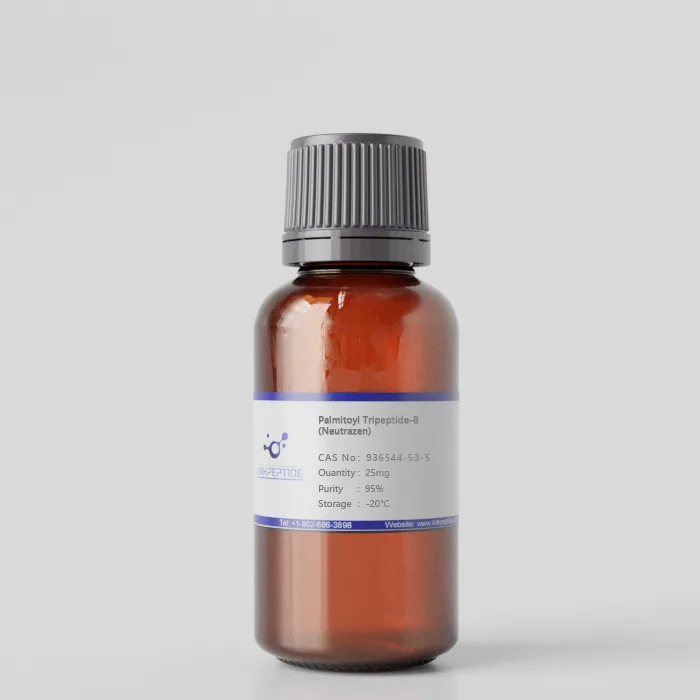
Product Name: Palmitoyl Tripeptide-8 (Neutrazen)
Cas No: 936544-53-5
Purity: 95%
Storage: Keep in dark and cool dry place -5~8 degree Celsius
Sequence: palmitoyl-His-D-Phe-Arg-NH2
Molar Mass: 695.9
Chemical Formula: C37H61N9O4
IUPAC Name: N-[(2S)-1-[[(2R)-1-[[(2S)-1-amino-5-(diaminomethylideneamino)-1-oxopentan-2-yl]amino]-1-oxo-3-phenylpropan-2-yl]amino]-3-(1H-imidazol-5-yl)-1-oxopropan-2-yl]hexadecanamide
SMILES: CCCCCCCCCCCCCCCC(=O)N[C@@H](CC1=CN=CN1)C(=O)N[C@H](CC2=CC=CC=C2)C(=O)N[C@@H](CCCN=C(N)N)C(=O)N
InChIKey: WBHUVOTYPRYBNG-QAXCHELISA-N
InChI: InChI=1S/C37H61N9O4/c1-2-3-4-5-6-7-8-9-10-11-12-13-17-22-33(47)44-32(25-29-26-41-27-43-29)36(50)46-31(24-28-19-15-14-16-20-28)35(49)45-30(34(38)48)21-18-23-42-37(39)40/h14-16,19-20,26-27,30-32H,2-13,17-18,21-25H2,1H3,(H2,38,48)(H,41,43)(H,44,47)(H,45,49)(H,46,50)(H4,39,40,42)/t30-,31+,32-/m0/s1
Application:
Palmitoyl Tripeptide-8 (Neutrazen) is a lipo-tripeptide designed to help soothe irritated skin, reduce visible redness, and reinforce long-term skin comfort. By modulating neurogenic inflammation pathways, Neutrazen supports the calming of reactive or sensitivity-prone skin while strengthening barrier resilience. It is widely used in cosmetic research targeting post-treatment soothing, environmental stress recovery, and reduced discomfort. The palmitoyl modification enhances penetration and stability, making it ideal for serums, creams, and sensitive-skin formulations. Palmitoyl Tripeptide-8 promotes a smoother, more balanced complexion and helps restore comfort to skin exposed to urban, thermal, or chemical stress.
Current Research:
Palmitoyl Tripeptide-8 (Neutrazen): Current Research Overview
Palmitoyl Tripeptide-8, widely known under trade names such as Neutrazen?, is a lipopeptide specifically developed for sensitive, reactive, and inflamed skin. Structurally, it’s a three–amino acid peptide linked to a palmitic acid chain, which improves its affinity for cell membranes and enhances penetration into the upper skin layers. It is positioned as a neuro-soothing, anti-inflammatory peptide that targets neurogenic inflammation – the nerve-driven component of redness, burning, and itching.
In modern cosmetic formulations, Palmitoyl Tripeptide-8 is used in face, body, and scalp products designed for sensitive, redness-prone, or post-procedure skin, and increasingly in barrier-repair lines.
Mechanism of Action: Substance P, Cytokines, and Neurogenic Inflammation
Sensitive and reactive skin is not only a barrier problem; it’s also a nervous system problem. When sensory nerve endings are overstimulated, they release neuropeptides such as Substance P, which then triggers the release of inflammatory cytokines and causes vasodilation, edema, and erythema.
Current technical and in vitro data describe Palmitoyl Tripeptide-8 acting along several key axes:
Reduction of Substance P release
Substance P is a major driver of neurogenic inflammation. Palmitoyl Tripeptide-8 has been shown to reduce Substance P–induced responses, which helps cut the cascade at an early stage. This leads to less vasodilation, decreased vascular permeability, and a reduction in redness and swelling.
Inhibition of inflammatory cytokines
The peptide also modulates the production of pro-inflammatory cytokines such as IL-1, IL-6, IL-8, and TNF-α in keratinocyte and fibroblast models. By lowering the levels of these mediators, it helps calm inflamed skin, reduce flare intensity, and prevent chronic low-grade inflammation that contributes to barrier damage and premature aging.
Attenuation of vasodilation and edema
Because neurogenic inflammation directly affects blood vessels, Palmitoyl Tripeptide-8 is reported to reduce vasodilation and neurogenic edema, which translates visually into less flushing, fewer visible red patches, and reduced swelling in irritated areas.
Restoration of the sensitivity threshold
A key marketing and mechanistic concept is that Palmitoyl Tripeptide-8 helps maintain and restore a normal skin sensitivity threshold. Over time, reactive skin tends to fire sensory nerves in response to very minor stimuli; by calming neurogenic signaling, the peptide helps skin behave more like “normal” skin again—less stinging, burning, and tightness in response to everyday triggers.
Place in Modern Cosmetic Peptide Science
Within the cosmetic peptide taxonomy, Palmitoyl Tripeptide-8 belongs to:
Neurocosmetic / neurosensory peptides – targeting nerve-related pathways (Substance P, neurogenic inflammation).
Sensitive-skin and anti-redness actives – designed to reduce erythema, flushing, and discomfort.
Inflammation-modulating peptides – acting on cytokines and microvascular responses.
It is often used alongside:
Barrier-repair ingredients (ceramides, cholesterol, fatty acids, ectoine),
Soothing agents (panthenol, bisabolol, madecassoside, allantoin),
Gentle humectants (glycerin, hyaluronic acid),
to build a complete “calm + repair” concept for sensitive or compromised skin. Some suppliers also highlight secondary benefits such as supporting collagen and ECM synthesis, linking it to prevention of premature aging associated with chronic inflammation.
In Vitro and Application-Level Data
Most available data come from manufacturer and ingredient-technical sources, but they are consistent and biologically plausible:
In cell and skin models, Palmitoyl Tripeptide-8 has been shown to:
Reduce Substance P–driven inflammatory responses,
Decrease expression and release of IL-1, IL-8, TNF-α and related markers,
Limit heat and chemical irritant–induced redness and temperature increase, indicating a real soothing effect.
Cosmetic-style tests on volunteers with sensitive or redness-prone skin typically report:
Reduced visible redness and blotchiness,
Less stinging, burning, and itching in response to known irritants or after procedures,
Improvements in comfort, smoothness, and overall skin feel within a few weeks of regular use.
These are standard cosmetic-level studies (small to medium sample sizes, short duration), so any claims should clearly remain in the comfort and appearance domain, not medical treatment of disease.
Safety and Formulation Considerations
Palmitoyl Tripeptide-8 is supplied as a high-purity synthetic lipopeptide, often pre-dissolved in water or glycols for easier use. Typical characteristics:
Usage levels: usually low, e.g. around 0.05–0.5% active peptide in finished formulas (depending on supplier solution strength).
Solubility and stability: designed to be compatible with standard emulsions, gels, and serums; generally stable across a typical cosmetic pH range and moderate processing temperatures.
Tolerance: safety and irritation testing support a very good tolerability profile, which is essential for sensitive-skin products and post-procedure care.
It is intended strictly for topical cosmetic use, not as a drug for treating diagnosed skin diseases or systemic neuropathic pain.
Get a Quote
 LinkPeptide