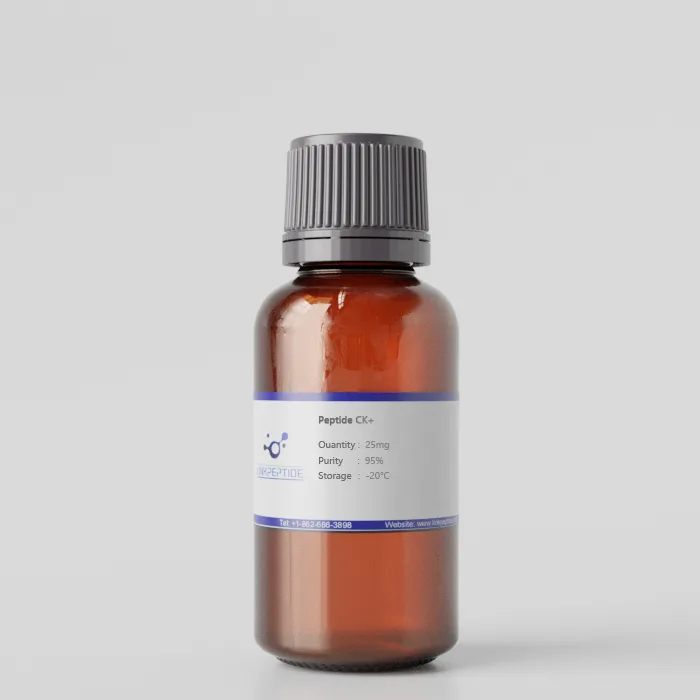
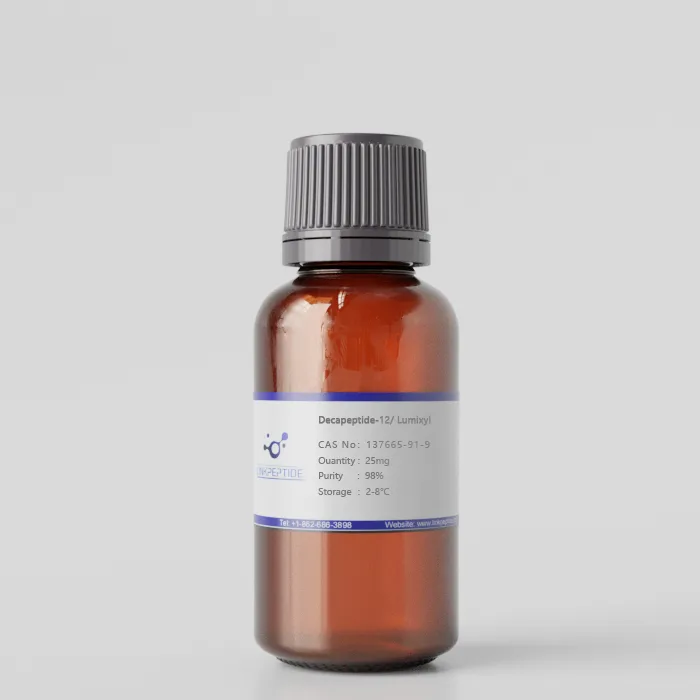
Product Name: Peptide CK+
Purity: 95%
Storage: Keep in dark and cool dry place -5~8 degree Celsius
Sequence: Ac-Arg-Lys-Arg-NH2
Molar Mass: 499.6
Chemical Formula: C20H41N11O4
IUPAC Name: (2S)-2-[[(2S)-2-acetamido-5-(diaminomethylideneamino)pentanoyl]amino]-6-amino-N-[(2S)-1-amino-5-(diaminomethylideneamino)-1-oxopentan-2-yl]hexanamide
SMILES: CC(=O)N[C@@H](CCCN=C(N)N)C(=O)N[C@@H](CCCCN)C(=O)N[C@@H](CCCN=C(N)N)C(=O)N
InChIKey: SISQGGKIXLSLMH-KKUMJFAQSA-N
InChI: InChI=1S/C20H41N11O4/c1-12(32)29-14(8-5-11-28-20(25)26)17(34)31-15(6-2-3-9-21)18(35)30-13(16(22)33)7-4-10-27-19(23)24/h13-15H,2-11,21H2,1H3,(H2,22,33)(H,29,32)(H,30,35)(H,31,34)(H4,23,24,27)(H4,25,26,28)/t13-,14-,15-/m0/s1
Application:
Peptide CK+ is an advanced bioactive peptide complex engineered to enhance skin firmness, clarity, and visible rejuvenation more effectively than standard peptide CK. With optimized stability and enhanced skin affinity, Peptide CK+ supports research focused on improving elasticity, refining texture, and reducing the look of fine lines. It also helps promote a brighter, more balanced complexion by supporting healthy epidermal communication and reinforcing the skin’s protective barrier. Ideal for high-performance serums, creams, and anti-aging treatments, Peptide CK+ delivers targeted support for revitalizing dull, stressed, or aging skin, contributing to a firmer and more radiant appearance.
Current Research:
Peptide CK+: Research Overview
Peptide CK+ is a cysteine–lysine–based micropeptide system developed as an enhanced variant of the original Peptide CK concept. It is typically defined as a short peptide or small peptide complex in which the Cys–Lys (CK) core is preserved and combined with additional residues and/or stabilizing modifications to improve redox performance, stability, and interaction with cutaneous structures. As with Peptide CK, the central focus is thiol-based redox activity, anti-glycation, and matrix preservation, but with extended activity and improved robustness under cosmetic use conditions.
The CK+ system retains:
Cysteine – providing a reactive thiol group for redox reactions, thiol–disulfide exchange, and metal binding.
Lysine – contributing a positively charged side chain for electrostatic interaction with acidic proteins, glycosaminoglycans, and phospholipids.
In CK+, this core is typically:
Embedded in a slightly longer peptide backbone (for example, additional neutral or polar residues) that modulates solubility and binding properties.
Stabilized through terminal modification (acetylation, amidation) or micro-encapsulation strategies that reduce oxidation and enzymatic degradation.
The result is a low–molecular-weight, highly water-soluble peptide system with strong chemical reactivity and improved in-formula stability compared with the base Cys–Lys dipeptide.
The thiol group of cysteine remains the functional center of CK+. Key redox-related behaviors include:
Scavenging of reactive oxygen species (ROS) such as hydroxyl and peroxyl radicals.
Reaction with lipid peroxides and reactive aldehydes formed during lipid oxidation.
Participation in thiol–disulfide exchange with oxidized proteins, contributing to restoration of native disulfide patterns.
Because Peptide CK+ is designed to be more stable and persistent in the skin environment, it can maintain an effective concentration of thiol functionality over longer exposure periods, enhancing its role as a secondary antioxidant buffer alongside endogenous systems like glutathione.
Peptide CK+ is positioned as a carbonyl-stress–modulating micropeptide, expanding on the anti-glycation behavior of the CK core. The cysteine residue can react with:
α-dicarbonyl compounds (for example, glyoxal and methylglyoxal),
Advanced lipid oxidation products containing carbonyl groups,
thereby lowering the availability of these reactive carbonyl species to attack long-lived proteins such as collagen and elastin. The enhanced stability and interaction profile of CK+ support:
Reduced formation of advanced glycation end products (AGEs).
Lower crosslinking of matrix proteins.
Preservation of collagen elasticity and mechanical compliance under chronic glycation and oxidative challenge.
These mechanisms are relevant in experimental models of photoaging, intrinsic aging, and pollution-induced carbonyl stress.
Peptide CK+ influences dermal and epidermal structure predominantly by protecting existing proteins rather than directly stimulating synthesis. Key aspects include:
Protection of collagen and elastin from glycation and oxidative fragmentation.
Stabilization of disulfide-rich domains in structural proteins, which is important for correct folding and fibril organization.
Reduction of oxidative and carbonyl damage to basement-membrane components and corneodesmosomal proteins at the stratum corneum level.
In vitro and ex vivo models using CK-type peptides show more homogeneous matrix architecture and reduced accumulation of oxidation and glycation markers compared with untreated controls. CK+ is designed to maintain these effects under more demanding environmental or formulation conditions.
The extended design of Peptide CK+ allows broader interaction with cellular systems:
Maintenance of cell viability in keratinocytes and fibroblasts under oxidative load.
Reduction of protein carbonylation and lipid peroxidation markers in cell cultures.
Partial normalization of stress-response pathways, including those associated with mitochondrial integrity and redox-sensitive transcription factors.
These effects position CK+ as a candidate micropeptide for early-stage intervention in oxidative and carbonyl stress, before pronounced structural breakdown occurs.
At the surface level, CK+ can contribute to:
Protection of stratum corneum lipids against peroxidation, supporting barrier function.
Maintenance of corneocyte cohesion through preservation of structural proteins and intercellular lipids.
More regular microrelief patterns, associated with lower oxidative damage and more stable corneodesmosomal structures.
These effects are indirect outcomes of redox and carbonyl-stress control, rather than direct keratolytic or swelling mechanisms.
Compared with the basic CK dipeptide, Peptide CK+ is engineered for:
Improved oxidative stability, often in the presence of chelators and co-antioxidants.
Better compatibility with complex emulsions, serums, and aqueous gels.
Retention of thiol activity during typical cosmetic shelf life and usage conditions.
Because of the high reactivity of the cysteine thiol, Peptide CK+ is generally:
Incorporated at low active levels,
Added during cool-down phases,
Protected from direct exposure to air and strong oxidants in the formula.
Summary
Peptide CK+ is an enhanced cysteine–lysine–based micropeptide system designed to extend the redox, anti-glycation, and matrix-preserving properties of the original CK dipeptide. Through improved stability and interaction with structural proteins and reactive species, it is studied as a protective peptide for mitigating oxidative and carbonyl stress, preserving extracellular-matrix quality, and supporting barrier and surface integrity in cutaneous research models.
Get a Quote
 LinkPeptide