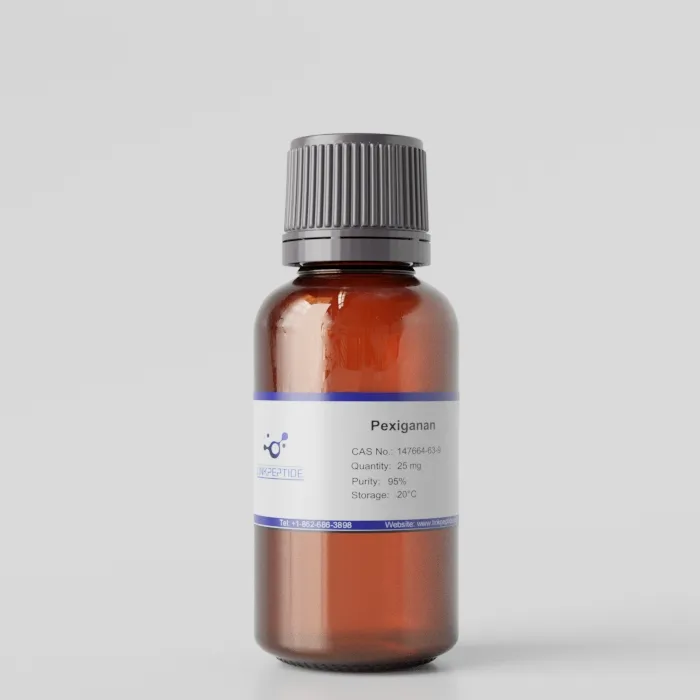
Product Name: Pexiganan
Form: Acetate salt
CAS No: 147664-63-9
Molar Mass: 2477.17
Chemical Formula: C122H210N32O22
Synonyms: TVF29Q70Q1
Storage: Store at -20℃
Sequence: GIGKFLKKAKKFGKAFVKILKK
Target: antibacterial
Application:
Pexiganan (CAS: 147664-63-9) is a synthetic antimicrobial peptide derived from magainin, a peptide found in the skin of the African clawed frog. Pexiganan exhibits broad-spectrum antimicrobial activity against a variety of Gram-positive and Gram-negative bacteria, including antibiotic-resistant strains such as methicillin-resistant Staphylococcus aureus (MRSA) and vancomycin-resistant Enterococcus (VRE). Its mechanism of action involves disrupting bacterial cell membranes, leading to cell lysis and death. Pexiganan has shown promise in the treatment of various bacterial infections, including diabetic foot ulcers, burns, and skin infections. It is typically administered topically as a cream or gel formulation. Clinical trials have demonstrated the efficacy and safety of pexiganan in treating infected wounds, with favorable outcomes in terms of bacterial eradication and wound healing. Despite its potential, further research is needed to optimize dosing regimens and investigate its potential for systemic use. Pexiganan represents a promising option for the management of bacterial infections, particularly in cases where conventional antibiotics may be ineffective due to resistance or limited penetration into infected tissues.
Current Research:
Pexiganan is a synthetic antimicrobial peptide developed for the treatment of cutaneous infections. Specifically, it has been investigated for its activity against diabetic foot infections (DFIs), which are a common and serious complication of diabetes. Pexiganan belongs to the class of cationic antimicrobial peptides (AMPs) that possess a broad spectrum of activity against a range of pathogens, including Gram-positive and Gram-negative bacteria. As a topical agent, pexiganan has demonstrated efficacy in treating infections without the systemic side effects commonly associated with oral or intravenous antibiotics.
Mechanism of Action
Pexiganan exerts its antimicrobial effects by disrupting the cell membrane integrity of bacterial cells. It does this through an interaction between its positively charged amino acid residues and the negatively charged components of bacterial cell membranes, such as phospholipids. This interaction causes the formation of pores in the bacterial membrane, leading to leakage of intracellular contents, disruption of cellular function, and ultimately, cell death.
One of the key advantages of pexiganan is its selectivity for bacterial cells over human cells. Because the peptide binds preferentially to bacterial membranes, it reduces the likelihood of toxicity to human tissues when used topically. Additionally, pexiganan has been shown to exhibit minimal resistance development, which is a significant concern with traditional antibiotics, particularly for multidrug-resistant (MDR) pathogens.
Clinical Applications
Pexiganan has primarily been investigated for the treatment of diabetic foot infections (DFIs), which can be challenging to manage due to the presence of both aerobic and anaerobic bacteria in infected ulcers. Diabetic patients are particularly vulnerable to infections due to impaired immune responses, poor circulation, and the presence of neuropathy. If left untreated, DFIs can lead to serious complications, including amputation.
Several clinical studies have evaluated the safety and efficacy of pexiganan in the treatment of mild to moderate diabetic foot infections. In these trials, pexiganan demonstrated superior or comparable efficacy to oral antibiotics in treating bacterial infections in foot ulcers, with a lower risk of systemic side effects. Notably, pexiganan is applied directly to the infected area, minimizing the potential for systemic toxicity.
In addition to DFIs, pexiganan is being explored for its use in other topical infections, including superficial skin infections, wound healing, and burns. Its effectiveness in treating these types of infections, particularly those caused by methicillin-resistant Staphylococcus aureus (MRSA), Escherichia coli, and Pseudomonas aeruginosa, is being actively studied.
Advantages Over Traditional Antibiotics
Broad-Spectrum Activity: Pexiganan is effective against a wide range of bacterial pathogens, including Gram-positive bacteria (e.g., Staphylococcus aureus) and Gram-negative bacteria (e.g., Escherichia coli, Pseudomonas aeruginosa). This makes it a versatile agent for treating mixed infections, which are common in chronic wounds and ulcers.
Topical Application: As a topical agent, pexiganan offers a localized treatment for infections, reducing the risk of systemic side effects. This is particularly advantageous for patients with chronic conditions like diabetes, where systemic antibiotics may have more significant risks, such as gastrointestinal disturbances or nephrotoxicity.
Low Resistance Development: Due to its mechanism of action, which involves disrupting bacterial cell membranes, pexiganan has shown a lower likelihood of resistance development compared to traditional antibiotics, which target specific bacterial enzymes or proteins. This makes it a promising alternative in an era of rising antibiotic resistance.
Safety Profile: Clinical trials have shown that pexiganan is generally well tolerated when applied topically. Unlike systemic antibiotics, the risk of serious adverse effects is minimized, making it a safer option for long-term or repeated use in vulnerable populations, such as those with diabetic neuropathy or immunocompromised states.
Clinical Trials and Efficacy
Several pivotal trials have assessed the efficacy of pexiganan in treating diabetic foot infections. In the PEP-01 clinical trial, pexiganan demonstrated non-inferiority to oral ciprofloxacin in treating mild-to-moderate diabetic foot infections, with comparable rates of infection resolution. Furthermore, patients treated with pexiganan had fewer side effects and a lower incidence of systemic antibiotic resistance.
However, while pexiganan has shown significant promise, some studies suggest that it may be less effective against severe infections or infections involving deep tissues or bone, as its topical application limits its ability to penetrate deeper tissues. For more severe cases of diabetic foot infections, systemic antibiotics may still be required in conjunction with pexiganan for optimal treatment outcomes.
Safety and Tolerability
Pexiganan is generally well tolerated, with few reported side effects. The most common adverse effects are local skin reactions, such as irritation or rash at the site of application. These reactions are usually mild and resolve upon discontinuation of the treatment. Unlike systemic antibiotics, pexiganan does not typically cause the gastrointestinal, renal, or hepatotoxicity associated with oral or intravenous antibiotics.
In rare cases, allergic reactions to pexiganan may occur, though these are infrequent. Given its local application, the risk of systemic side effects is considerably lower than that of other antimicrobial therapies.
Future Directions
Research into pexiganan’s potential for treating other skin infections beyond diabetic foot ulcers is ongoing. These include its potential use for burns, chronic wounds, surgical site infections, and other superficial bacterial infections. Pexiganan’s efficacy against MRSA, a pathogen that is notoriously difficult to treat with conventional antibiotics, may make it especially useful in hospital-acquired infections and community-associated infections.
In addition, ongoing studies are investigating the combination of pexiganan with other antimicrobial agents to enhance its effectiveness against polymicrobial infections and infections caused by antibiotic-resistant pathogens.
Conclusion
Pexiganan represents a promising alternative for the treatment of topical bacterial infections, especially diabetic foot infections. Its broad-spectrum activity, low risk of resistance, and localized application offer distinct advantages over traditional systemic antibiotics. While it has shown efficacy in treating mild to moderate infections, its role in severe infections or those requiring deeper tissue penetration remains limited. Nevertheless, with continued research and development, pexiganan has the potential to become an integral part of the treatment arsenal for skin and wound infections.
Reference:
Get a Quote
 LinkPeptide