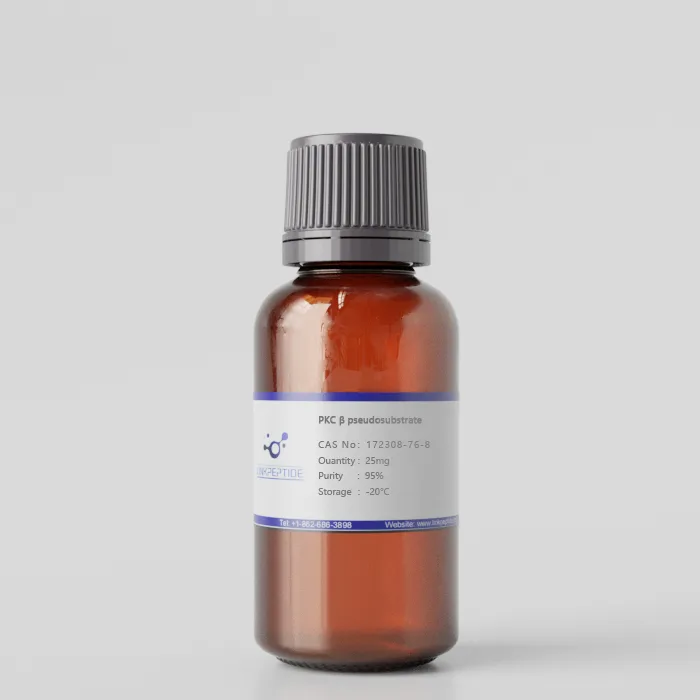
Product Name:PKC ζ pseudosubstrate
Purity:95%
Molar Mass:4673.59
Chemical Formula:C208H336N74O44S3
Storage:Store at -20 degrees Celsius
Sequence:CRQIKIWFQNRRMKWKK CSIYRRGARRWRKLYRAN
Application:PKC ?? Pseudosubstrate is a synthetic peptide designed to specifically inhibit the activity of Protein Kinase C zeta (PKC ??) by mimicking its autoinhibitory domain. This peptide competes with natural substrates for the binding site, effectively blocking PKC ?? activation without affecting other PKC isoforms. PKC ?? Pseudosubstrate is crucial for research focused on the role of PKC ?? in various cellular processes, including signal transduction, cell proliferation, and apoptosis. With its high purity and targeted action, this peptide is an essential tool for dissecting the specific functions of PKC ?? in both normal and pathological conditions.
Current Research:
The PKC ζ pseudosubstrate is a synthetic peptide inhibitor designed to selectively inhibit the activity of protein kinase C zeta (PKC ζ), an atypical isoform of the PKC family involved in various cellular processes, including cell proliferation, differentiation, and survival. This peptide mimics the autoinhibitory pseudosubstrate sequence present in the regulatory domain of PKC ζ, thereby competitively binding to the kinase's active site and preventing substrate phosphorylation.
Mechanism of Action
In its inactive state, PKC ζ is autoinhibited by its pseudosubstrate domain, which occupies the substrate-binding cavity, blocking access to exogenous substrates. The synthetic PKC ζ pseudosubstrate peptide replicates this inhibitory sequence, allowing it to bind to the catalytic domain of PKC ζ. This binding effectively inhibits PKC ζ activity by preventing the phosphorylation of downstream targets, thereby modulating signaling pathways mediated by this kinase.
Research Applications
The PKC ζ pseudosubstrate has been extensively utilized as a research tool to dissect the specific functions of PKC ζ in various cellular contexts. By selectively inhibiting PKC ζ, researchers can elucidate its role in signaling pathways and its contributions to physiological and pathological processes. For instance, studies have employed this inhibitor to investigate PKC ζ's involvement in insulin signaling, cell polarity, and cancer progression.
Considerations
While the PKC ζ pseudosubstrate is a valuable tool for probing PKC ζ-specific functions, it is essential to consider its specificity and potential off-target effects. Some studies have reported that similar inhibitory peptides, such as the ζ-inhibitory peptide (ZIP), can interact with multiple PKC isoforms, leading to broader effects than initially anticipated. Therefore, careful experimental design and appropriate controls are crucial when interpreting results obtained using these inhibitors.
In summary, the PKC ζ pseudosubstrate is a potent and selective inhibitor that has significantly advanced the understanding of PKC ζ-mediated signaling pathways. Its application in research continues to provide insights into the diverse roles of PKC ζ in cellular function and disease.
Reference:
Get a Quote
 LinkPeptide