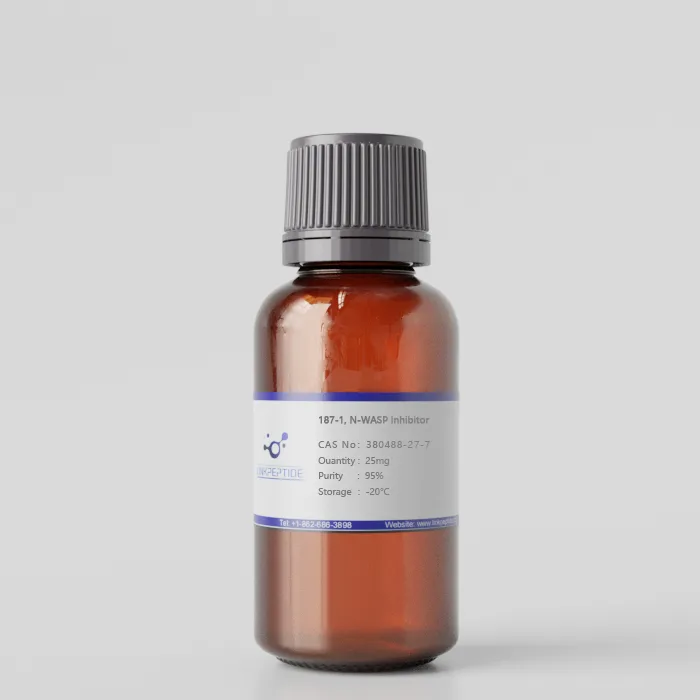
Product Name:187-1, N-WASP inhibitor
Synonyms:CHEMBL436918, QKFPFFPQKFPFFP
CAS No:380488-27-7
Purity:95%
Molar Mass:1784.1
Chemical Formula:C96H122N18O16
Storage:Store at -20 degrees Celsius
Sequence:QKFPFFPQKFPFFP
Application:
187-1, N-WASP Inhibitor is a potent small molecule that selectively targets the Neuronal Wiskott-Aldrich Syndrome Protein (N-WASP), a crucial regulator of actin cytoskeleton dynamics. By inhibiting N-WASP, 187-1 disrupts actin polymerization, affecting essential cellular processes like cell movement, shape, and intracellular trafficking. This inhibitor is extensively used in research to explore N-WASP’s role in various biological activities, including cell migration, invasion, and endocytosis. It also provides valuable insights into the involvement of actin remodeling in diseases such as cancer and neurodegenerative disorders, making it a promising tool for developing new therapeutic strategies targeting cytoskeletal pathways.
Current Research:
187-1 is a synthetic 14-amino-acid cyclic peptide that functions as an allosteric inhibitor of neural Wiskott-Aldrich syndrome protein (N-WASP), a key regulator of actin cytoskeleton dynamics. By stabilizing N-WASP in its autoinhibited conformation, 187-1 effectively prevents the activation of the Arp2/3 complex, thereby inhibiting actin polymerization. This inhibition is particularly potent against phosphatidylinositol 4,5-bisphosphate (PIP₂)-stimulated actin assembly, with an IC₅₀ of approximately 2 μM.
The mechanism of action involves 187-1 binding to N-WASP, reinforcing its autoinhibited state and obstructing the conformational changes necessary for Arp2/3 complex activation. This selective inhibition of N-WASP-mediated actin nucleation does not directly affect actin polymerization, allowing for targeted studies of N-WASP functions without broadly disrupting actin dynamics.
In cellular studies, 187-1 has been utilized to dissect the role of N-WASP in processes such as cell motility, endocytosis, and pathogen internalization. By inhibiting N-WASP activity, researchers can observe resultant changes in actin filament organization and cellular behavior, thereby elucidating N-WASP's specific contributions to cytoskeletal regulation.
Despite its utility in research, the commercial availability of 187-1 has become limited, with some suppliers discontinuing its sale for unspecified reasons. Researchers interested in employing this inhibitor may need to explore alternative sources or consider custom synthesis to obtain the peptide for their studies.
In summary, 187-1 serves as a valuable tool for investigating N-WASP-mediated actin assembly and its implications in various cellular functions. Its ability to selectively inhibit N-WASP provides insights into the molecular mechanisms governing actin cytoskeleton dynamics and associated cellular processes.
Reference:
Get a Quote
 LinkPeptide