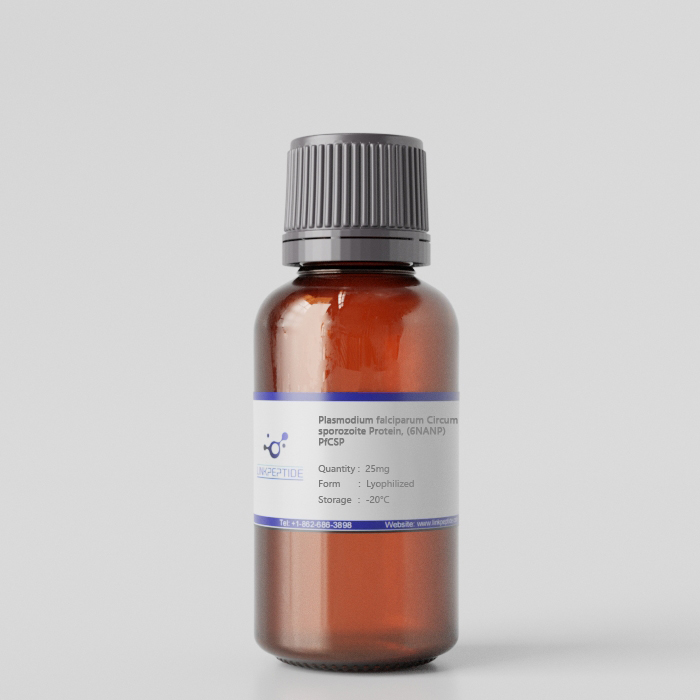
Product Name: Plasmodium falciparum Circumsporozoite Protein, (6NANP) PfCSP
Sequence One Letter Code: NANPNANPNANPNANPNANPNANPC
Sequence Three Letter Code: H-Asn-Ala-Asn-Pro-Asn-Ala-Asn-Pro-Asn-Ala-Asn-Pro-Asn-Ala-Asn-Pro-Asn-Ala-Asn-Pro-Asn-Ala-Asn-Pro-Cys-OH
Chemical Formula:C99H151N37O38S1
Molecular Weight: 2499.7
Purity: 95%
Form: Lyophilized
Storage Conditions: - 20 °C
Research Area: Infection Disease Research
Source / Species: Plasmodium
Conjugation: Unconjugated
Code Nacres: NA.26
Application: This peptide contains six NANP repeat motifs derived from the central immunodominant region of the Plasmodium falciparum circumsporozoite protein (PfCSP), the most abundant surface antigen on malaria sporozoites. PfCSP plays a crucial role during the early stage of malaria infection by mediating parasite invasion of hepatocytes. Antibodies directed against the NANP repeat region have been shown to neutralize sporozoites and block liver cell invasion. Because of its strong immunogenicity, the NANP repeat region is a key component of several malaria vaccine candidates. This peptide is widely used in immunogenicity studies, antibody screening, and vaccine development research. It supports investigations into host immune responses against malaria parasites and the design of antibody-based protective strategies.
Current Research: Introduction to Plasmodium falciparum Circumsporozoite Protein Malaria remains one of the most significant infectious diseases worldwide, caused primarily by the parasite Plasmodium falciparum. The parasite is transmitted to humans through the bite of infected Anopheles mosquitoes, introducing sporozoites into the bloodstream. During the early stage of infection, these sporozoites travel to the liver and invade hepatocytes, initiating the parasite’s life cycle within the host. One of the most abundant proteins on the surface of malaria sporozoites is the circumsporozoite protein (CSP). CSP plays a crucial role in parasite development and host cell invasion. Because of its accessibility on the sporozoite surface and its strong immunogenic properties, CSP has become a major target for malaria vaccine development and immunological research. Structure of the NANP Repeat Region The central region of Plasmodium falciparum CSP (PfCSP) contains multiple NANP repeat motifs, consisting of the amino acid sequence asparagine–alanine–asparagine–proline. These repetitive units form an immunodominant region that is highly recognized by the host immune system. The peptide described here contains six NANP repeats, representing a segment of this central region. Repetitive NANP motifs contribute significantly to the antigenicity of CSP and are responsible for eliciting strong antibody responses during infection or vaccination. Because these repeats form a well-defined epitope recognized by protective antibodies, synthetic peptides containing NANP sequences are widely used to study immune recognition of malaria parasites. Role of PfCSP in Malaria Infection Circumsporozoite protein plays an essential role in the early stages of malaria infection. After transmission by mosquito bite, sporozoites coated with CSP migrate through the bloodstream and eventually reach the liver. CSP contributes to the parasite’s ability to interact with host cells and invade hepatocytes, enabling the parasite to establish infection. The NANP repeat region is prominently exposed on the sporozoite surface, making it readily accessible to antibodies generated by the host immune system. This accessibility is one reason why antibodies targeting the NANP motif can effectively interfere with sporozoite function. Antibody Recognition and Neutralization Antibodies directed against the NANP repeat region have been shown to neutralize malaria sporozoites and inhibit infection. These antibodies bind to the repetitive motifs on CSP, blocking the parasite’s ability to interact with host cells and preventing invasion of liver cells. Because of this protective effect, the NANP sequence has become a major focus of research aimed at understanding how immune responses can prevent malaria infection. Synthetic peptides containing multiple NANP repeats allow researchers to evaluate how antibodies recognize and bind to this immunodominant region. Such studies are essential for identifying immune mechanisms that contribute to protection against malaria. Applications in Malaria Vaccine Development The NANP repeat region of PfCSP is a critical component of several malaria vaccine candidates. Vaccines targeting CSP aim to stimulate the production of antibodies capable of recognizing and neutralizing sporozoites before they invade liver cells. Synthetic peptides containing NANP motifs are widely used in vaccine development studies to evaluate immune responses and optimize antigen design. By incorporating NANP sequences into vaccine constructs, researchers can test how effectively candidate vaccines induce protective antibody responses. These studies have played an important role in guiding the development of malaria vaccines designed to block early stages of infection. Applications in Immunogenicity and Antibody Screening In addition to vaccine research, the NANP repeat peptide is commonly used in immunogenicity assays and antibody screening experiments. Researchers use the peptide to measure antibody responses generated in experimental models or clinical studies. These assays help determine how strongly immune systems respond to CSP-derived antigens and whether specific antibodies recognize the NANP epitope. The peptide is also useful for evaluating the specificity and binding characteristics of monoclonal antibodies targeting malaria parasites. Such experiments support efforts to develop antibody-based protective strategies against malaria infection. Supporting Research on Host Immune Responses Understanding how the immune system responds to malaria parasites is essential for improving prevention strategies. The NANP repeat peptide provides a convenient experimental model for studying host immune recognition of Plasmodium falciparum antigens. Researchers can use this peptide to analyze antibody binding, investigate antigen presentation, and explore the molecular interactions involved in parasite neutralization. These studies contribute to a deeper understanding of protective immunity against malaria. Conclusion The PfCSP NANP repeat peptide, containing six NANP motifs from the central region of the Plasmodium falciparum circumsporozoite protein, represents a key antigenic sequence involved in immune recognition of malaria sporozoites. Antibodies targeting this region can neutralize parasites and block hepatocyte invasion, making it an important focus of malaria research. Widely used in immunogenicity studies, antibody screening, and vaccine development, this peptide supports investigations into host immune responses and strategies aimed at preventing malaria infection. Its role as a model antigen continues to contribute to advances in malaria immunology and vaccine design.
Get a Quote
 LinkPeptide