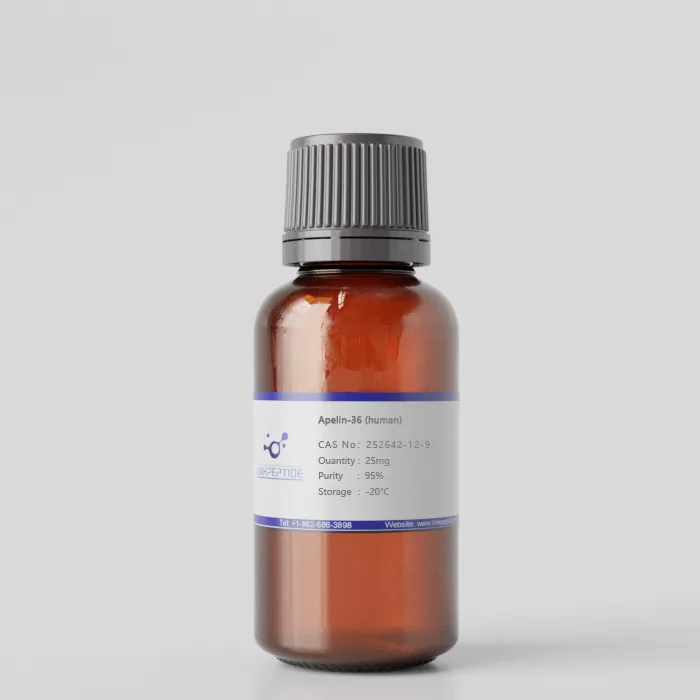
Product Name:Pro-Adrenomedullin (45-92), human
Form:TFA salt
Purity:95%
Storage:2-8 degree Celsius
Molar Mass:5114.8
Chemical Formula:C215H359N67O73S2
Sequence:Glu-Leu-Arg-Met-Ser-Ser-Ser-Tyr-Pro-Thr-Gly-Leu-Ala-Asp-Val-Lys-Ala-Gly-Pro-Ala-Gln-Thr-Leu-Ile-Arg-Pro-Gln-Asp-Met-Lys-Gly-Ala-Ser-Arg-Ser-Pro-Glu-Asp-Ser-Ser-Pro-Asp-Ala-Ala-Arg-Ile-Arg-Val
Application:Pro-Adrenomedullin (45-92), human is a bioactive peptide fragment derived from pro-adrenomedullin (PAMP), encompassing amino acids 45-92. This peptide has been studied for its role in vascular regulation, immune modulation, and metabolic function. Research suggests that PAMP (45-92) exhibits vasodilatory, anti-inflammatory, and antimicrobial properties, making it relevant in cardiovascular, immune, and endocrine studies. It is widely used in hypertension, sepsis, and metabolic disorder research, with potential applications in endothelial function regulation, stress adaptation, and inflammatory disease models. Due to its physiological importance, PAMP (45-92) is a key candidate for therapeutic peptide development.
Current Research:
Introduction
Pro-Adrenomedullin (45-92), human, is a C-terminal fragment derived from pro-adrenomedullin (PAMP), a precursor to adrenomedullin (ADM), a potent vasodilator and immune regulator. The amino acid sequence 45-92 includes bioactive regions responsible for vascular homeostasis, immune responses, and metabolic function. Studies suggest that PAMP (45-92) plays a critical role in endothelial health, inflammation regulation, and infection control, making it a promising candidate in cardiovascular, immunological, and metabolic research.
Cardiovascular and Vasodilatory Research
PAMP and its derivatives, including PAMP (45-92), human, are implicated in vascular homeostasis and blood pressure regulation. Research findings suggest:
Induction of nitric oxide (NO) synthesis, promoting vasodilation and blood pressure reduction.
Endothelial protection and function enhancement, making it a candidate for hypertension and atherosclerosis studies.
Regulation of vascular tone, supporting its role in ischemia-reperfusion injury and heart disease research.
Given these effects, PAMP (45-92) is being explored as a potential therapeutic agent in hypertension and cardiovascular disease.
Immunomodulatory and Anti-Inflammatory Effects
PAMP (45-92) has been studied for its role in immune function, particularly in:
Inhibiting pro-inflammatory cytokines (e.g., TNF-α, IL-6, IL-1β), suggesting anti-inflammatory potential.
Enhancing antimicrobial defense mechanisms, indicating applications in sepsis and infection control.
Regulating immune cell activity, influencing macrophages, dendritic cells, and neutrophils.
Its ability to modulate immune responses and prevent excessive inflammation makes PAMP (45-92) relevant in inflammatory and autoimmune disease research.
Metabolic and Endocrine Research
PAMP fragments, including PAMP (45-92), are being studied for their role in metabolism and endocrine regulation. Research suggests that:
It may regulate insulin secretion, making it relevant for diabetes and metabolic syndrome models.
It interacts with stress-related hormonal pathways, contributing to adrenal function research.
It affects lipid metabolism, with implications for obesity and cardiovascular risk reduction.
These findings position PAMP (45-92) as a potential target for metabolic disorder therapies.
Potential Research and Therapeutic Applications
Due to its vasodilatory, immune-modulating, and metabolic-regulating effects, PAMP (45-92), human, is being explored for:
Cardiovascular disease research, particularly for hypertension and endothelial dysfunction models.
Sepsis and immune-related inflammation studies, targeting infection-induced cytokine dysregulation.
Metabolic disorder models, including insulin regulation, glucose homeostasis, and lipid metabolism research.
Conclusion
Pro-Adrenomedullin (45-92), human, is a bioactive peptide fragment involved in vascular regulation, immune response, and metabolic homeostasis. Its vasodilatory, anti-inflammatory, and metabolic properties make it a valuable research tool in cardiovascular, immunology, and endocrine studies. Ongoing research continues to explore its therapeutic potential in sepsis, blood pressure regulation, and metabolic disorders, with promising applications in biomarker discovery and peptide-based drug development.
Get a Quote
 LinkPeptide

![[Orn5]-URP](https://www.linkpeptide.com/wp-content/uploads/2024/10/Orn5-URP-jpg-3.webp "[Orn5]-URP")