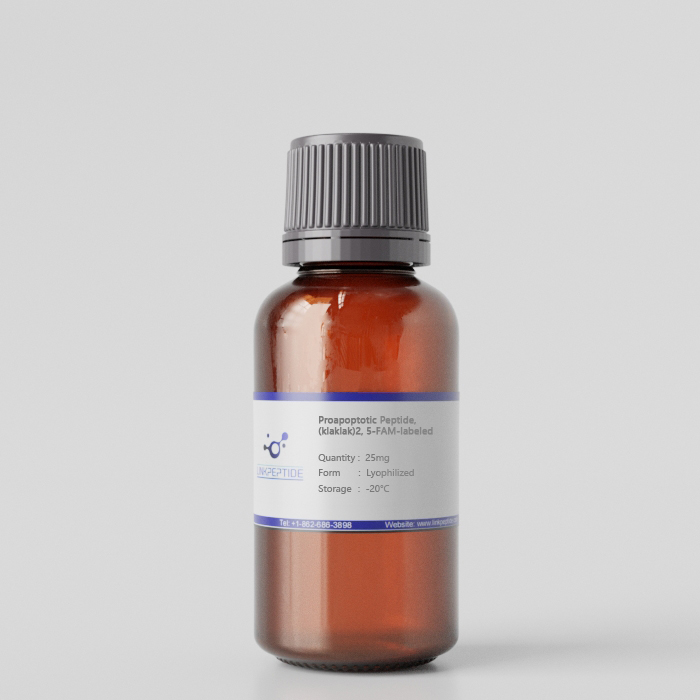
Product Name: Proapoptotic Peptide, (klaklak)2, 5-FAM-labeled
Sequence One Letter Code: 5-FAM-klaklakklaklak-NH2
Sequence Three Letter Code: 5-FAM-D-Lys-D-Leu-D-Ala-D-Lys-D-Leu-D-Ala-D-Lys-D-Lys-D-Leu-D-Ala-D-Lys-D-Leu-D-Ala-D-Lys-NH2
Molecular Weight: 1881.4
Purity: 95%
Form: Lyophilized
Storage Conditions: - 20 °C Protected from light
Research Area: Cancer Disease Research
Conjugation: Conjugated
Conjugation Type: Fluorescent dyes
Code Nacres: NA.26
Application: 5-FAM-(KLAKLAK)₂ Peptide (D-Amino Acid Form) is a fluorescently labeled pro-apoptotic peptide composed of the amphipathic sequence (KLAKLAK)₂ synthesized using D-amino acids, which enhance proteolytic stability and biological activity. The peptide adopts an α-helical conformation and becomes cytotoxic to eukaryotic cells following receptor-mediated internalization. Once inside the cell, it selectively disrupts mitochondrial membranes, leading to loss of membrane potential and induction of programmed cell death (apoptosis). The attached 5-carboxyfluorescein (5-FAM) label allows visualization and quantitative analysis of peptide uptake and intracellular localization. This peptide is widely used in research on targeted apoptosis, mitochondrial dysfunction, cancer therapeutics, and peptide-based drug delivery strategies.
Current Research: Peptide-based molecules are increasingly used in biomedical research to investigate mechanisms of cell death, intracellular targeting, and therapeutic delivery. One well-known example is the (KLAKLAK)₂ peptide, an amphipathic sequence originally designed to disrupt bacterial membranes. When delivered into eukaryotic cells through targeted delivery systems, this peptide can selectively damage mitochondria and trigger apoptosis. The 5-FAM-(KLAKLAK)₂ peptide synthesized in the D-amino acid configuration adds fluorescence detection and enhanced stability, making it a valuable tool for studying mitochondrial function, targeted apoptosis, and peptide-based therapeutics. Structure and Design of the Peptide The core sequence (KLAKLAK)₂ consists of repeating lysine (K), leucine (L), and alanine (A) residues arranged to form an amphipathic α-helical structure. Amphipathic helices contain both hydrophobic and positively charged regions, allowing them to interact strongly with lipid membranes. In this peptide: Leucine and alanine residues contribute hydrophobic interactions with membrane lipids. Lysine residues provide positive charge that promotes association with negatively charged membranes. The peptide is synthesized using D-amino acids, which are mirror images of the naturally occurring L-amino acids found in most proteins. This modification provides several advantages: Increased resistance to proteolytic degradation Enhanced biological stability in cellular environments Prolonged activity in experimental systems The peptide is also labeled with 5-carboxyfluorescein (5-FAM), a widely used fluorescent dye that enables visualization and quantitative measurement of peptide behavior in cells. Fluorescent Labeling with 5-FAM The 5-FAM fluorophore provides strong fluorescence with excitation and emission wavelengths typically around 495 nm and 520 nm. Incorporation of this fluorescent label allows researchers to monitor peptide uptake and localization using a variety of fluorescence-based techniques. Fluorescent labeling enables: Visualization of peptide internalization in living cells Tracking of intracellular distribution Quantitative measurement of peptide uptake Because of its brightness and compatibility with standard imaging systems, 5-FAM labeling makes the peptide suitable for microscopy and high-throughput assays. Mechanism of Cytotoxic Activity The (KLAKLAK)₂ peptide exhibits membrane-disrupting activity when it reaches intracellular organelles. In eukaryotic cells, the peptide is typically delivered through receptor-mediated internalization or targeted delivery strategies. Once inside the cell, the peptide preferentially accumulates in mitochondria, where its amphipathic α-helical structure allows it to interact with mitochondrial membranes. This interaction leads to disruption of the mitochondrial membrane integrity, resulting in: Loss of mitochondrial membrane potential Release of apoptotic signaling factors Activation of downstream apoptotic pathways These events ultimately trigger programmed cell death (apoptosis). Because the peptide is not strongly toxic to cells unless internalized, it is often used in targeted systems that deliver the peptide specifically to certain cell types. Applications in Targeted Apoptosis Research The fluorescent (KLAKLAK)₂ peptide is widely used as a model molecule in studies investigating targeted induction of apoptosis. Researchers frequently combine the peptide with targeting ligands such as antibodies, receptor-binding peptides, or cell-penetrating sequences. In these systems, the targeting component guides the peptide to specific cells, where it becomes internalized and exerts its mitochondrial-disrupting effect. This strategy allows investigators to explore how selective cell killing can be achieved through peptide-based targeting approaches. Studying Mitochondrial Dysfunction Because the peptide specifically disrupts mitochondrial membranes, it is also used as a tool for studying mitochondrial biology and apoptotic signaling. Researchers can examine how mitochondrial damage influences cellular pathways involved in: Apoptosis regulation Cellular metabolism Reactive oxygen species production Stress responses Fluorescent tracking of the peptide provides insights into how mitochondrial targeting correlates with cellular responses. Applications in Cancer and Therapeutic Research The ability of (KLAKLAK)₂ peptides to induce apoptosis after targeted delivery has attracted interest in cancer research and therapeutic development. Tumor cells often exhibit altered mitochondrial regulation and resistance to apoptosis, making mitochondrial-targeting strategies an area of active investigation. Researchers use fluorescently labeled versions of the peptide to: Evaluate targeted delivery strategies Study selective tumor cell apoptosis Analyze intracellular trafficking of therapeutic peptides These experiments help assess how peptide-based molecules can be engineered for targeted anticancer applications. A Tool for Studying Peptide-Based Delivery Systems The 5-FAM-(KLAKLAK)₂ peptide in D-amino acid form combines mitochondrial-disrupting activity with fluorescence detection and improved stability. This combination makes it particularly useful for investigating how peptides enter cells, interact with organelles, and influence cellular fate. Through applications in fluorescence imaging, apoptosis research, mitochondrial studies, and targeted therapeutic development, this peptide continues to support research exploring innovative strategies for controlling cell survival and death.
Get a Quote
 LinkPeptide