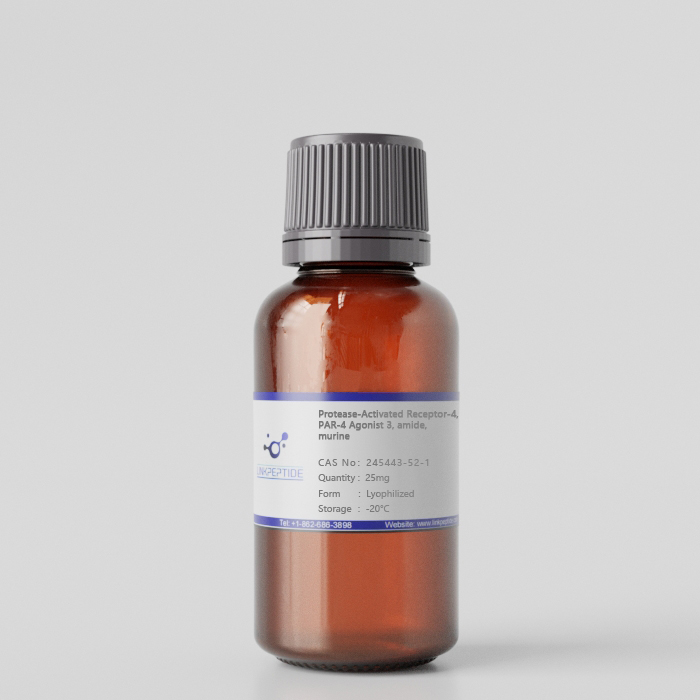
Product Name: Protease-Activated Receptor-4, PAR-4 Agonist 3, amide, murine
Sequence One Letter Code: GYPGKF-NH2
Sequence Three Letter Code: H-Gly-Tyr-Pro-Gly-Lys-Phe-NH2
Cas No: 245443-52-1
Chemical Formula:C33H46N8O7
Molecular Weight: 666.8
Purity: 95%
Form: Lyophilized
Storage Conditions: - 20 °C
Research Area: Cardiovascular Disease Research
SMILES: C1C[C@H](N(C1)C(=O)[C@H](CC2=CC=C(C=C2)O)NC(=O)CN)C(=O)NCC(=O)N[C@@H](CCCCN)C(=O)N[C@@H](CC3=CC=CC=C3)C(=O)N
IUPAC: (2S)-1-[(2S)-2-[(2-aminoacetyl)amino]-3-(4-hydroxyphenyl)propanoyl]-N-[2-[[(2S)-6-amino-1-[[(2S)-1-amino-1-oxo-3-phenylpropan-2-yl]amino]-1-oxohexan-2-yl]amino]-2-oxoethyl]pyrrolidine-2-carboxamide
INCHIKEY: NAIYNSCJEHHFMV-FWEHEUNISA-N
INCHI:
InChI=1S/C33H46N8O7/c34-15-5-4-9-24(31(46)40-25(30(36)45)17-21-7-2-1-3-8-21)38-29(44)20-37-32(47)27-10-6-16-41(27)33(48)26(39-28(43)19-35)18-22-11-13-23(42)14-12-22/h1-3,7-8,11-14,24-27,42H,4-6,9-10,15-20,34-35H2,(H2,36,45)(H,37,47)(H,38,44)(H,39,43)(H,40,46)/t24-,25-,26-,27-/m0/s1
Source / Species: murine
Conjugation: Unconjugated
Code Nacres: NA.26
Application: Protease-Activated Receptor-4 (PAR-4) Agonist 3, amide, murine is a synthetic peptide designed to selectively activate murine PAR-4, a thrombin-responsive G protein–coupled receptor. Based on established activating sequences such as GYPGKF-NH₂ and AYPGKG-NH₂, this peptide mimics the tethered ligand exposed following receptor cleavage. PAR-4 plays an essential role in thrombin signaling, platelet activation, and vascular smooth muscle contraction. The agonist induces concentration-dependent functional responses in murine experimental systems, providing controlled receptor activation independent of proteolysis. It is widely used in cardiovascular and vascular biology research to characterize PAR-4 pharmacology, downstream signaling cascades, and contractile responses. This peptide supports mechanistic studies of thrombin-mediated cellular processes and receptor-specific functional analysis in platelet and smooth muscle models.
Current Research: Protease-Activated Receptor-4 (PAR-4) has emerged as a critical mediator of thrombin-driven signaling in murine systems, particularly in platelet activation and vascular smooth muscle physiology. As a member of the protease-activated receptor (PAR) family of G protein–coupled receptors (GPCRs), PAR-4 is activated by proteolytic cleavage of its N-terminal extracellular domain. This cleavage exposes a tethered ligand sequence that folds back intramolecularly to initiate receptor activation. Synthetic murine PAR-4 agonist peptides—modeled on canonical activating sequences such as GYPGKF-NH₂ and AYPGKG-NH₂—bypass proteolysis by directly mimicking the exposed tethered ligand, thereby enabling precise and reproducible receptor stimulation. PAR-4 in Murine Platelet Biology In murine platelets, PAR-4 serves as the principal thrombin receptor. Unlike human platelets, which express both PAR-1 and PAR-4, murine platelets rely predominantly on PAR-4 to mediate thrombin-induced aggregation. This species distinction has positioned murine PAR-4 as a central target in experimental thrombosis models. Activation of PAR-4 triggers G protein coupling primarily through G_q and G_12/13 pathways, leading to phospholipase Cβ activation, intracellular calcium mobilization, protein kinase C activation, and RhoA-mediated cytoskeletal remodeling. Recent studies emphasize that PAR-4 signaling generates a comparatively sustained intracellular calcium response relative to PAR-1 (in species where both are present), contributing to prolonged platelet activation and stable thrombus formation. Synthetic PAR-4 agonist peptides are routinely used to isolate receptor-specific contributions to aggregation, granule secretion, integrin αIIbβ3 activation, and phosphatidylserine exposure without confounding effects of thrombin-mediated fibrin generation or cleavage of additional substrates. Downstream Signaling Complexity Current research highlights that PAR-4 signaling is not limited to classical G_q-dependent calcium flux. Increasing evidence demonstrates engagement of β-arrestin scaffolding pathways, MAP kinase cascades (ERK1/2), and PI3K/Akt signaling in murine models. These pathways regulate integrin activation, cytoskeletal rearrangement, and procoagulant membrane dynamics. Synthetic PAR-4 agonists provide a controlled approach to dissect these downstream signaling modules under defined concentration-dependent conditions. Importantly, PAR-4 activation has been linked to differential kinetics of platelet spreading and clot retraction. Compared with rapid thrombin cleavage, peptide agonists allow graded receptor stimulation, facilitating pharmacological profiling and receptor desensitization studies. This precision is particularly valuable in experiments examining receptor cross-talk with GPVI (collagen receptor) or ADP receptors (P2Y₁/P2Y₁₂). Vascular Smooth Muscle and Contractile Signaling Beyond platelets, murine PAR-4 is expressed in vascular smooth muscle cells (VSMCs), where it contributes to thrombin-induced vasoconstriction and vascular remodeling. Activation of PAR-4 in VSMCs stimulates G_q-mediated calcium release and G_12/13-driven Rho kinase activation, promoting actin–myosin contractility. Synthetic agonist peptides enable researchers to evaluate receptor-specific contractile responses in isolated vessel preparations without the proteolytic complexity associated with thrombin exposure. Recent vascular biology studies also investigate PAR-4’s role in inflammatory signaling, endothelial barrier modulation, and smooth muscle proliferation. Peptide agonists are employed in ex vivo arterial ring assays and cultured VSMC models to characterize dose-dependent contractile force generation and downstream phosphorylation events. Translational Relevance and Antithrombotic Research Interest in PAR-4 has intensified due to its potential as a safer antiplatelet target. Clinical and preclinical research suggests that selective PAR-4 modulation may attenuate thrombus formation while preserving aspects of physiological hemostasis. In murine models, PAR-4 knockout or pharmacologic inhibition reduces thrombosis in arterial injury models, underscoring its therapeutic relevance. Synthetic murine PAR-4 agonist peptides serve as reference pharmacological tools when evaluating novel antagonists, biased ligands, or genetic modifications. By providing receptor-specific activation independent of thrombin cleavage, these peptides allow investigators to benchmark inhibitory efficacy and characterize signaling selectivity. Experimental Applications In contemporary cardiovascular and thrombosis research, murine PAR-4 agonist peptides are widely applied in: Platelet aggregation and secretion assays Intracellular calcium mobilization studies Flow cytometric analysis of integrin activation Clot retraction and procoagulant activity assays Vascular smooth muscle contraction experiments Receptor desensitization and signaling bias studies Their defined amide-terminated structure enhances stability and receptor affinity while preserving sequence fidelity to the endogenous tethered ligand motif. Because activation is concentration-dependent and protease-independent, these agonists provide reproducible experimental control across biochemical, cellular, and ex vivo vascular systems. Overall, synthetic murine PAR-4 agonist peptides remain indispensable reagents for mechanistic investigation of thrombin-responsive GPCR signaling. They support precise dissection of platelet activation pathways, vascular contractile mechanisms, and receptor-specific pharmacology in murine cardiovascular research models.
Get a Quote
 LinkPeptide